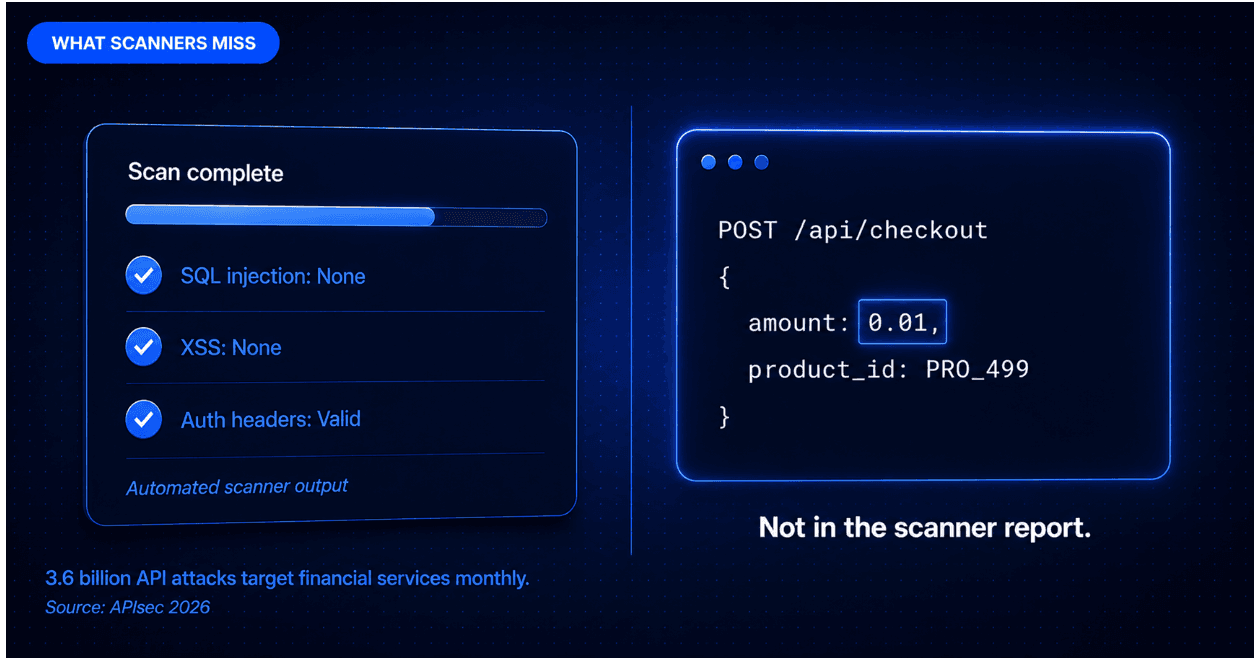
A scanner looking for SQL injection will not catch the vulnerability that lets a buyer pay $0.01 for a $499 subscription. It will not catch the race condition that allows the same balance to be spent twice. It will not catch the business logic gap that lets a refund go to a different payment method than the original charge. These are the attacks that cost real money.
Financial services face 3.6 billion API attacks monthly according to APIsec's 2026 analysis. The most impactful category is not injection or authentication failure. It is transaction manipulation. Automated scanning consistently misses it because detecting it requires understanding what the payment system is supposed to do and then testing whether it enforces that under adversarial conditions. Here is how Capture The Bug tests payment APIs for this class of vulnerability.
Price and Amount Field Tampering
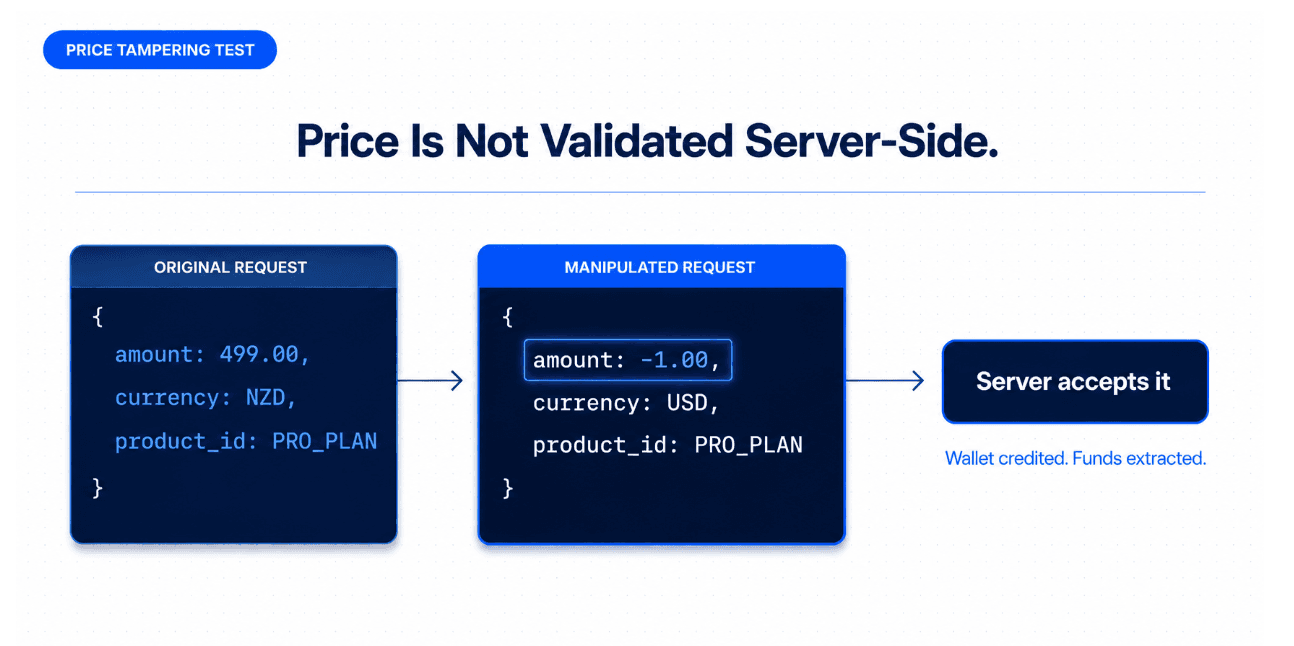
The most direct form of transaction manipulation is modifying the amount field between client and server. In a correctly implemented payment system, the price is authoritative server-side and the client sends only a product identifier. In a misconfigured system, the client sends the price and the server accepts it.
We intercept checkout requests and modify the amount field: changing 499.00 to 0.01, to -1.00, and to 0.00. Negative amounts are particularly instructive because an API that processes a negative purchase as a refund rather than rejecting it can credit a wallet or extract funds from a merchant without any purchase being made.
We also test currency switching. An API that validates the numeric amount but not the currency code can be exploited to pay in a lower-value currency than the one the price was set in. The broader API parameter handling methodology is explored in the guide to API penetration testing, but payment APIs require specific test cases that go beyond standard OWASP API Top 10 coverage.
Race Condition and Double-Spend Testing
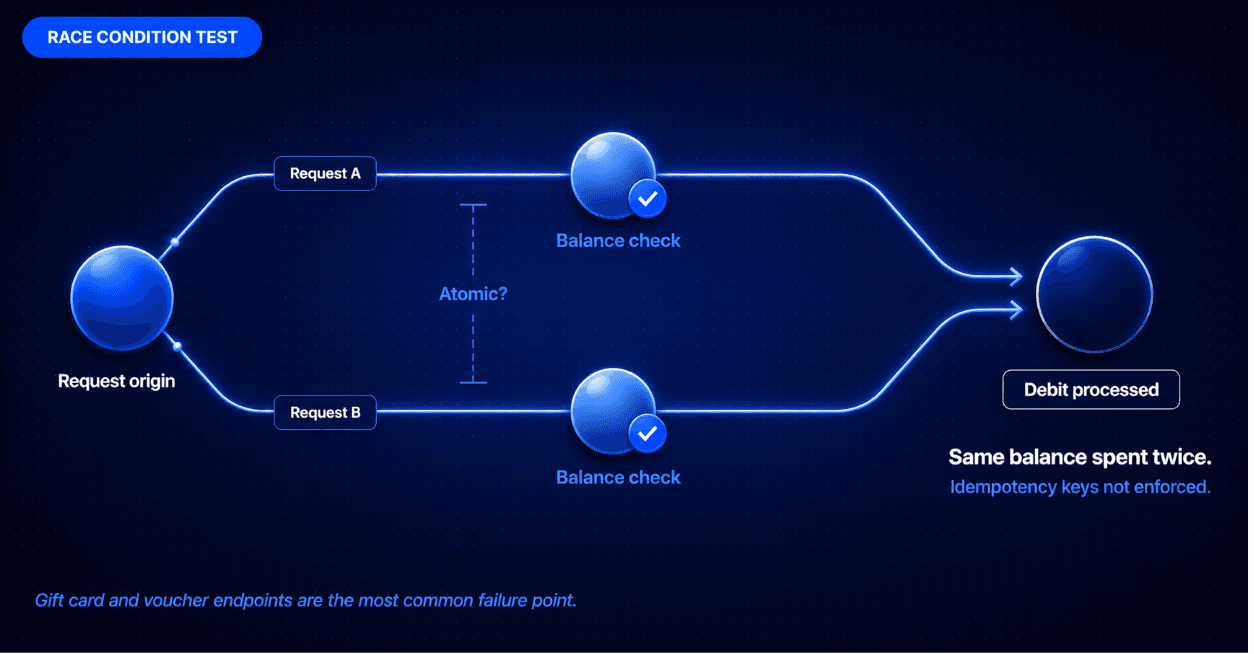
Race conditions exploit the window between when a balance is checked and when it is debited. If those operations are not atomic, two concurrent requests can both pass the balance check and both succeed, allowing the same funds to be spent twice or a voucher to be redeemed multiple times.
We test this using parallel request attacks: multiple simultaneous requests against the same endpoint with the same session credentials and payment parameters. We establish whether idempotency keys are correctly enforced, whether concurrent requests produce duplicate charges or credits, and whether rate-limiting applies per payment method or per session.
Gift card and voucher redemption endpoints are a specific target because they frequently have looser atomicity controls than primary payment flows. A single-use voucher applied in two simultaneous requests before either registers the redemption is a straightforward business loss requiring no technical sophistication from the attacker.
Your Last Pentest Is Already Out of Date
Every week you ship without continuous testing is a week a vulnerability goes unseen. See what Capture The Bug finds in your first engagement.
Transaction IDOR and Webhook Testing
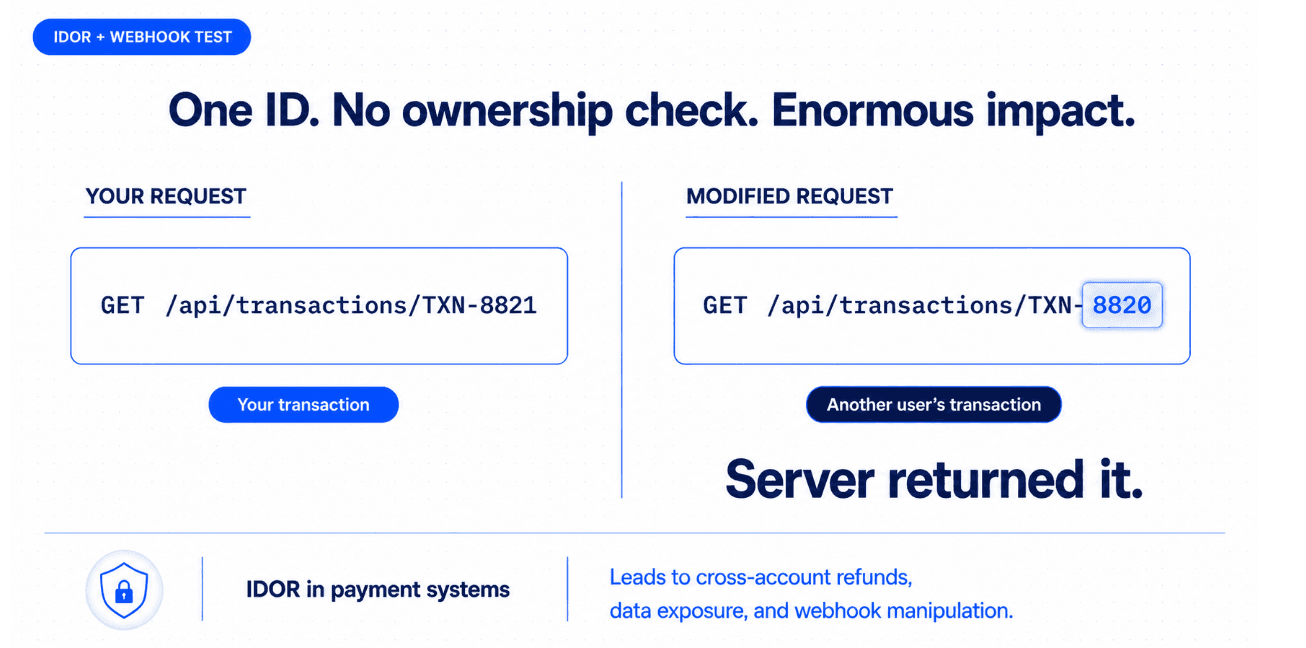
IDOR in payment systems allows an attacker to access or manipulate another user's transaction records by modifying identifiers in API requests. We test whether a transaction ID is validated against the authenticated user's account server-side, and whether changing the ID in a refund or dispute request allows processing against a different user's transaction.
Webhook handlers are a specific test target. A webhook that updates order status based on a transaction ID in the payload, without verifying that ID belongs to the correct order, can be manipulated to mark an unpaid order as paid by referencing a legitimate transaction from a different account. This is one of the highest-impact business logic flaws in payment systems and one that automated scanners are structurally unable to detect.
We also test refund endpoint idempotency. A refund endpoint without correct idempotency key enforcement can process duplicate requests independently, refunding a single purchase multiple times. Response tampering is another vector: we test whether the payment provider response can be intercepted and modified to force a success code from a declined transaction.
The regulatory context for fintech payment testing, including APRA CPS 234 and RBNZ cyber resilience guidance, is covered in the sector-specific guide to penetration testing for fintech companies in Australia.
What We Deliver After a Payment API Test
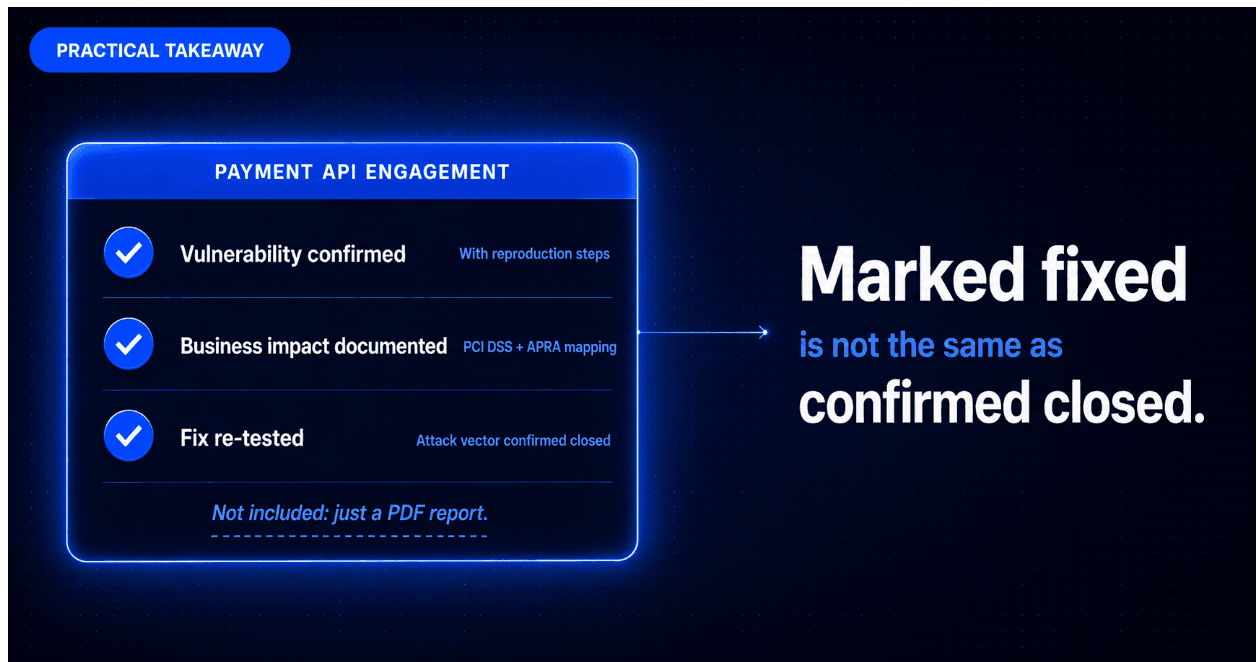
Payment API findings are documented with specific reproduction steps and business impact framing, not CVSS scores alone. A payment manipulation vulnerability at CVSS 5.0 may carry higher business risk than a critical injection finding in a non-payment endpoint, depending on the transaction volume it affects.
Findings map to PCI DSS requirements for organisations handling card data and to APRA CPS 234 format for Australian financial entities. For New Zealand organisations under RBNZ guidance, we document findings in the format the RBNZ and FMA look for when reviewing cybersecurity control effectiveness.
Re-testing fixed endpoints is part of the engagement scope, not an optional add-on. The process described in the guide to what happens after a penetration test applies directly here: a payment API finding marked as fixed without re-testing the specific attack vector is an assumption, not a confirmed close.
Book a payment API security consultation with Capture The Bug to scope a targeted engagement on your transaction endpoints.
Plan Your Annual Pentesting Strategy the Right Way
Learn how modern SaaS companies structure pentesting across the year to reduce risk, stay compliant, and avoid last-minute panic before audits.
FAQ
What types of transaction manipulation does Capture The Bug test for in payment APIs?
Capture The Bug tests five primary transaction manipulation categories: price and amount field tampering (including negative amounts and currency manipulation), race conditions enabling double-spend or duplicate redemption, IDOR vulnerabilities allowing cross-account transaction access or manipulation, refund and reversal abuse including duplicate refund processing, and webhook response tampering where payment authorisation decisions can be manipulated at the integration layer.
Why do automated scanners miss payment API transaction manipulation?
Automated scanners test for known vulnerability patterns in request syntax and server responses. Transaction manipulation vulnerabilities require understanding what a payment flow is supposed to do and testing whether it actually enforces that logic. A scanner cannot assess whether a refund can exceed the original amount, whether concurrent requests exploit a race condition, or whether a webhook handler validates transaction ownership. These require manual test cases built around the specific payment logic.
What is a race condition in a payment system and how is it tested?
A race condition in a payment system exploits the window between when a balance or payment method is checked and when it is debited. If those operations are not atomic, two concurrent requests can both pass the balance check and both succeed. Capture The Bug tests this using parallel request attacks, sending multiple simultaneous requests against the same endpoint to establish whether idempotency keys are correctly enforced, whether duplicate charges or credits are possible, and whether rate-limiting applies per payment method.
How does IDOR affect payment systems specifically?
IDOR in payment systems allows an attacker to access or manipulate another user's transaction records by modifying identifiers in API requests. In payment contexts this extends beyond data exposure: a refund request with a modified transaction ID can process a refund against a different user's transaction, a webhook handler without ownership validation can be used to mark unpaid orders as paid, and order references without server-side ownership checks can allow account-crossing operations. These are high-impact business logic flaws that automated scanners cannot detect.
How does Capture The Bug document payment API findings for compliance?
Findings from payment API engagements are categorised by attack type, business impact, and regulatory implication. For organisations handling card data, findings are mapped to PCI DSS requirements. For Australian financial entities under APRA CPS 234 and New Zealand organisations under RBNZ guidance, findings are documented in the format auditors expect. Every finding includes specific reproduction steps and confirmed business impact, not just severity scores, because payment manipulation risk depends on transaction volume and business context.