OWASP API Top 10 Explained with Real-World Examples
APIs now sit at the center of almost every modern product. They move money, expose customer data, connect partners, and power mobile and web experiences. When an API fails, it rarely fails quietly. It fails at scale.
That is why the OWASP API Top 10 matters. It is not a theoretical list. It is a pattern library of how real breaches happen in real companies.
At Capture The Bug, a CREST-certified PTaaS provider working with teams across ANZ, the US, and globally, these issues show up again and again. Different industries, different tech stacks, same mistakes.
This guide explains each OWASP API Top 10 risk in plain language, with real-world examples and practical context. No buzzwords. No fear marketing. Just clarity.
Why the OWASP API Top 10 Exists
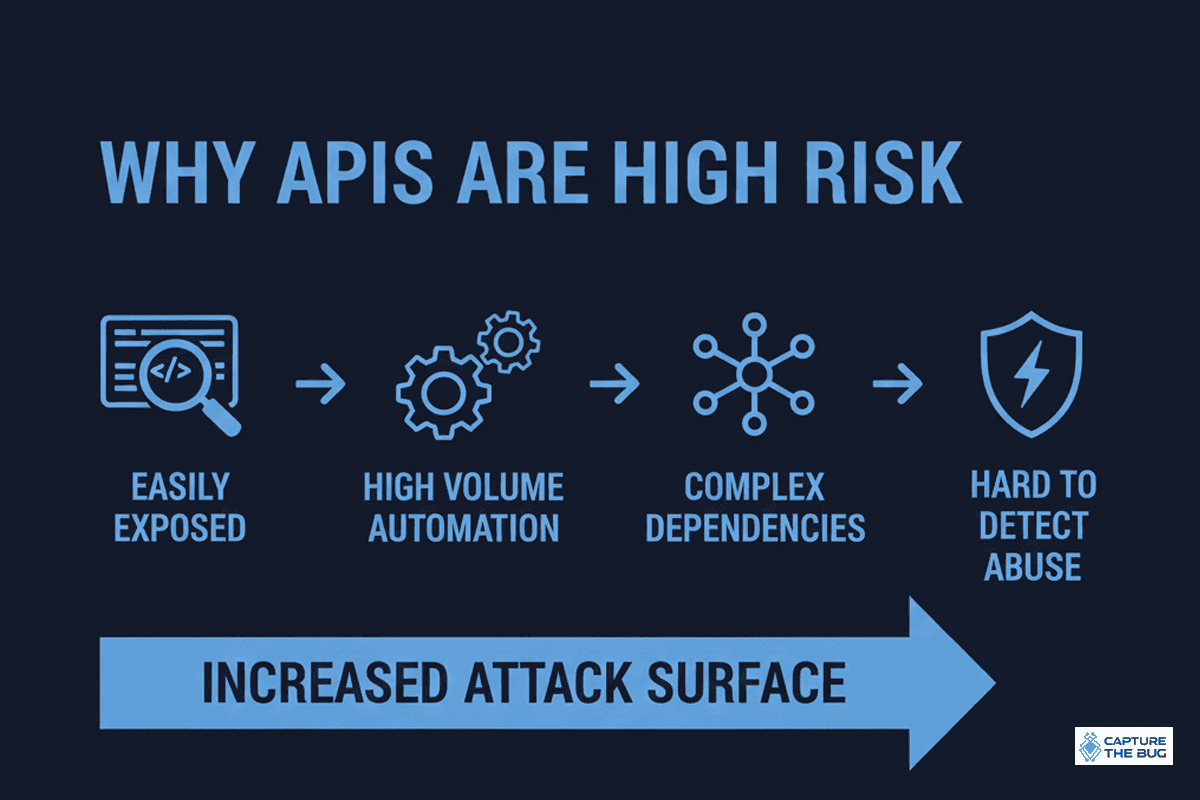
The original OWASP Top 10 focused on web applications. APIs changed the game. APIs are designed for machines, not humans. They assume trust, speed, and structure. That makes them powerful, but also fragile when authorization, validation, or visibility is weak.
The OWASP API Top 10 highlights the most common ways attackers exploit that fragility.
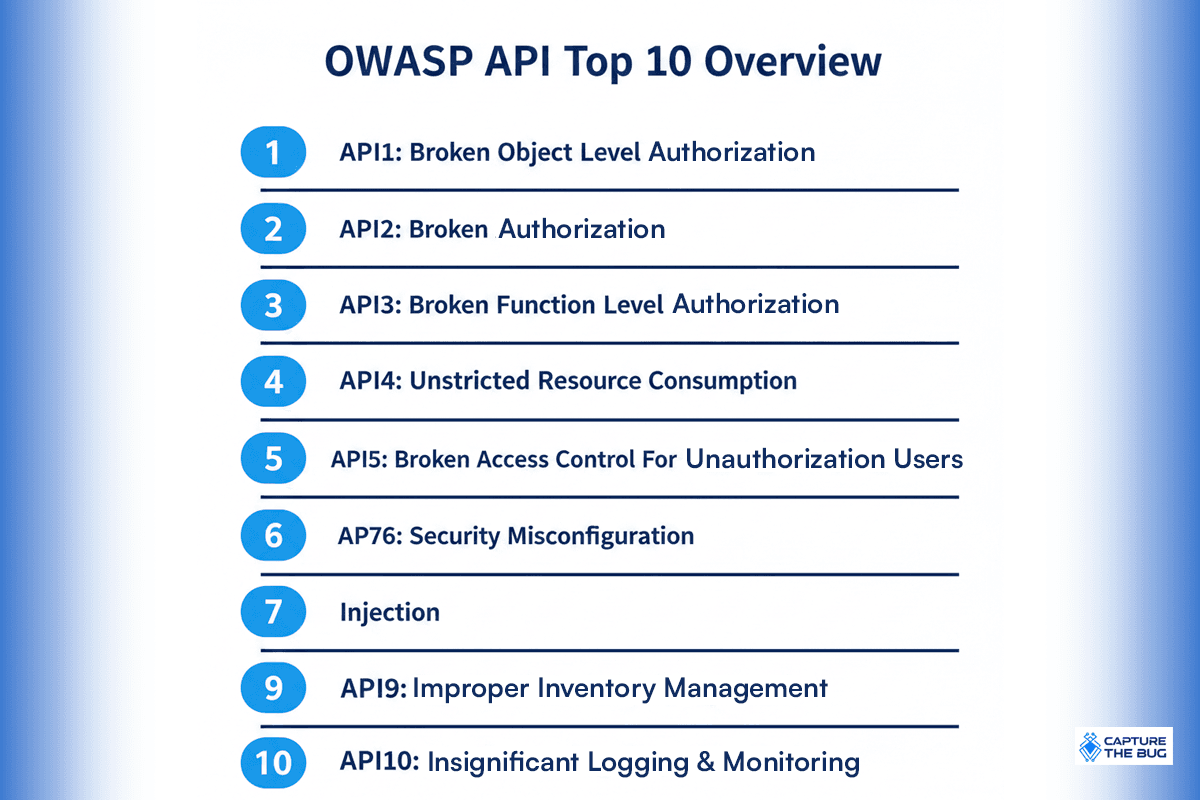
API1: Broken Object Level Authorization (BOLA)
This happens when an API checks that a user is logged in, but does not check whether they are allowed to access a specific object. In simple terms, the API trusts the ID you send.
What goes wrong
A user changes an object ID in a request and gains access to someone else's data.
Real-world example
A fitness platform exposed private profile data because its API allowed any authenticated user to request any user ID. Privacy settings did not matter. The API never checked ownership.
Why it matters
This is one of the most common API breaches. It leads directly to data exposure at scale.
API2: Broken Authentication
Authentication failures occur when APIs rely on weak token handling, poor session controls, or predictable credentials.
What goes wrong
Attackers reuse leaked credentials, brute-force tokens, or abuse long-lived sessions.
Real-world example
A major government service exposed data of tens of millions of users because once logged in, the API allowed broad queries without re-verifying intent or scope.
Why it matters
Authentication is not just logging in. It is continuous proof of identity and intent.
API3: Broken Object Property Level Authorization
Here, the user is allowed to access an object, but not all of its fields.
What goes wrong
The API returns or accepts sensitive fields without checking whether the user should see or modify them.
Real-world example
In an e-commerce backend, sellers could update their own products. Due to weak property-level checks, a seller could also modify payment configuration fields belonging to other stores.
Why it matters
This often goes unnoticed because the endpoint itself looks legitimate.
API4: Unrestricted Resource Consumption
APIs are designed for speed, but speed without limits is dangerous.
What goes wrong
An attacker sends excessive requests or heavy queries, exhausting backend resources.
Real-world example
A public API with no request limits was flooded with thousands of requests per minute, causing service outages for paying customers.
Why it matters
Availability is part of security. Downtime is a business risk, not just a technical one.
API5: Broken Function Level Authorization
This occurs when APIs expose powerful actions without properly restricting who can call them.
What goes wrong
A user with basic access calls admin-level functions by guessing or discovering endpoints.
Real-world example
An account update endpoint allowed any authenticated user to change another user's profile by modifying a user identifier in the request.
Why it matters
Attackers do not need new endpoints. They reuse existing ones in unintended ways.
API6: Unrestricted Access to Sensitive Business Data
Some APIs expose internal or commercial data without strong access controls.
What goes wrong
Sensitive reports, financial data, or customer records are accessible through undocumented or poorly protected endpoints.
Real-world example
An internal reporting API exposed revenue data because it was never intended to be public, yet was reachable from the internet.
Why it matters
Not all sensitive data is personal data. Business data leaks can be just as damaging.
API7: Server-Side Request Forgery (SSRF)
SSRF occurs when an API fetches external resources based on user input, without validating destinations.
What goes wrong
Attackers trick the server into making requests to internal systems or metadata services.
Real-world example
A commerce platform's image processing API was abused to access internal infrastructure, leading to deeper system exposure.
Why it matters
SSRF often acts as a bridge to far more serious internal access.
API8: Security Misconfiguration
This is not a single bug. It is death by defaults.
What goes wrong
Open endpoints, verbose error messages, outdated components, or unnecessary features remain exposed.
Real-world example
A vehicle tracking service exposed live location data for hundreds of thousands of devices because its API had no authentication enabled.
Why it matters
Attackers love misconfigurations because they require no creativity.
API9: Improper Inventory Management
You cannot protect what you do not know exists.
What goes wrong
Old versions, deprecated endpoints, and forgotten APIs remain live and unmonitored.
Real-world example
A company patched a known issue in its latest API version, but attackers continued using an older version that was still active.
Why it matters
API sprawl is one of the biggest blind spots in growing teams.
API10: Unsafe Consumption of APIs
APIs are not just providers. They are also consumers.
What goes wrong
Applications trust data returned by third-party APIs without validation.
Real-world example
A client application executed malicious input embedded in API responses, leading to user data compromise.
Why it matters
Security responsibilities are shared across the entire ecosystem.
What These Risks Have in Common
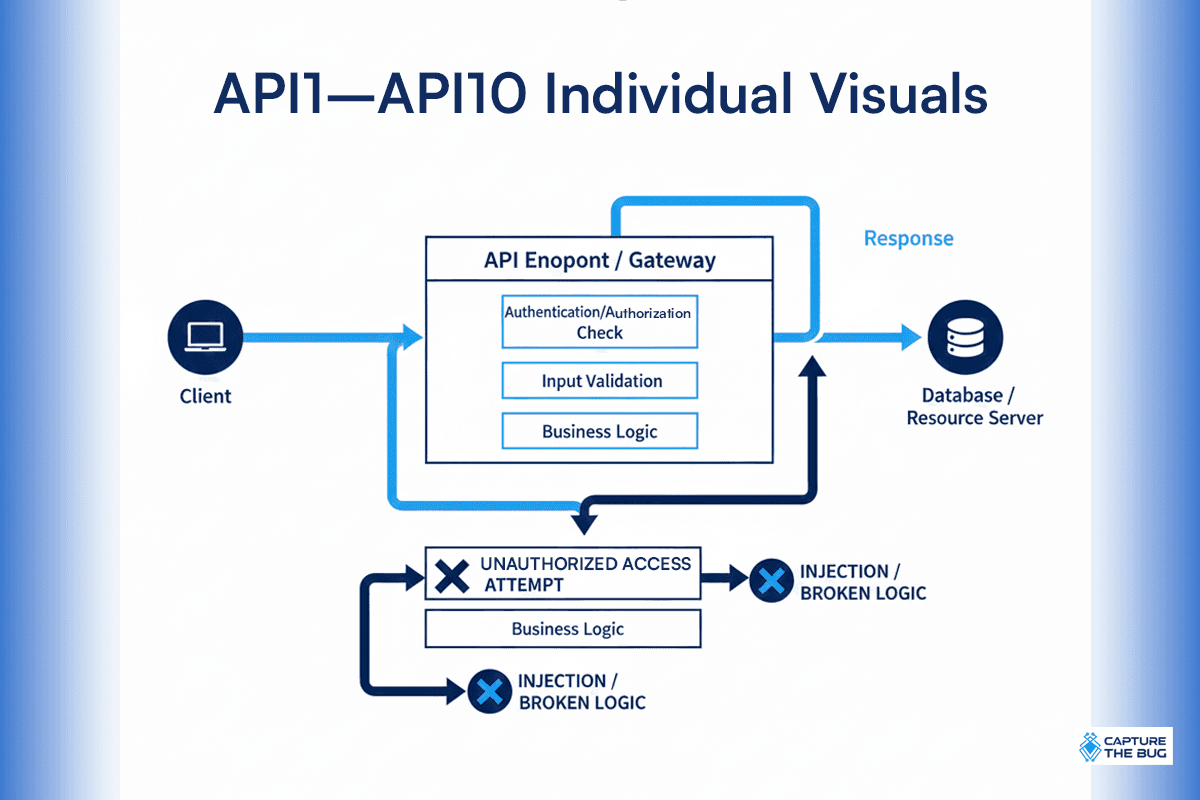
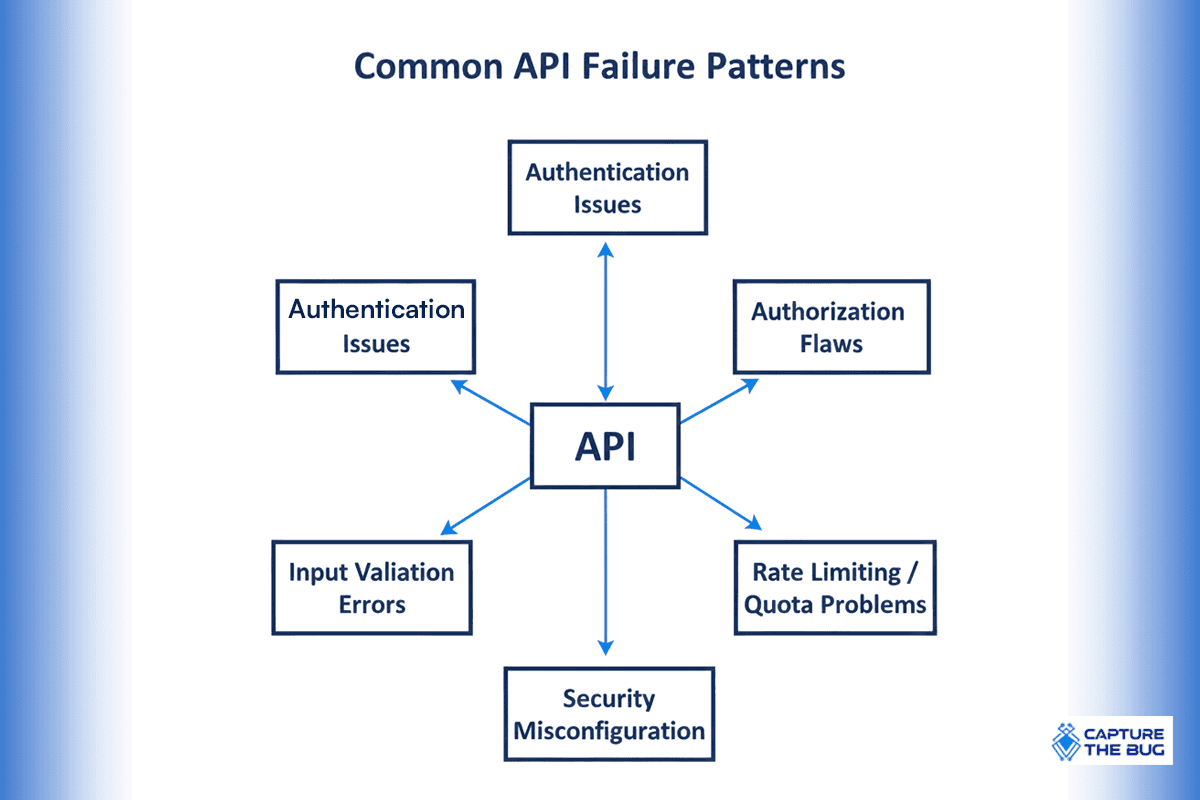
Across all ten categories, a pattern emerges. APIs fail when authorization is assumed instead of enforced, trust is implicit instead of verified, and visibility is partial instead of complete.
Most breaches are not caused by advanced exploits. They are caused by missing checks.
How Capture The Bug Approaches API Risk
Capture The Bug works with API-heavy teams across SaaS, fintech, and regulated industries. Our approach focuses on how APIs behave in reality, not just how they look in documentation.
That means mapping real, live API usage (including undocumented paths), validating authorization at object, property, and function levels, testing how APIs behave under abuse (not just normal use), and verifying fixes in real time so teams know risk is actually reduced.

Final Thoughts
The OWASP API Top 10 is not a checklist to satisfy audits. It is a lens into how attackers think. APIs break when teams assume good behavior. Attackers never do.
The strongest API programs start with three habits: know every API you expose, verify every action every time, and test continuously as systems change. When those habits are in place, API security stops being reactive and starts becoming predictable.
OWASP API Top 10: FAQ
What is the OWASP API Top 10?
It is a list of the ten most common and impactful API security risks, based on real-world data and breaches.
Why are APIs more vulnerable than traditional web apps?
Because APIs assume trust, operate at scale, and often lack human-visible safeguards.
What is the most common API vulnerability?
Broken object level authorization consistently appears as the top cause of API data breaches.
How often should APIs be tested for these risks?
Every time APIs change. One-time testing does not match modern release cycles.
Is API security only a technical issue?
No. It is a business risk issue because APIs expose data, revenue, and trust.