

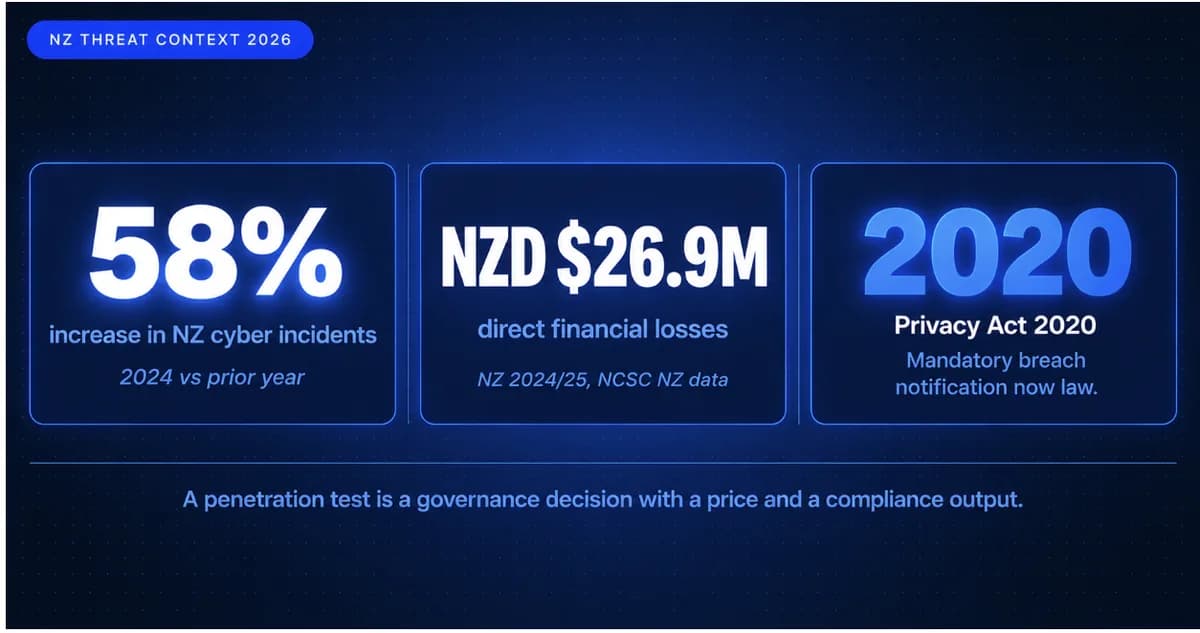
New Zealand cyber incidents rose 58% in 2024. Direct financial losses from cyber incidents in New Zealand totalled $26.9 million in 2024/25 according to NCSC NZ data. The Privacy Act 2020's mandatory breach notification provisions mean that a security failure is no longer just a cost to remediate. It is a regulatory event with a public disclosure obligation.
That shift is changing how NZ businesses think about penetration testing. It is no longer a technical exercise reviewed by the IT team. It is a governance decision with a price, a compliance output, and an executive audience. Understanding what that price looks like in NZD, and what drives it in the New Zealand market specifically, is the starting point for every NZ organisation planning a security testing budget in 2026.
NZD Pricing Ranges by Test Type (2026)
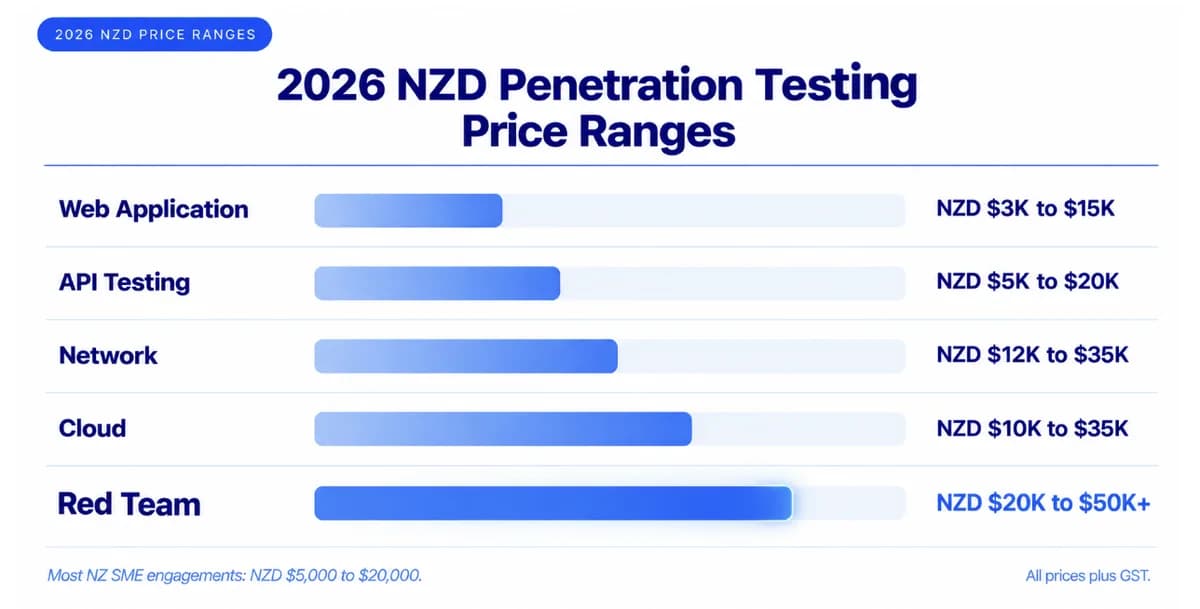
These ranges are based on published NZ and ANZ provider pricing in 2025 and 2026. Every engagement is scoped individually. Treat these as verified benchmarks for budget planning, not fixed prices.
Web Application Penetration Testing
A focused penetration test on a single web application typically costs between NZD $3,000 and $15,000 plus GST for a standard scope. A simple site with one user role sits at the low end. A multi-role SaaS platform with authenticated testing, payment flows, and API coverage sits toward the upper end or above it.
API Penetration Testing
NZD $5,000 to $20,000 plus GST. Cost scales with endpoint count, authentication model complexity, and whether business logic testing is required. Fintech and open banking platforms with RBNZ or PCI DSS reporting requirements typically sit above the midpoint. The NZ financial services sector faces RBNZ cyber resilience expectations that treat API security as a priority testing area, which pushes scopes and costs toward the upper end of this range.
Internal and External Network Testing
Mid-market engagements covering multi-asset web, API, and limited infrastructure typically cost NZD $12,000 to $35,000. Simpler external network assessments on a defined IP range start lower. Internal network assessments covering Active Directory, segmentation, and lateral movement testing require more tester days and cost more.
Cloud Penetration Testing
NZD $10,000 to $35,000 for AWS, Azure, or GCP environments. Single-account external reviews sit lower. Multi-account hybrid cloud environments with NZISM or ISO 27001 evidence requirements sit higher.
Red Team Assessments
NZD $20,000 to $50,000 for scoped mid-market exercises. Red team is not the right starting point for most NZ organisations. If your last penetration test was more than twelve months ago, start with a focused engagement before commissioning a red team exercise.
Most NZ small business engagements fall between NZD $5,000 and $20,000, based on published 2025 and 2026 provider pricing.
What Drives Penetration Testing Cost in New Zealand
Scope is the primary driver. The NZ market has a specific dynamic AU buyers rarely face: the pool of CREST-accredited providers is smaller, which limits competitive tension on compliance-grade pricing. Cyber insurers and regulators increasingly require manual testing and retests for policy issuance and renewals, and that demand pressure in a smaller supplier market means NZ pricing does not compress the way a larger market might allow.
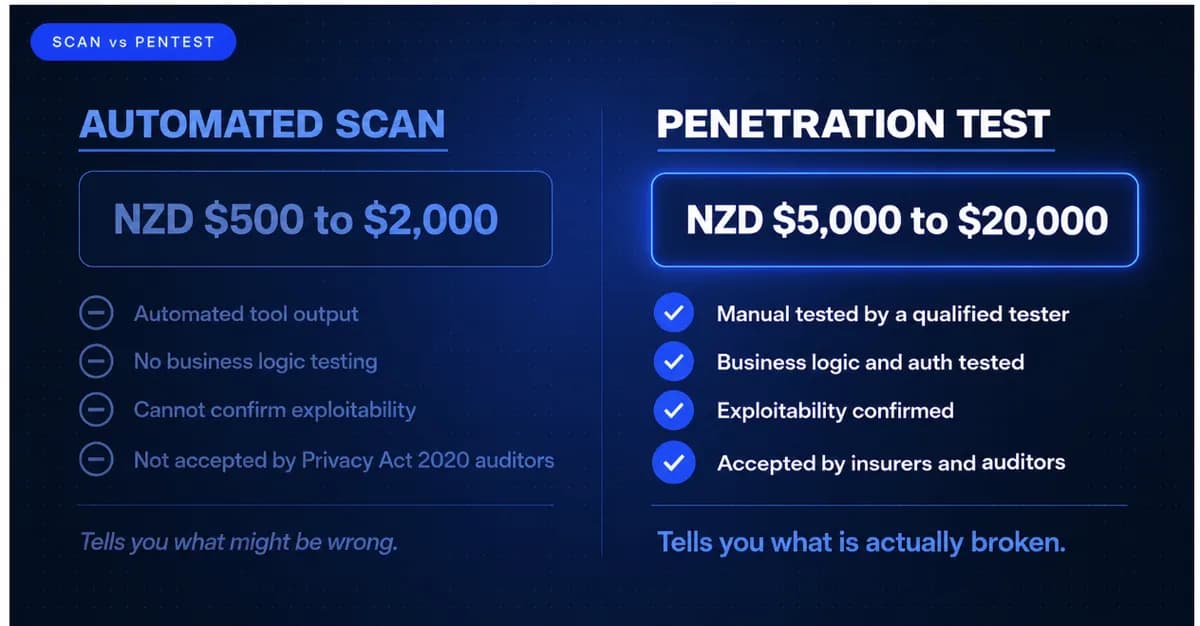
Testing depth is the second driver. Any quote under NZD $2,000 to $3,000 for a web application test is almost certainly an automated scan, not a penetration test. Scans find known vulnerabilities but do not validate business logic, confirm exploitability, or produce evidence that Privacy Act 2020 reviews and cyber insurance underwriters require.
Compliance requirements add cost and value simultaneously. PCI DSS, ISO 27001, NZISM, or Privacy Act 2020 reporting requires specific documentation structured for auditors and the Office of the Privacy Commissioner. The guide to continuous penetration testing for SOC 2 and ISO 27001 compliance covers how each engagement builds the evidence trail regulators expect.
Retesting inclusion is the fourth driver. A test without retesting produces a finding list, not a confirmed security posture. The guide to what happens after a penetration test covers the confirmed closure evidence that NZISM compliance reviews and cyber insurance renewals require.
The NZ-Specific ROI Calculation
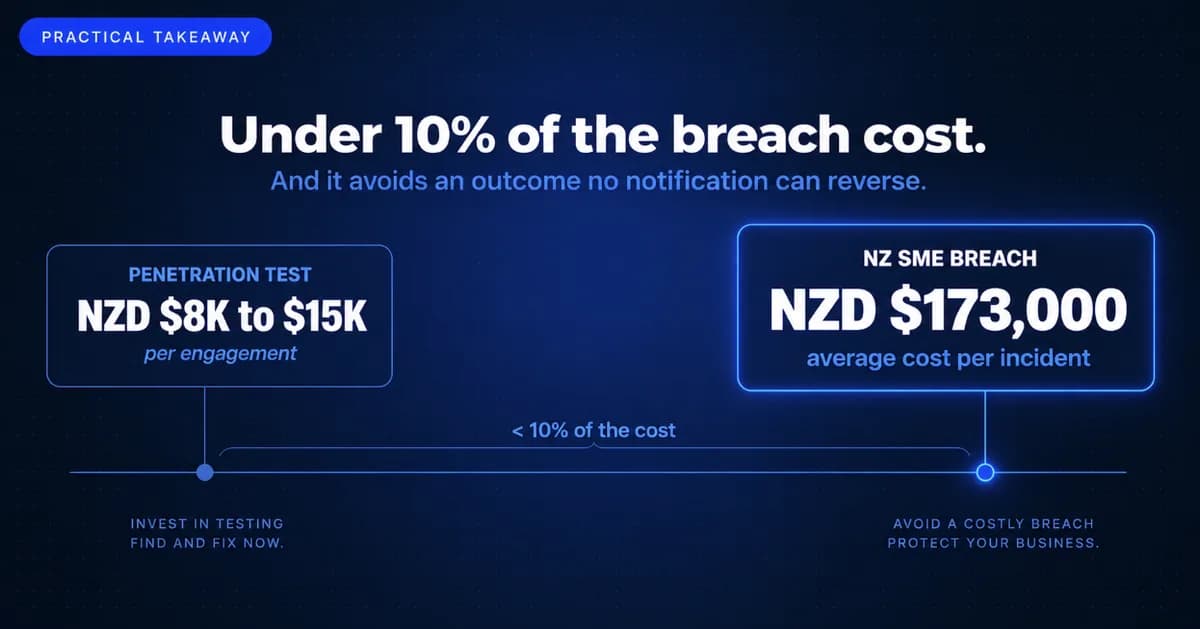
The average NZ SME breach cost is NZD $173,000. A well-scoped penetration test costs NZD $8,000 to $15,000 for a typical NZ business, under 10% of that figure, producing findings that when remediated directly reduce that risk.
The Privacy Act 2020 adds a second calculation. A breach triggering mandatory notification to the Office of the Privacy Commissioner carries reputational cost, regulatory action risk, and customer notification obligations the NZD $173,000 estimate does not fully capture. A penetration test that closes a critical vulnerability before it produces a notifiable breach avoids an outcome that no breach notification can reverse.
For NZ organisations approaching a cyber insurance renewal, a Privacy Act 2020 review, or a NZISM-aligned security assessment, a CREST-certified engagement from a provider with NZ regulatory experience is the most defensible security investment in 2026.
Book a scoping consultation to get an accurate NZD quote for your environment, compliance requirements, and timeline.
Book a Scoping ConsultationPlan Your Annual Pentesting Strategy the Right Way
Learn how modern SaaS companies structure pentesting across the year to reduce risk, stay compliant, and avoid last-minute panic before audits.

Your Last Pentest Is Already Out of Date
Every week you ship without continuous testing is a week a vulnerability goes unseen. See what Capture The Bug finds in your first engagement.
Frequently Asked Questions
Q1: How much does penetration testing cost in New Zealand in 2026?
A: Penetration testing in New Zealand typically costs between NZD $3,000 and NZD $50,000 in 2026, depending on test type and scope. Web application tests range from NZD $3,000 to $15,000 for standard scope. API and network tests range from NZD $5,000 to $35,000. Red team assessments for mid-market NZ organisations typically range from NZD $20,000 to $50,000. Most NZ SME engagements fall between NZD $5,000 and $20,000. Any web application test quoted below NZD $2,000 to $3,000 is almost certainly an automated scan rather than a manual penetration test.
Q2: Does the New Zealand Privacy Act 2020 require penetration testing?
A: The Privacy Act 2020 does not explicitly mandate penetration testing. However, Privacy Principle 5 requires agencies to protect personal information using reasonable security safeguards. The Office of the Privacy Commissioner evaluates whether an organisation maintained reasonable security measures when investigating a breach. Regular CREST-certified penetration testing is the strongest evidence of proactive security diligence available to NZ organisations, and it directly supports both Privacy Act compliance and cyber insurance renewal requirements.
Q3: What is NZISM and why does it affect penetration testing costs in NZ?
A: The New Zealand Information Security Manual (NZISM) is the government's information security standard, used by government agencies and increasingly referenced by regulated private sector entities. NZISM references security testing as part of system certification and accreditation. NZISM-aligned testing requires specific documentation and evidence outputs that add to engagement scope, which increases cost compared to an uncertified commercial assessment. CREST-certified testing is recognised within the GCSB and NCSC NZ guidance ecosystem as meeting professional assessment standards.
Q4: What is the difference between a vulnerability scan and a penetration test in New Zealand?
A: A vulnerability scan runs automated tools against your systems and reports known vulnerability patterns at scale. It does not manually exploit findings, test business logic, or confirm whether a finding is genuinely exploitable in your specific environment. A penetration test uses manual techniques to actively attempt exploitation, validate severity in context, and test the specific logic of your application or network. NZ Privacy Act 2020, PCI DSS, ISO 27001, and NZISM compliance reviews require penetration test reports. They do not accept automated scan outputs as a substitute.
Q5: Should a NZ business choose a local or offshore penetration testing provider?
A: There are practical reasons to choose a provider with NZ regulatory experience. The Privacy Act 2020, NZISM, and CERT NZ guidance are specific to New Zealand. A provider already working within these frameworks produces compliance evidence structured for NZ auditors and insurers, rather than advice based on US or European rules that may not directly translate to NZ obligations. CREST certification from CREST International or CREST ANZ is the quality baseline that NZ enterprise procurement and financial sector bodies recognise. Verifying accreditation before signing is more reliable than taking a provider's description of their qualifications at face value.