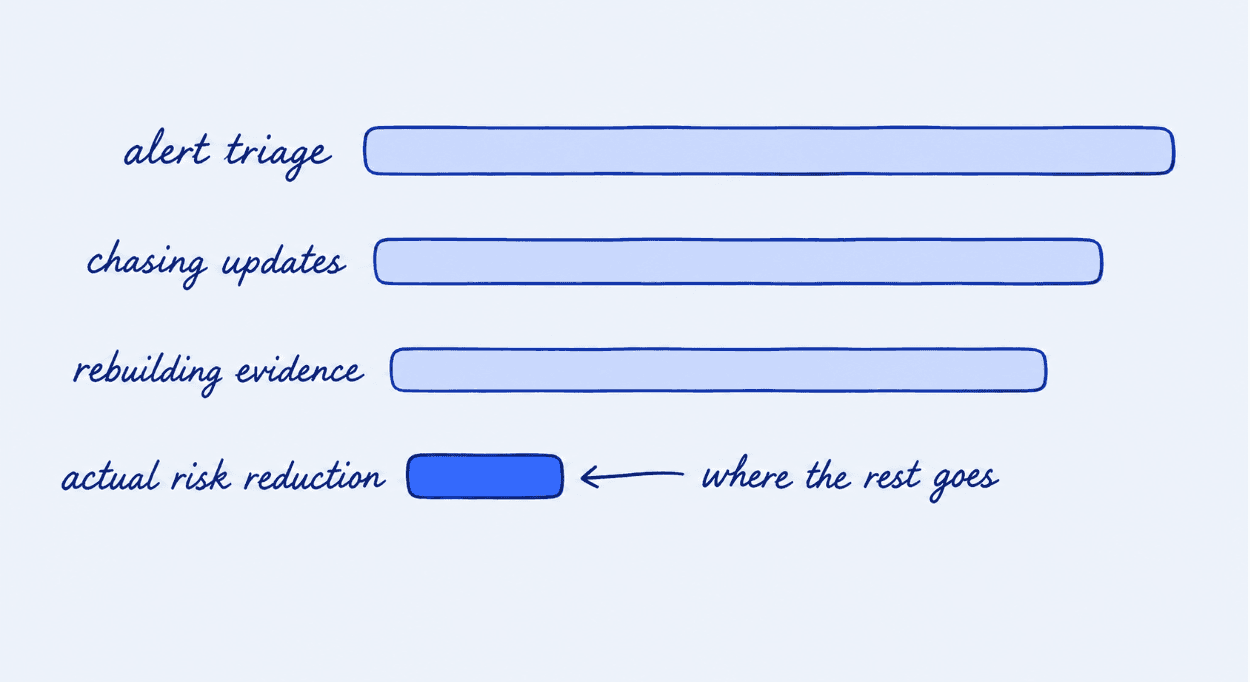
There is a particular kind of exhaustion that security professionals in New Zealand and Australia know well. It is the exhaustion of being overwhelmed by a breach or fighting a live incident. It is quieter than that. It is the exhaustion of spending Tuesday morning validating whether a vulnerability flagged on Monday is actually exploitable in the way it was described. Then spending Wednesday chasing the engineering team for a remediation update on a finding from six weeks ago. Then spending Thursday reformatting last quarter's test report into the format the compliance team needs for Friday's audit preparation.
The product is not being made more secure in any of those hours. Risk is not being reduced. Evidence is not being built. Time is being spent on the administration of security rather than on security itself.
This is the busywork problem, and it is costing ANZ security teams far more than most leadership teams realise.
What the Data Says About Where the Time Actually Goes
The numbers behind this problem are specific enough to be uncomfortable.
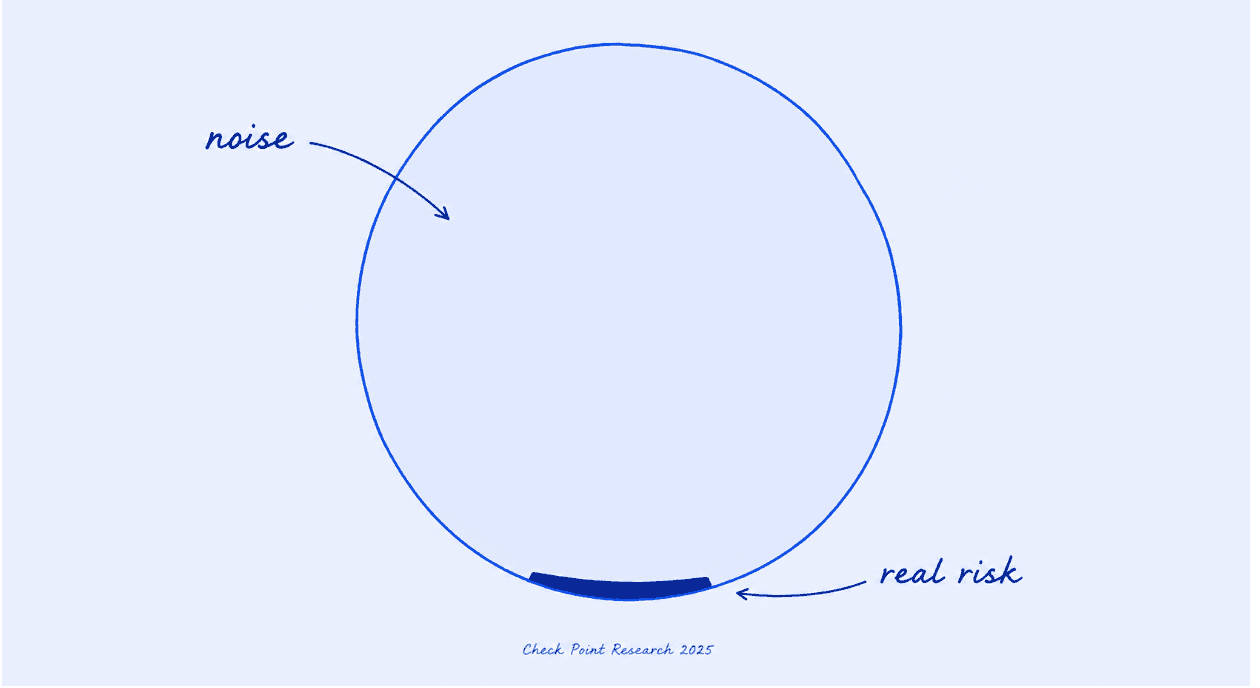
Research from Check Point, published in 2025, found that after exploitability validation, only 7.8 percent of vulnerability alerts warranted critical or high attention. That means for every 100 alerts a security team receives, 92 of them consume triage time without producing meaningful risk reduction. The team is not ignoring the other 92. They are working through them, one by one, to determine that they do not warrant priority action.
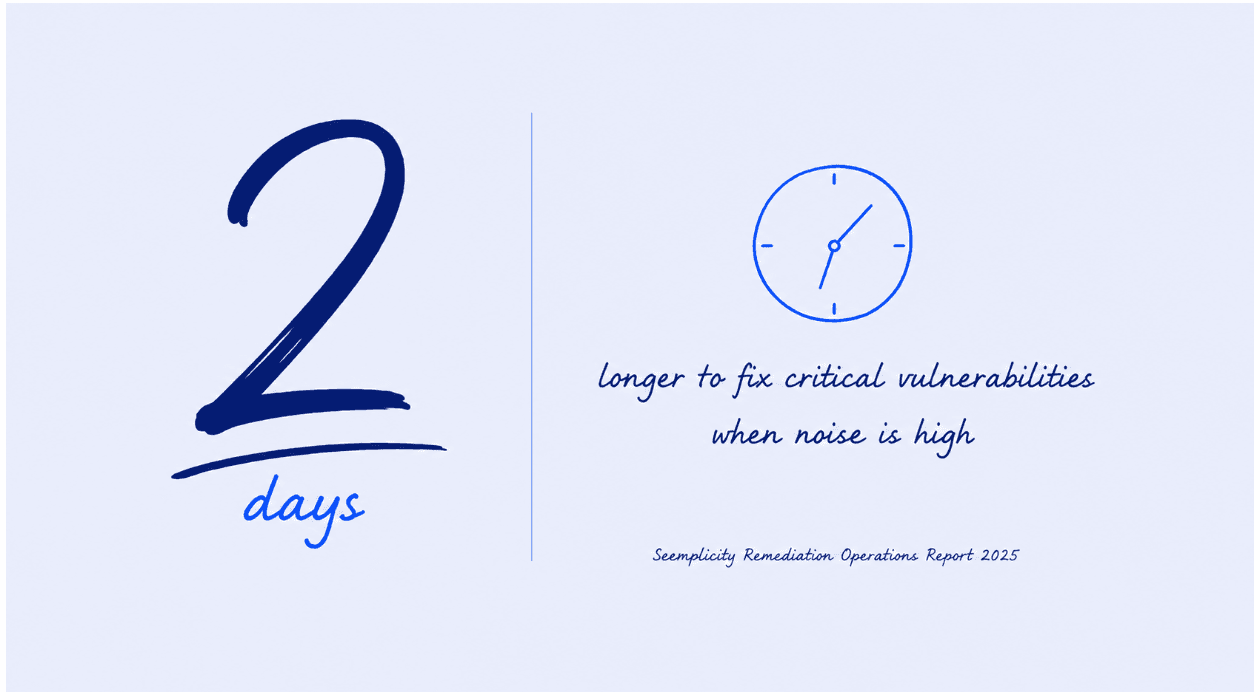
The Seemplicity 2025 Remediation Operations Report adds another dimension. Organisations dealing with high alert noise take an average of two additional days to remediate critical vulnerabilities compared to those with low noise. The noise does not just consume time. It delays the work that matters most by creating a cognitive overhead that slows the entire remediation pipeline.
The 2026 State of Pentesting report, published by The Hacker News in January 2026, identified a structural cause behind the coordination problem. Historically, penetration test results have been delivered as static reports, often disconnected from ticketing systems and remediation workflows. This creates a situation where findings data becomes siloed from other security data, ownership after the report handoff is unclear, and tracking fixes as they move through the engineering team breaks down entirely.
The result is a cycle that most security leads in New Zealand, Australia, Fiji, and the Pacific recognise immediately. The test runs. The report arrives. The team spends days triaging the findings, weeks chasing remediation updates across email threads, and months trying to reconstruct a coherent evidence trail when the next audit or enterprise customer review arrives. None of that time produces findings. None of it reduces risk. It is the administrative surface area that the traditional testing model creates, and it grows with every engagement that follows the same pattern.
Why the Traditional Model Creates Busywork by Design
Understanding why the traditional model produces this outcome requires looking at how it is structured.
A traditional penetration test is a closed engagement. A scope is agreed, testing runs for a defined window, and a report is delivered. At the moment the report arrives, the engagement ends. From that point forward, the ownership of everything that happens next, triage, prioritisation, remediation tracking, follow-up verification, and compliance documentation, sits entirely with the internal team.
That structure made sense in a world where a security test was a rare event with months between engagements. In that environment, the administrative overhead was infrequent enough to be manageable.
The Astra Security State of Continuous Pentesting Report 2026, drawing on 6.8 million findings across 8,000 engagements and more than 1,000 organisations in 70 countries, documented a different reality. A critical vulnerability was found every 48 seconds in 2025. In 2024 the same metric was one critical finding every 12 minutes. The attack surface is not static. It is producing new risk faster than a closed annual engagement model can track. When the frequency of new findings increases at that rate but the testing model remains event-based, the administrative overhead of managing findings, tracking remediation, and maintaining current evidence does not distribute across the year. It accumulates until the next engagement window, then lands all at once. The security team's time is consumed by reconstruction rather than prevention.
What Continuous Testing Changes About the Workload
A continuous testing model does not just produce more findings. It changes the operational relationship between the testing activity and the team that acts on it.
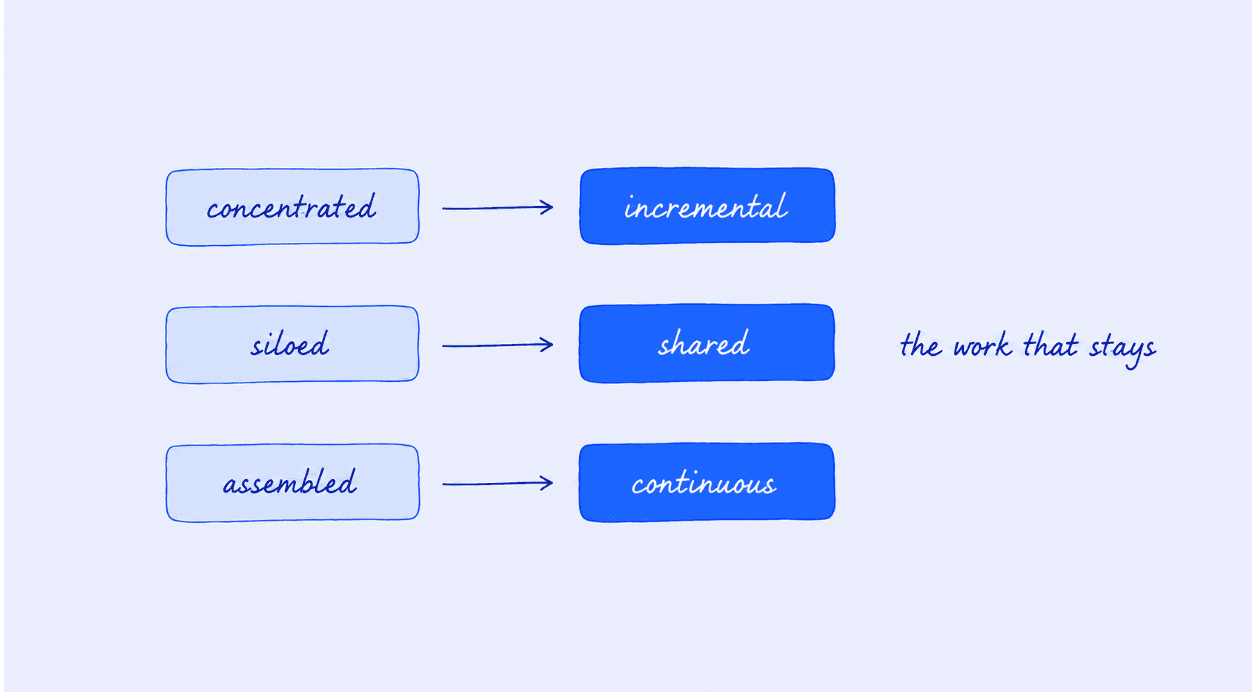
The most immediate change is triage. When findings arrive in a shared platform in real time rather than in a static report at the end of an engagement, the triage process becomes incremental rather than concentrated. A team that receives one or two verified findings per week can evaluate and act on them in the flow of normal operations. A team that receives forty findings in a single report delivery faces a concentrated triage burden that displaces everything else in the queue.
The second change is remediation tracking. When the testing programme and the remediation tracking exist in the same platform, the status of every finding is visible without chasing. An engineering team closing a vulnerability updates the same system where the finding originated. The security lead does not need to send emails asking for updates. The status is either current or it is not, and the gap is visible without a coordination effort to reveal it.
The third change is evidence production. In a continuous programme, the compliance evidence trail builds automatically as a by-product of the testing activity. By the time a SOC 2 Type II observation period closes, or an enterprise customer requests a security documentation package, the evidence exists and is current. It does not need to be assembled, reformatted, or supplemented from scattered historical records. Capture The Bug's penetration testing services are built around exactly this operational model. CREST-certified testing activity flows into a shared platform where findings, remediation status, and retesting verification are visible to both the testing team and the client. The administrative surface area that consumes security team hours in the traditional model does not exist in the same way because the coordination infrastructure is part of the programme rather than external to it.
Your Last Pentest Is Already Out of Date
Every week you ship without continuous testing is a week a vulnerability goes unseen. See what Capture The Bug finds in your first engagement.
The Real Cost of the Busywork Problem
When a security team's time is consumed by administrative overhead, the cost is not just the hours spent. It is the hours not spent on work that actually reduces risk.
A senior security engineer spending two days per week validating low-priority alerts and chasing remediation updates is a senior security engineer who is not building detection capability, not reviewing architecture decisions for new features, not coaching the engineering team on secure implementation patterns, and not running the threat modelling sessions that catch design-level vulnerabilities before they reach production.
The Astra Security data noted that the most impactful vulnerability classes in 2025 did not have CVE numbers because they were not generic vendor bugs. They were design decisions made by the product team. Finding those vulnerabilities requires the kind of expert, contextual reasoning that a senior security professional is positioned to provide. It is also the first thing that gets displaced when the week fills with administrative overhead. For companies in New Zealand, Australia, Fiji, and the Pacific that are managing SOC 2, ISO 27001, or PCI DSS requirements alongside active product development, the cost of that displacement is both operational and commercial. Every hour a senior security resource spends on administrative overhead is an hour the business pays for expertise and receives administration. Continuous testing redistributes that equation. The administrative work that the traditional model deposits with the internal team is absorbed into the programme structure. The internal team's hours go back to the work that the programme itself cannot do: the judgement, the architecture thinking, and the strategic security decisions that require human expertise and organisational context.
What This Means for Teams Across ANZ and the Pacific
The Hacker News 2026 State of Pentesting report made one observation that is worth sitting with: in 2026 and beyond, successful penetration testing programmes will be measured not only by what they find but by how effectively those findings drive action.
That measurement is impossible when the coordination overhead of a traditional model consumes the team's capacity to act. It becomes straightforward when the testing programme and the remediation infrastructure are the same thing.
For security-conscious leadership teams across New Zealand, Australia, Fiji, and the Pacific, the question worth asking is not whether the current testing model produces findings. It almost certainly does. The question is whether the team has the time and the operational clarity to act on those findings effectively, or whether the hours are going somewhere else. That conversation, scoping what a continuous programme would look like and what it would change about the operational load, is the first step Capture The Bug takes with every team across the region that is ready to move from managing the busywork to eliminating it. Visit Capture The Bug's penetration testing services to start that conversation.
Plan Your Annual Pentesting Strategy the Right Way
Learn how modern SaaS companies structure pentesting across the year to reduce risk, stay compliant, and avoid last-minute panic before audits.
FAQ
1. Why do security teams spend so much time on administrative overhead?
The traditional penetration testing model delivers findings as static reports and closes the engagement at delivery. Everything that follows, triage, prioritisation, remediation tracking, verification, and compliance documentation, sits with the internal team. Research from Seemplicity's 2025 Remediation Operations Report found that high alert noise alone adds an average of two extra days to critical vulnerability remediation. When this overhead accumulates across multiple engagements, it consumes a significant portion of security team capacity.
2. What percentage of vulnerability alerts actually require critical attention?
Check Point Research in 2025 found that after exploitability validation, only 7.8 percent of vulnerability alerts warranted critical or high attention. This means the majority of alert triage time is spent on findings that do not require priority action, representing a significant drain on security team capacity.
3. How does continuous penetration testing reduce security team workload?
Continuous testing changes the operational model in three ways. Findings arrive incrementally rather than in concentrated report deliveries, reducing triage burden. Remediation tracking is built into the shared platform rather than managed through external coordination. And compliance evidence builds continuously as a by-product of testing activity rather than being assembled manually before each audit cycle.
4. How fast is the vulnerability landscape actually moving in 2026?
The Astra Security State of Continuous Pentesting Report 2026, based on 6.8 million findings across 8,000 engagements, found that a critical vulnerability was identified every 48 seconds in 2025, compared to every 12 minutes in 2024. Critical findings also grew from 1 in 40 total findings in 2024 to 1 in 10 in 2025, a 14.6 times faster growth rate than total vulnerability volume.
5. How does a continuous testing model support compliance documentation?
In a continuous programme, every testing activity, finding, remediation, and retest verification is timestamped and recorded in a shared platform as the programme runs. By the time a SOC 2 Type II observation period closes or an audit is scheduled, the evidence trail exists and is current. There is no manual assembly, no reformatting, and no gap between what happened and what can be demonstrated.
6. Does Capture The Bug serve companies in Fiji and the Pacific region?
Yes. Capture The Bug works with security teams across New Zealand, Australia, Fiji, and the broader Pacific, providing CREST-certified continuous penetration testing with operational visibility and compliance documentation aligned to SOC 2, ISO 27001, and PCI DSS requirements.