From Ad Hoc to Intentional: Laying the First Real Security Foundation
Every mature security program starts before there is a budget, a team, or a clear roadmap. It starts in what most frameworks quietly call the partial stage. This is the moment when security exists, but only just enough to keep the business moving.
At Capture The Bug, we work with companies across ANZ, the US, and beyond who are exactly here. Startups closing their first enterprise deal. SaaS teams preparing for SOC 2. Founders who know security matters but are unsure where to begin without slowing growth.
This stage is not a failure. It is a beginning. The danger is not being in the partial stage. The danger is staying there without intention.
This article breaks down what the partial stage really looks like, why it feels chaotic, and how organizations can build strong security foundations without overengineering or burning scarce resources.
What the partial stage really looks like
In the early phase, security is usually reactive. Something triggers action. A customer questionnaire. An auditor request. A partner asking for proof. The response is often rushed and fragmented, but well intentioned.
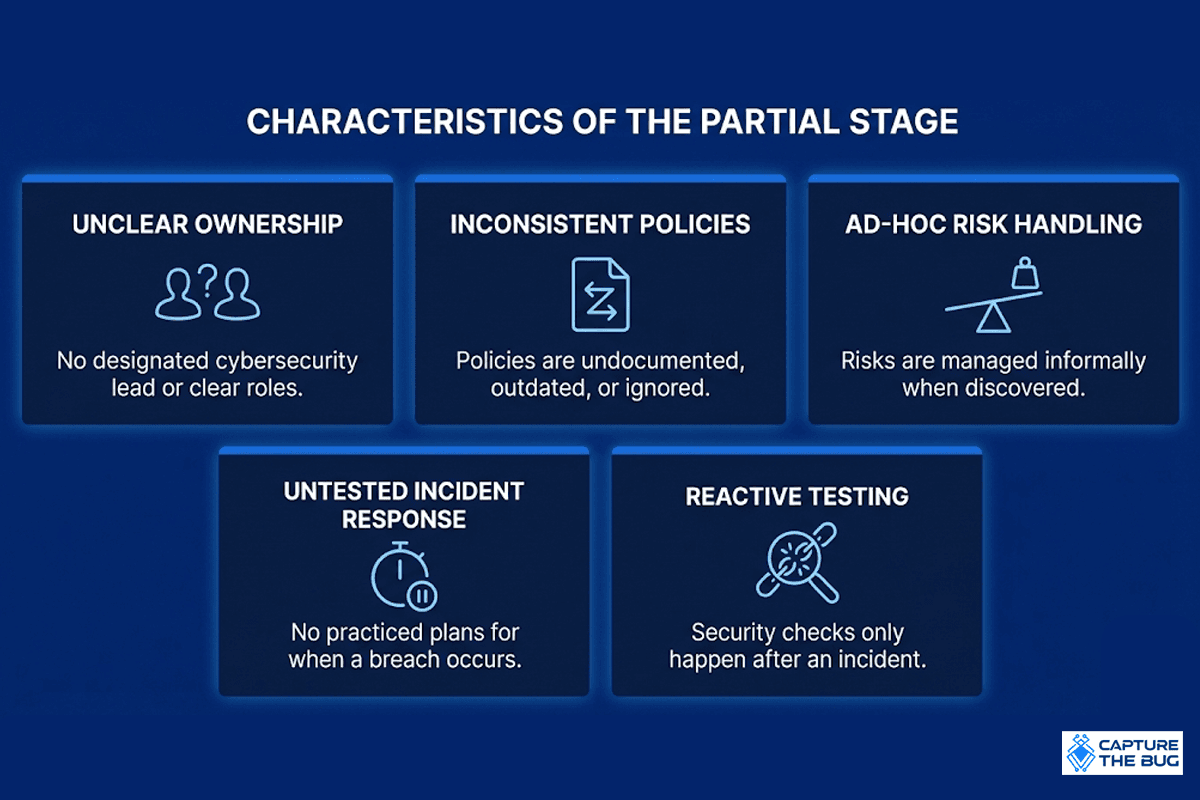
Most partial-stage organizations share a few clear traits:
- Security ownership is unclear: One person may be "handling security" alongside engineering, IT, or operations. There is effort, but no single point of accountability.
- Policies exist, but they are inconsistent: Some documents are copied from templates. Others are written during late nights before audits. Coverage is uneven and rarely reviewed.
- Risk is acknowledged, but not managed over time: Risks may be discussed in meetings or noted in spreadsheets, but there is no living record that tracks what matters most and why.
- Incident response is theoretical: A plan may exist, but it has never been tested. In some cases, there is no plan at all, only good intentions.
- Testing happens when required, not when needed: Security assessments are driven by deadlines rather than strategy.
This is not negligence. It is the reality of early growth. Teams are focused on building products, acquiring customers, and staying alive. Security becomes something you "handle" rather than something you design.
Why this stage feels so uncomfortable
The partial stage is stressful because it exposes a gap between responsibility and capability. Leaders know they are responsible for customer data and system reliability, but they do not yet have the structure to prove it consistently. Every new request feels like starting from scratch.
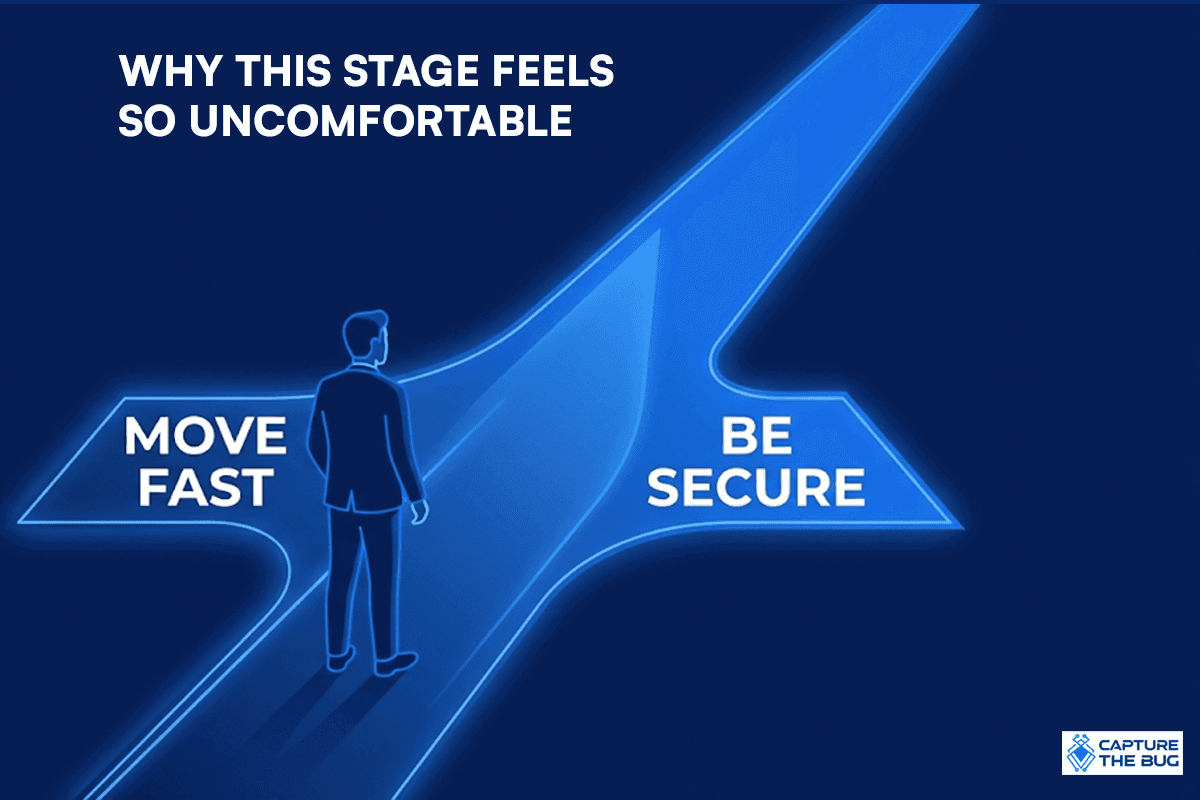
There is also a constant tension between speed and caution. Teams fear that investing too much in security will slow momentum. At the same time, they fear that doing too little will cost them deals, trust, or worse.
This is where many companies stall. They react, patch, and move on, hoping the next request will be further away.
The truth is simpler. Progress at this stage is not about doing everything. It is about doing a few things deliberately and doing them well.
The real constraint is not knowledge, it is resources
Most early-stage teams already know what "good security" looks like in theory. The issue is capacity. Budgets are tight. Headcount is limited. Time is fragmented. Security competes with product, sales, and customer delivery.
This leads to short-term decisions that make sense individually but create long-term drag. One-off fixes. One-time tests. Documents written and forgotten.
Security feels expensive because it is being rebuilt repeatedly instead of being layered intentionally. The goal at the partial stage is not maturity. The goal is momentum.
Building foundations without boiling the ocean
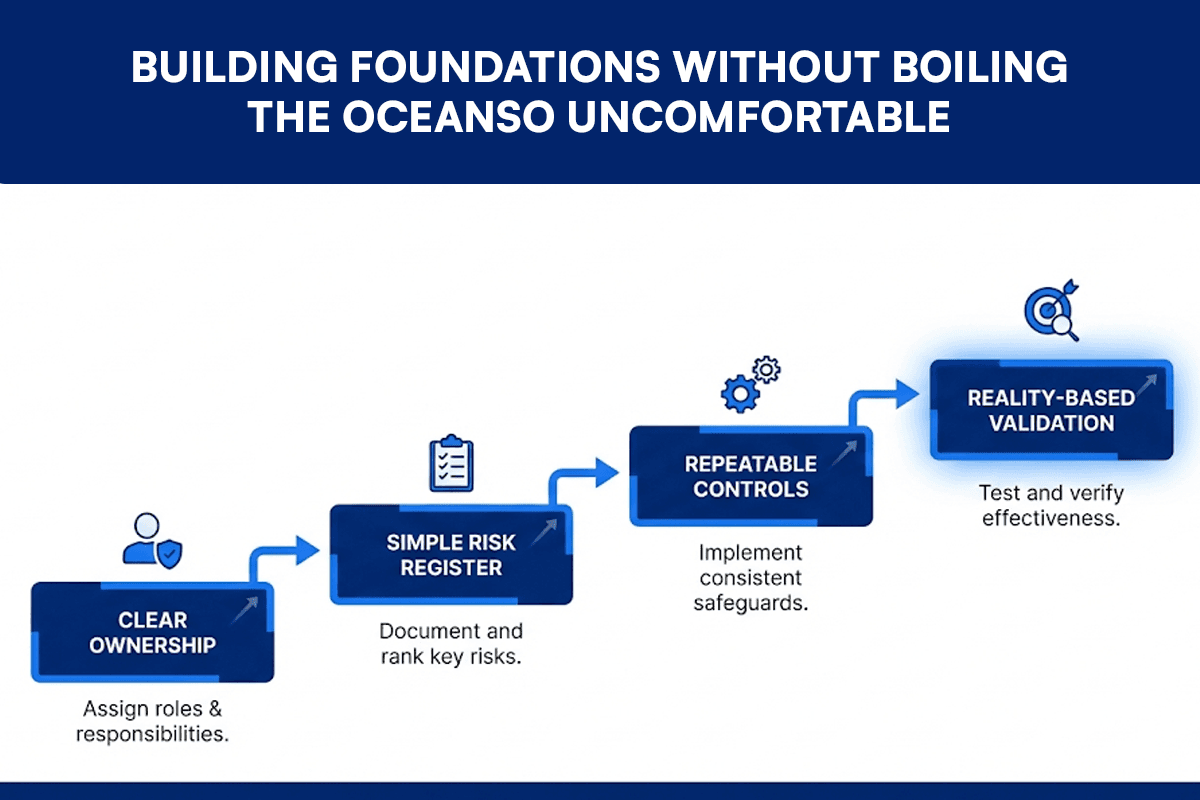
Moving forward does not require a full security department or a perfect framework. It requires clarity in a few key areas.
1. Establish clear ownership, even if it is part-time
Every security program needs a name next to it. Not a committee. Not a shared inbox. A person.
This does not mean hiring a full-time security leader on day one. It means assigning accountability. Someone who tracks decisions, maintains continuity, and represents security in planning conversations.
2. Turn scattered risks into a simple risk register
A basic risk register changes that. It does not need to be complex. It needs to answer three questions clearly:
- What is the risk?
- Why does it matter to the business?
- What are we doing about it right now?
3. Focus on repeatability, not perfection
At the partial stage, consistency matters more than depth. It is better to have a small set of controls that are applied the same way every time than a large set that no one remembers.
4. Validate reality, not assumptions
Early security programs often rely on assumptions. Validation replaces belief with evidence. Verify that controls work, fixes hold, and changes do not silently undo previous decisions.
How Capture The Bug supports this stage
Capture The Bug works with organizations precisely at this inflection point. Companies that are serious about security but realistic about constraints.
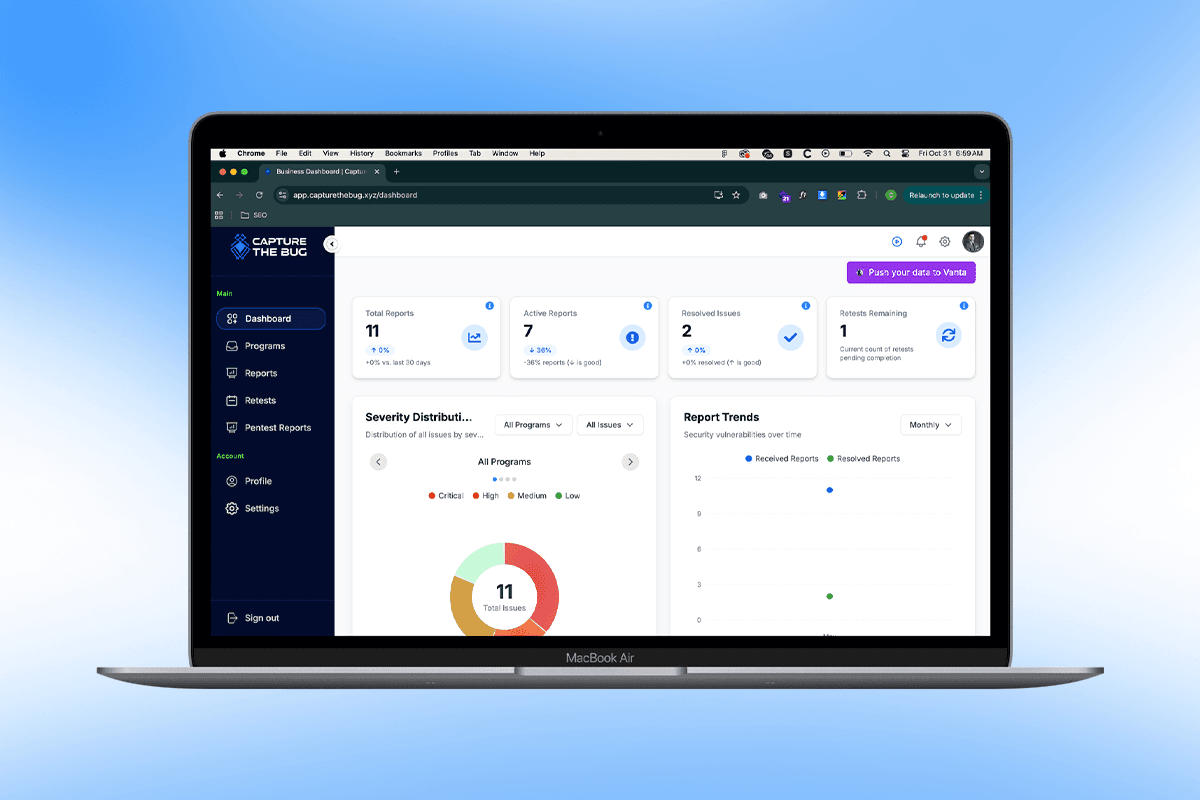
Instead of treating early security as a compliance sprint, the focus is on building confidence gradually. Clear ownership is supported through guided programs. Risk visibility is strengthened through consistent testing and reporting that shows what matters now.
Testing is aligned to growth, not fear. As systems evolve, visibility evolves with them. This prevents the common trap of rebuilding security from scratch every year.
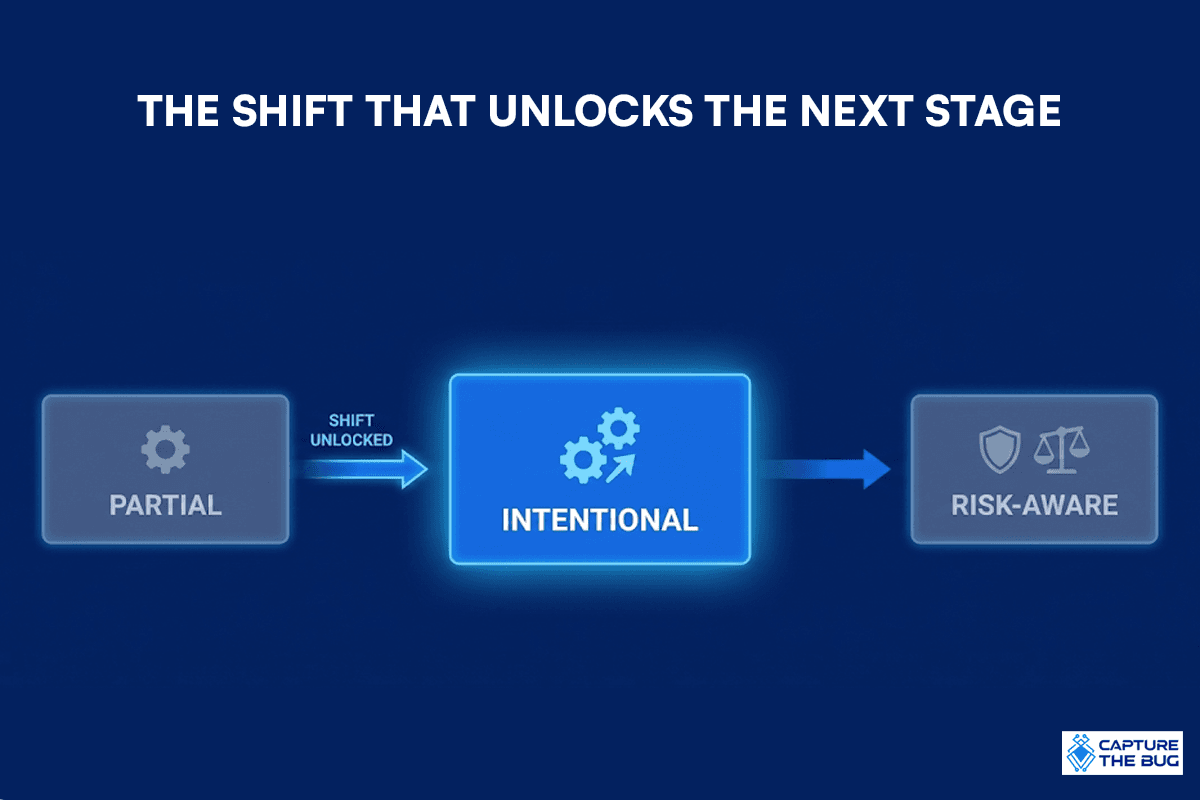
The shift that unlocks the next stage
The transition out of the partial stage does not happen when everything is perfect. It happens when security decisions stop being ad hoc.
- When risks are tracked over time.
- When ownership is clear.
- When testing informs strategy instead of reacting to pressure.
At that point, security becomes part of how the business thinks, not just how it responds. That is the real foundation.

Conclusion
Every strong security program started imperfectly. What separates mature organizations from stalled ones is not how early they invested, but how intentionally they built.
The partial stage is not something to rush through or hide. It is the moment where habits are formed. Build them with care, and everything that follows becomes easier.
FAQ
What is the partial stage in security maturity?
The partial stage is the early phase where security practices exist but are reactive, inconsistent, and driven by external pressure rather than internal strategy.
Is it risky to stay in the partial stage too long?
Yes. Staying reactive increases operational risk, slows audits, and weakens customer trust over time.
What is the first step to improving early security?
Clear ownership. Assigning responsibility creates continuity and prevents security from being treated as an afterthought.
Do startups need full security teams at this stage?
No. Most benefit more from clear accountability, basic structure, and consistent validation than from large teams.
How does Capture The Bug help early-stage security programs?
Capture The Bug helps teams validate their real security posture, build repeatable foundations, and demonstrate trust without unnecessary complexity.