Imagine a Wellington-based fintech closes its Series A in March. The founders did everything right. They ran a penetration test before the raise, got a clean report, impressed the investors, and signed on the dotted line. Twelve months later, their payment API has three new integrations, the team shipped six major releases, and a critical authorisation flaw has been sitting undetected since September.
The annual pentest is booked for April. The breach happens in February.
This is not a hypothetical edge case. It is a pattern that plays out across New Zealand, Australia, Fiji, and the broader Pacific region every year. The fault is not with the people involved. The fault is with a security model that was designed for a different era, one where code changed slowly, infrastructure was static, and a yearly snapshot was genuinely representative. In 2026, that model has a cost. And it is much higher than most leadership teams realise.
The Real Problem With the Annual Testing Model
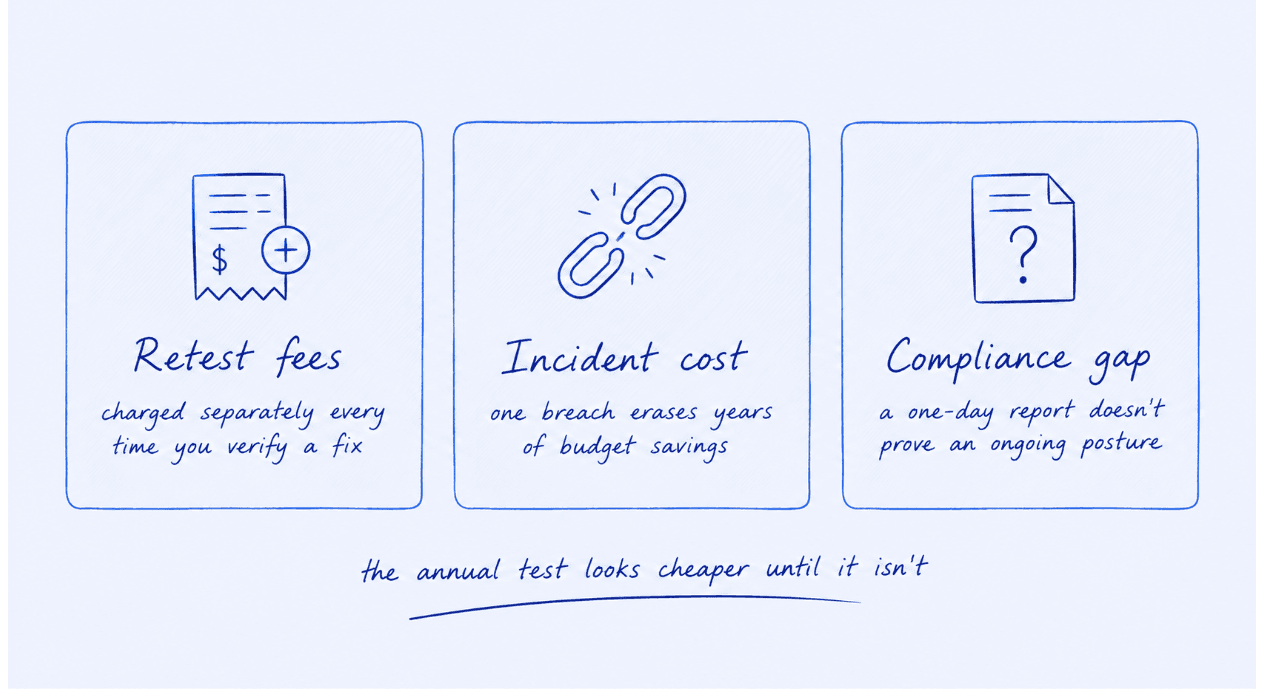
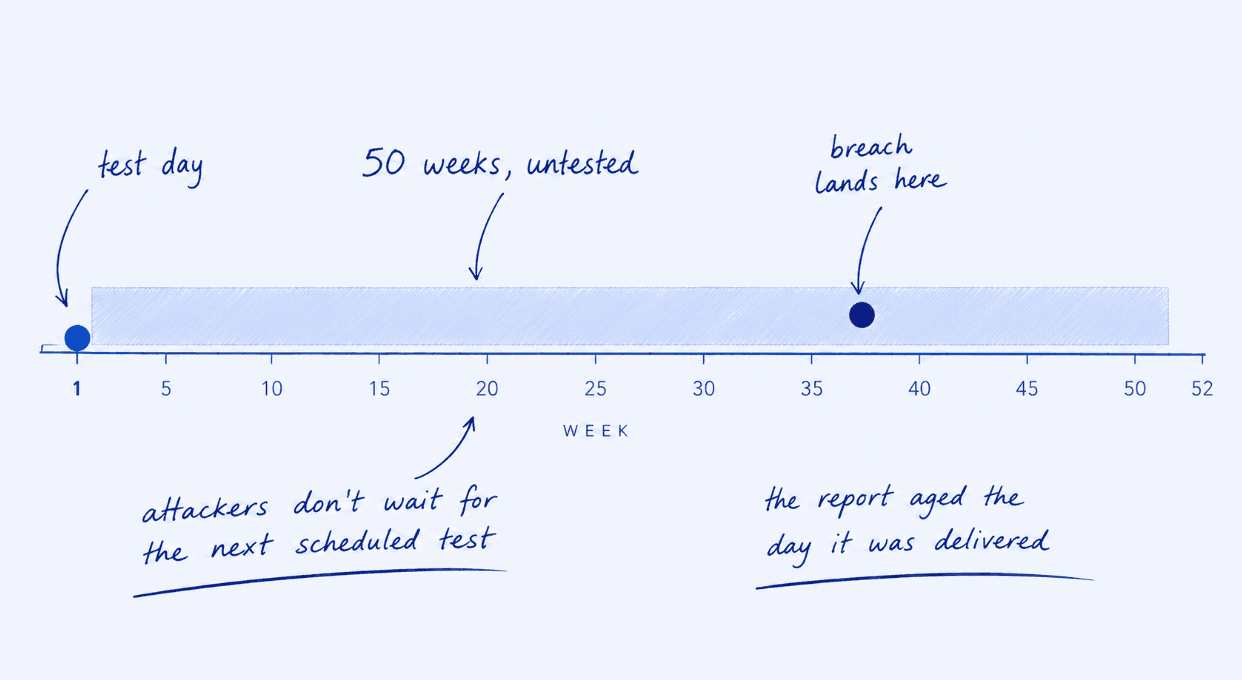
Traditional penetration testing works like this: a provider is engaged, a scope is agreed, testing runs for one to two weeks, a report is delivered, and the engagement closes. The report has value on the day it is produced. It starts losing relevance the moment the next line of code is committed.
For a SaaS product in active development, that can be daily.
A team shipping weekly is effectively operating blind for 50 of the 52 weeks they paid to cover. Every new feature, every third-party integration, every infrastructure change after the test date is untested territory. Attackers do not wait for the next scheduled assessment to look for weaknesses. They probe continuously. The model being used to defend against them is not built to match that pace.
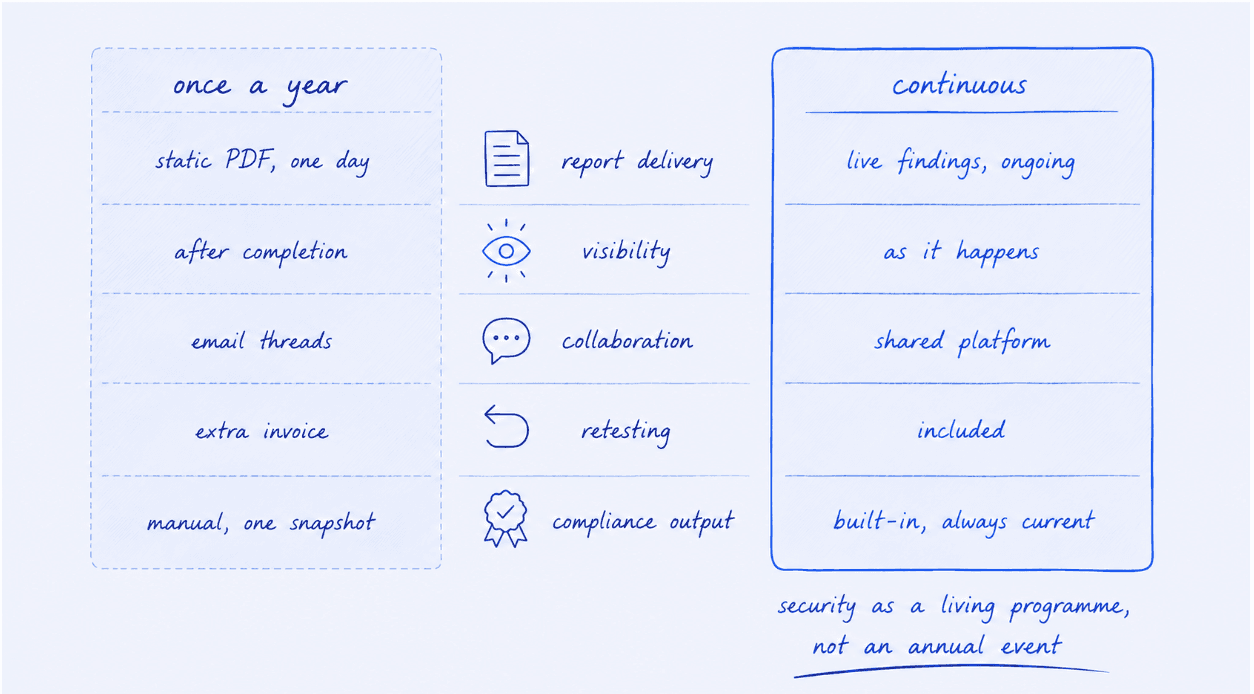
The traditional model also has a visibility problem. A PDF report tells a security lead what was found on one specific day. It does not tell them what was fixed, what was partially fixed, what was deprioritised, or what appeared after the fact. Accountability disappears into email threads and spreadsheets. Remediation becomes impossible to track with any confidence.
What Continuous Testing Actually Delivers
Penetration Testing as a Service changes the model from an event to an ongoing programme. Instead of one engagement per year with a final report, continuous testing means coverage that runs alongside the product as it grows.
What that looks like in practice is a shared dashboard where findings appear as they are identified, where the team and the testing provider are working from the same information at the same time, and where retesting to confirm a fix is part of the service rather than an additional invoice.
For a SaaS team shipping regularly, the value of this is immediate. A vulnerability found the week after a new feature ships is caught before it can be exploited. A fix that closes one issue but inadvertently opens another gets caught in the next cycle rather than in a breach notification.
For compliance-driven teams preparing for SOC 2 or ISO 27001, the value is the evidence trail. Instead of a single report from one day of testing, there is a documented programme of continuous security activity that an auditor can review. That documentation is built automatically rather than assembled manually before every audit. Capture The Bug's penetration testing services are built around this model, giving teams across ANZ and the Pacific the rigour of CREST-certified testing with the visibility of a live platform.
Your Last Pentest Is Already Out of Date
Every week you ship without continuous testing is a week a vulnerability goes unseen. See what Capture The Bug finds in your first engagement.
The Numbers That Shift the Comparison
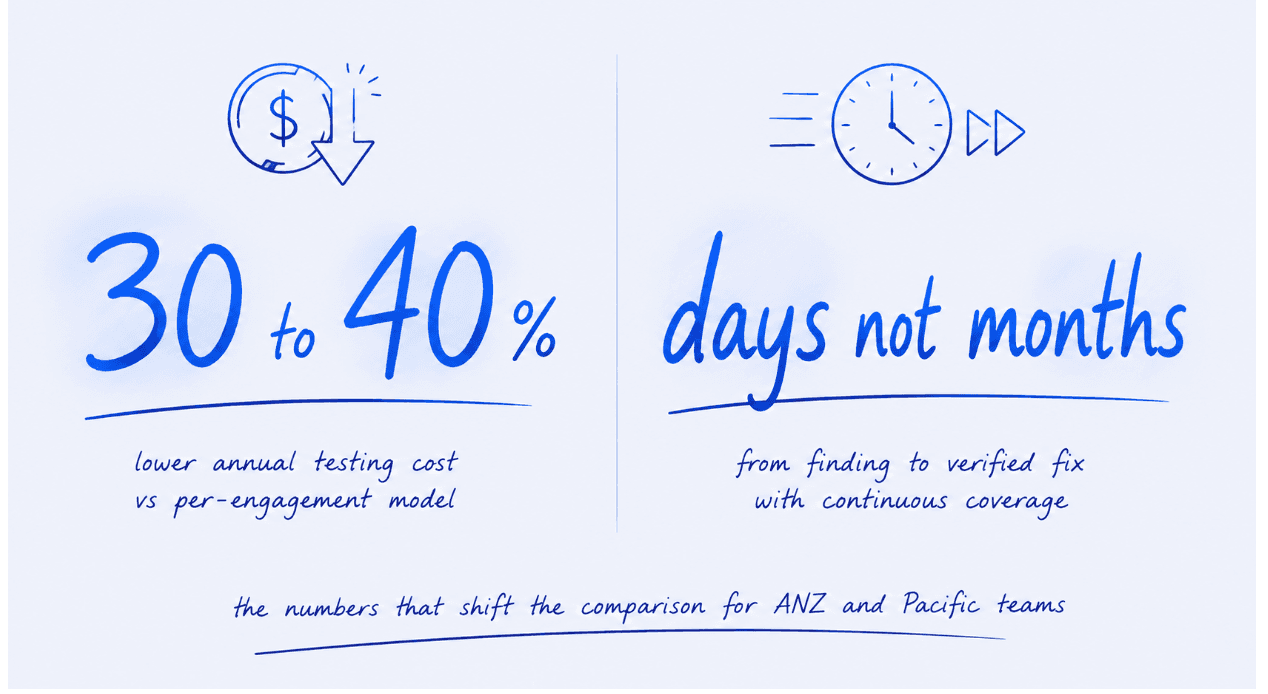
Across the companies Capture The Bug works with, continuous testing typically reduces annual testing-related costs by 30 to 40 percent compared to a traditional per-engagement model. The saving comes from eliminating redundant scoping, removing separate retest charges, and reducing the time engineering teams spend managing the back-and-forth with external vendors.
Beyond the direct cost saving, the risk reduction is the more significant number. Every week a critical vulnerability sits open is a week of exposure. Continuous coverage eliminates the majority of that window. Findings are surfaced faster, fixes are confirmed faster, and the gap between discovery and resolution shrinks from months to days.
For Pacific businesses operating in sectors where a single breach can trigger regulatory scrutiny from multiple jurisdictions, from the Reserve Bank of New Zealand to the Australian Prudential Regulation Authority, that reduction in exposure time is not just a security metric. It is a business continuity argument.
Why ANZ and Pacific Teams Are Making the Switch
New Zealand and Australian companies, and increasingly businesses in Fiji and across the Pacific, face a specific challenge that makes the annual testing model particularly risky. Many operate in industries where clients are global, compliance requirements span multiple frameworks, and the expectation from enterprise customers is that security is a continuous programme rather than an annual exercise.
A prospect in Singapore asking for security documentation during due diligence is not asking for a report dated fourteen months ago. They are asking for evidence that security is happening now. An annual penetration test cannot provide that. A continuous programme can.
The shift happening across the region is not driven by regulatory mandate alone. It is driven by commercial reality. Enterprise customers, insurance providers, and investors are all asking harder questions about security posture than they were three years ago. Teams that can answer those questions with a live dashboard and a documented remediation history close deals faster than teams that send a PDF. Capture The Bug's penetration testing services give ANZ and Pacific teams the answer to those questions, backed by CREST-certified rigour and real-time visibility.
The Question Worth Asking This Quarter
Every SaaS team, fintech, and compliance-driven organisation in New Zealand, Australia, Fiji, and the Pacific should ask one question before their next renewal cycle: what happened to their product between their last test date and today, and is any of it currently untested?
If the answer involves major releases, new integrations, infrastructure changes, or team growth, the answer to that question is almost certainly yes. Something is untested. The only variable is whether it gets found by the security programme or by someone else.
A conversation with the Capture The Bug team starts with exactly that question. Understanding the specific gap is the first step toward closing it, and it costs nothing to find out where the exposure actually sits. To explore what a continuous testing programme looks like for a specific product and team, visit Capture The Bug's penetration testing services and book a direct consultation.
Plan Your Annual Pentesting Strategy the Right Way
Learn how modern SaaS companies structure pentesting across the year to reduce risk, stay compliant, and avoid last-minute panic before audits.
FAQ
1. What is the difference between PTaaS and traditional penetration testing?
Traditional penetration testing is a one-time engagement that produces a static report. PTaaS, or Penetration Testing as a Service, is a continuous programme where testing runs alongside product development, findings appear in real time, and retesting is included as part of the service rather than billed separately.
2. Why does the gap between annual tests matter?
Every change made to a product after a test date is untested. For teams shipping regularly, that means the majority of the year is operating without verified security coverage. Attackers probe continuously, so a model that only checks once a year creates a significant window of undetected risk.
3. Is PTaaS more expensive than traditional pentesting?
When compared on a full-year basis including retest fees, remediation tracking, and compliance documentation, continuous PTaaS typically costs 30 to 40 percent less than running multiple traditional engagements to achieve comparable coverage.
4. Does continuous testing satisfy SOC 2 and ISO 27001 requirements?
Yes. Continuous testing produces a documented programme of security activity that satisfies auditors far more comprehensively than a single annual report. It provides the evidence trail that compliance frameworks are designed to require.
5. Which businesses in New Zealand and Australia should consider switching to PTaaS?
Any SaaS team shipping regularly, any fintech or compliance-driven business managing sensitive customer data, and any organisation preparing for SOC 2, ISO 27001, or PCI DSS certification should evaluate PTaaS. The model is particularly relevant for businesses that are growing quickly and cannot afford the risk exposure that comes with annual testing cycles.
6. Does Capture The Bug operate in Fiji and the broader Pacific region?
Yes. Capture The Bug works with clients across New Zealand, Australia, Fiji, and the wider Pacific, providing CREST-certified penetration testing with the regional understanding that sector-specific compliance requirements demand.