
Automotive Cybersecurity: Securing the Connected Vehicle Revolution
The automotive industry faces unprecedented cybersecurity challenges as vehicles transform into sophisticated connected computers on wheels. With up to 100 million lines of code and increasing wireless connectivity, modern vehicles present complex attack surfaces that require specialized security assessment approaches to protect against evolving cyber threats.
The Connected Vehicle Threat Landscape
Transportation systems have become prime targets for cybercriminals, with major cyberattacks increasing 48% over five years, from 12 incidents in 2020 to 60 projected for 2025. Only 19% of drivers feel secure about their connected vehicles, while 76% fear remote hacking attempts, highlighting the urgent need for comprehensive automotive cybersecurity strategies.
Primary Attack Vectors:
- Infotainment system vulnerabilities enabling remote vehicle control
- Over-the-air (OTA) update system exploitation for malicious code injection
- Bluetooth and Wi-Fi network attacks targeting wireless communications
- On-board diagnostics (OBD) port exploitation through physical access
- Key fob relay attacks bypassing keyless entry systems
- Electronic Control Unit (ECU) tampering and firmware modifications
The consequences extend beyond data theft to physical safety risks, with demonstrated attacks achieving remote control of critical vehicle functions including steering, braking, and engine systems.
AI Integration: Revolutionary Capabilities, New Risks
Artificial intelligence integration in vehicles unlocks transformative capabilities while introducing significant cybersecurity risks. AI-powered voice assistants face prompt injection attacks that could manipulate vehicle commands, while onboard AI deployment creates hardware-specific vulnerabilities in chip-based accelerators.
AI-Specific Threats:
- Voice command manipulation through audio injection attacks
- Machine learning model poisoning affecting autonomous driving decisions
- AI-powered reconnaissance enabling personalized social engineering
- Sensor manipulation deceiving autonomous vehicle decision-making systems
- Neural network backdoors compromising safety-critical AI functions
Attackers increasingly leverage AI to enhance their own capabilities, creating sophisticated phishing campaigns and automated vulnerability discovery tools that target connected vehicle ecosystems.
One platform to manage, track, and secure all your penetration tests.
Simplify your vulnerability management with Capture The Bug’s PTaaS platform where businesses and security experts collaborate seamlessly.
Electric Vehicle Charging Infrastructure Vulnerabilities
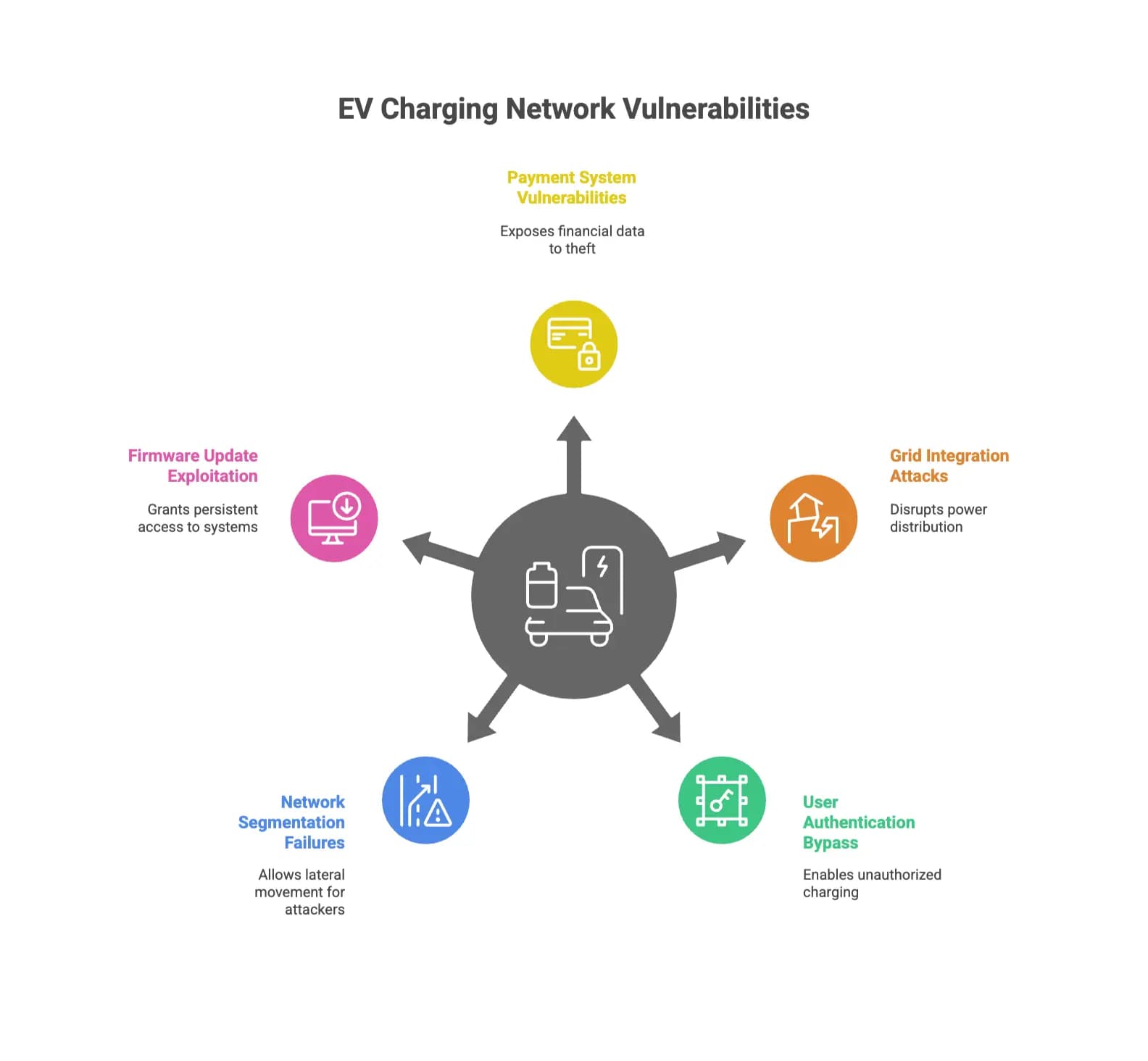
EV charging networks represent emerging hotspots for cyberthreats, with predictions that charging infrastructure will become primary targets for data theft and system hijacking. These networks handle payment data, user profiles, and grid integration controls that create attractive targets for cybercriminals.
Charging Infrastructure Risks:
- Payment system vulnerabilities exposing financial data
- Grid integration attacks affecting power distribution
- User authentication bypass enabling unauthorized charging
- Network segmentation failures allowing lateral movement
- Firmware update mechanisms targeted for persistent access
The interconnected nature of charging networks means successful attacks can cascade across multiple locations and impact regional power systems.
Autonomous Vehicle Security Challenges
Autonomous vehicles face unique security challenges where cyberattacks can directly impact physical safety. Attackers target sensor systems, decision-making algorithms, and communication protocols to disrupt traffic flow or cause accidents through systematic manipulation.
Autonomous System Vulnerabilities:
- LIDAR and camera sensor spoofing attacks
- GPS manipulation causing navigation errors
- V2X communication interference disrupting traffic coordination
- Machine learning model attacks affecting driving decisions
- Remote emergency override system exploitation
These attacks require sophisticated understanding of both cybersecurity and automotive engineering, making professional security assessment essential for autonomous vehicle deployment.
Experience Capture The Bug Platform
Streamline your security testing with our PTaaS platform. Collaborate with expert testers, track vulnerabilities, and secure your applications effortlessly.
Supply Chain and Platform Standardization Risks
Platform standardization across automotive manufacturers creates systemic vulnerabilities where single flaws can affect millions of vehicles simultaneously. Interconnected supply chains increase the risk of vulnerabilities propagating across entire automotive ecosystems.
Supply Chain Attack Vectors:
- Third-party component compromises affecting multiple manufacturers
- Software update mechanisms targeted for widespread distribution
- Component authentication bypasses enabling counterfeit parts
- Development tool compromises injecting vulnerabilities at source
- Vendor access management failures enabling lateral movement
The automotive supply chain's complexity requires comprehensive security assessment covering all suppliers and integration points.
Physical Attack Methods and Countermeasures
Physical access to vehicles creates multiple attack vectors that remote security measures cannot address. Professional security testing must evaluate physical security controls alongside digital protections to provide comprehensive coverage.
Physical Security Assessments:
- OBD-II port security and access controls
- USB and media port exploitation testing
- ECU tampering detection and prevention
- Key fob security and relay attack mitigation
- Physical network access point security
- Aftermarket modification security implications
Testing methodologies must simulate real-world scenarios where attackers have varying levels of physical access to target vehicles.
Regulatory Compliance and Standards
The UN-ECE WP.29 regulation mandates cybersecurity management systems for automotive manufacturers, requiring risk assessment, monitoring, and incident response capabilities. Compliance requires demonstrable security testing and continuous vulnerability management.
Key Regulatory Requirements:
- Cybersecurity management system implementation
- Risk assessment and threat analysis documentation
- Security monitoring and incident response procedures
- Type approval processes including cybersecurity validation
- Software update security requirements and testing
Professional security assessment helps manufacturers meet regulatory obligations while identifying vulnerabilities that could impact type approval processes.
Professional Security Testing Methodologies
Automotive cybersecurity requires specialized testing approaches that address both traditional IT security and operational technology unique to vehicles. Testing must consider safety implications while maintaining comprehensive security coverage.
Specialized Testing Areas:
- In-vehicle network security assessment covering CAN, LIN, and Ethernet protocols
- Wireless communication security testing for cellular, Wi-Fi, and Bluetooth interfaces
- Infotainment system penetration testing including mobile app integrations
- Telematics platform security assessment for remote services
- ECU firmware analysis and reverse engineering for vulnerability identification
Expert testing combines automotive domain knowledge with cybersecurity expertise to identify vulnerabilities that automated tools cannot detect.
Business Impact and Risk Management
Automotive cyberattacks create cascading impacts including production shutdowns, recall costs, regulatory fines, and reputation damage. Recent attacks on major manufacturers have caused weeks-long production halts and millions in recovery costs.
Business Continuity Considerations:
- Manufacturing system resilience against cyber disruption
- Customer data protection and privacy compliance
- Brand reputation management during security incidents
- Supply chain partner security coordination
- Insurance and liability considerations for connected vehicle risks
Organizations need comprehensive risk management strategies that address both immediate security threats and long-term business continuity requirements.
Future Threat Evolution
Underground forums reveal constantly evolving automotive attack techniques, with car theft advancing beyond traditional mechanical methods to sophisticated electronic exploitation. The democratization of hacking tools makes advanced attacks accessible to less skilled criminals.
Emerging Threat Patterns:
- Standardized attack tools targeting common automotive platforms
- AI-enhanced attack automation reducing technical skill requirements
- Cross-platform vulnerabilities affecting multiple manufacturers
- Integration point attacks targeting connected service ecosystems
- Persistent threat campaigns focusing on automotive supply chains
Professional security assessment must anticipate these evolving threats and validate defensive measures against sophisticated attack scenarios.
Frequently Asked Questions
FAQ 1: How can automotive manufacturers protect against the increasing sophistication of vehicle cyberattacks?
Manufacturers should implement comprehensive security-by-design approaches including regular penetration testing, secure development practices, robust OTA update mechanisms, and continuous monitoring systems. Professional security assessment covering both physical and digital attack vectors is essential for identifying vulnerabilities before attackers exploit them in the wild.
FAQ 2: What unique challenges does automotive cybersecurity present compared to traditional IT security?
Automotive cybersecurity must address safety-critical systems where attacks can cause physical harm, complex supply chains with numerous integration points, regulatory compliance requirements specific to transportation, and the challenge of securing devices with 15+ year lifespans. Unlike traditional IT, automotive systems require specialized testing approaches that understand both cybersecurity and automotive engineering.
About Capture The Bug
Capture The Bug is New Zealand's home-grown PTaaS platform, combining CREST-certified expertise with continuous vulnerability management. Built for modern engineering teams, it delivers live dashboards, instant retests, and measurable assurance — replacing static reports with real-time visibility.
Learn more: capturethebug.xyz