A CISO at a fast-growing SaaS company in Melbourne received a penetration testing report from a new provider. The findings were delivered within 48 hours of the engagement starting. Fourteen vulnerabilities, neatly categorised, with severity ratings and suggested remediation steps. The report looked thorough. The team got to work.
Three weeks into remediation, a senior engineer noticed something. Four of the fourteen findings described vulnerabilities that did not match the actual behaviour of the application. The authentication logic flagged in one finding had been correctly implemented for over a year. Two API vulnerabilities described attack paths that the application's architecture made structurally impossible. One finding referenced a third-party library version the team had not used in eighteen months.
The report had not been wrong due to carelessness. It had been generated fast and with genuine technical capability, but without the human contextual reasoning to distinguish what was theoretically possible from what was actually exploitable in this specific application.
The team spent two weeks validating which findings were real before they could start fixing the ones that were.
This is not an isolated story. It is what happens when speed replaces verification.
What the Current Research Actually Shows
The market for fast, broad penetration testing coverage is growing quickly, and the tools producing that coverage have become genuinely sophisticated. For organisations in New Zealand, Australia, Fiji, and the Pacific navigating a landscape where attack surfaces expand faster than security teams can manually review them, broader coverage at higher frequency has real value.
But coverage and confidence are not the same thing.
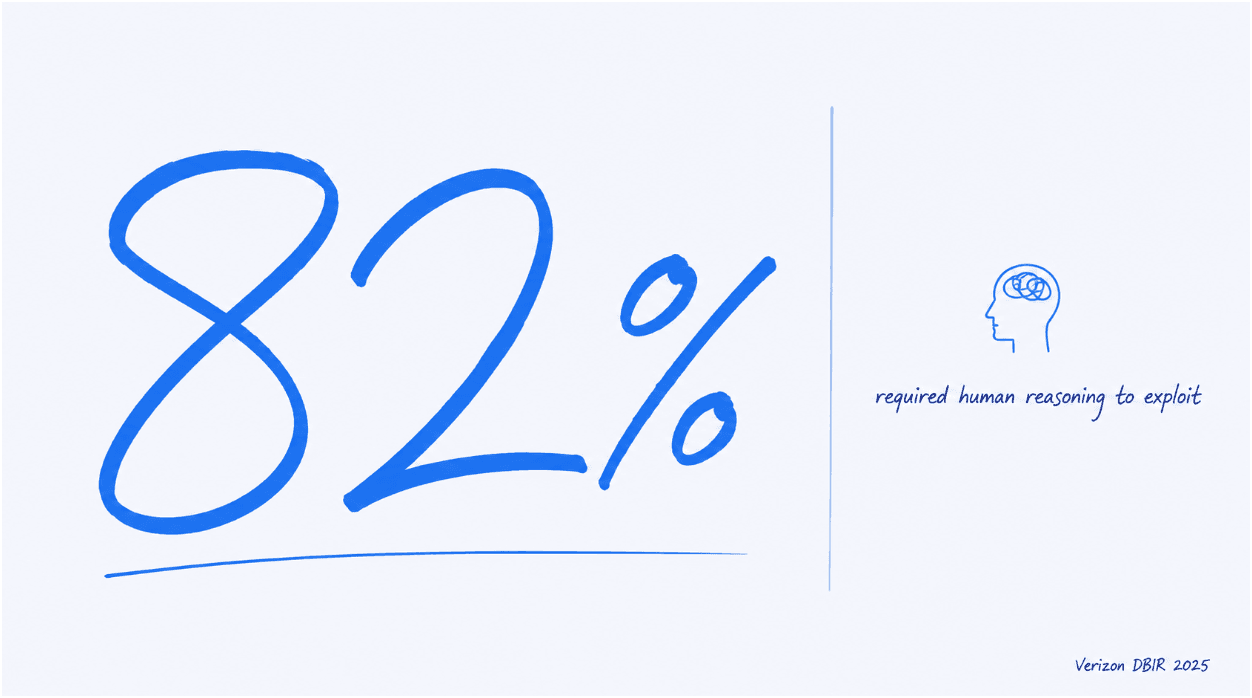
The Verizon DBIR 2025 report shows 82 percent of exploited vulnerabilities required human reasoning to identify and validate. That figure reflects a structural reality that no amount of testing speed resolves on its own. Business logic vulnerabilities, authorisation flaws, and context-specific weaknesses require a tester who understands what the application is supposed to do, not just what it technically exposes.
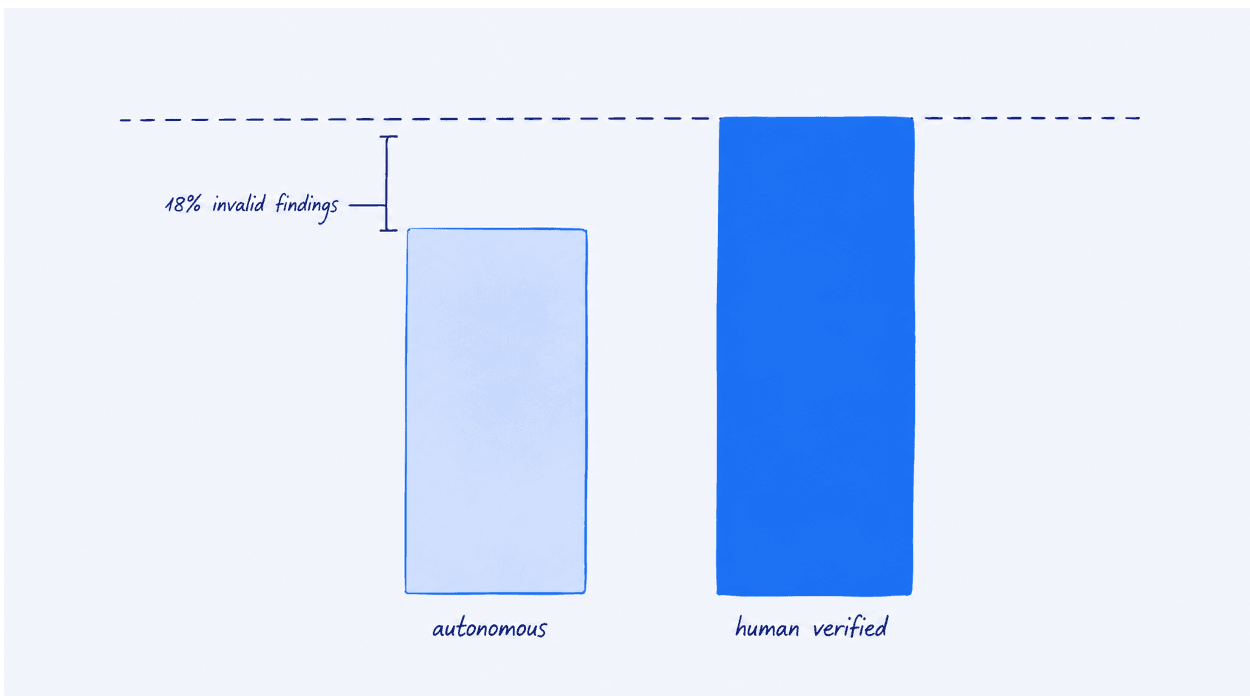
The best autonomous pentest agent measured in a live enterprise environment in the Stanford ARTEMIS study submitted 18 percent invalid findings, while the top human testers on the same network achieved 100 percent validity. That 18 percent gap sounds manageable in isolation. For an engineering team acting on every finding in a critical system, it means one in five remediations starts with a false premise. For a compliance report submitted to a SOC 2 assessor or an enterprise customer's security team, it means credibility risk on every finding that cannot be independently verified. Support for fully automated pentesting has collapsed from 29 percent to 9 percent in a year. 47 percent of security teams now prefer a hybrid model where humans validate findings before they reach engineers. The market has tried the fully autonomous approach at scale and drawn its own conclusion.
The Specific Problems That Require a Human
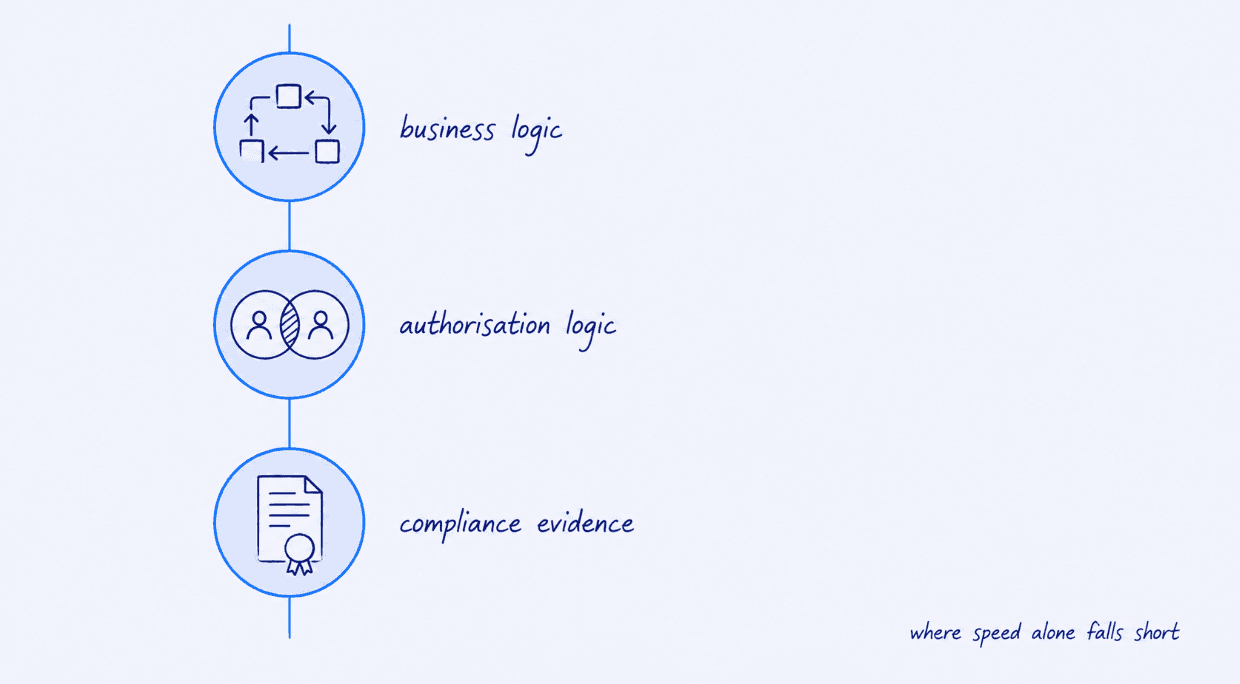
Speed and breadth are genuine strengths of fast testing tools. There are specific categories of vulnerability, however, where removing human expertise from the verification process does not just reduce quality. It produces findings that are either wrong or incomplete in ways that matter commercially and operationally.
Business logic vulnerabilities are the clearest example. These are flaws in the way an application is designed to behave, not in the underlying technology it runs on. A payment flow that allows a user to complete a transaction without triggering the correct authorisation check is a business logic flaw. A multi-step process where completing step three without step two produces an unintended outcome is a business logic flaw. These are not theoretical vulnerabilities that show up in a library version check. They require a tester to understand the intended behaviour of the application and then reason about what happens when that behaviour is circumvented.
Autonomous pentesting struggles with high false positives, business logic vulnerabilities, and creative exploit chaining. It fails against advanced defences like SSL pinning. A tester who has spent time in the application, who understands the user roles and the transaction flows, finds these flaws. A process that has not modelled the application's intended behaviour will miss them.
Authorisation logic is the second category. The question of who can access what, under which conditions, and what happens when those conditions are not met correctly is one of the most consequential security questions for any SaaS product handling sensitive data. 78 percent of security teams saw fully automated tools miss critical vulnerabilities in the last year. Authorisation failures are disproportionately represented in that figure because they require reasoning about the relationship between user roles, data access, and application state, not just scanning for known patterns. Compliance evidence is the third. An auditor reviewing a SOC 2 report, a PCI DSS assessor evaluating testing evidence, or an enterprise security team conducting due diligence on a vendor all want to know one thing: was this finding real, and was the remediation verified? A finding that was generated quickly but never validated by a human tester creates friction in every one of those conversations. A finding that was verified, documented, and retested by a CREST-certified tester travels through compliance and due diligence processes without friction because it carries the accountability of a qualified professional behind it.
Your Last Pentest Is Already Out of Date
Every week you ship without continuous testing is a week a vulnerability goes unseen. See what Capture The Bug finds in your first engagement.
What Human Verification Actually Adds
Verification is not a second pass through the same findings. It is a fundamentally different kind of assessment.
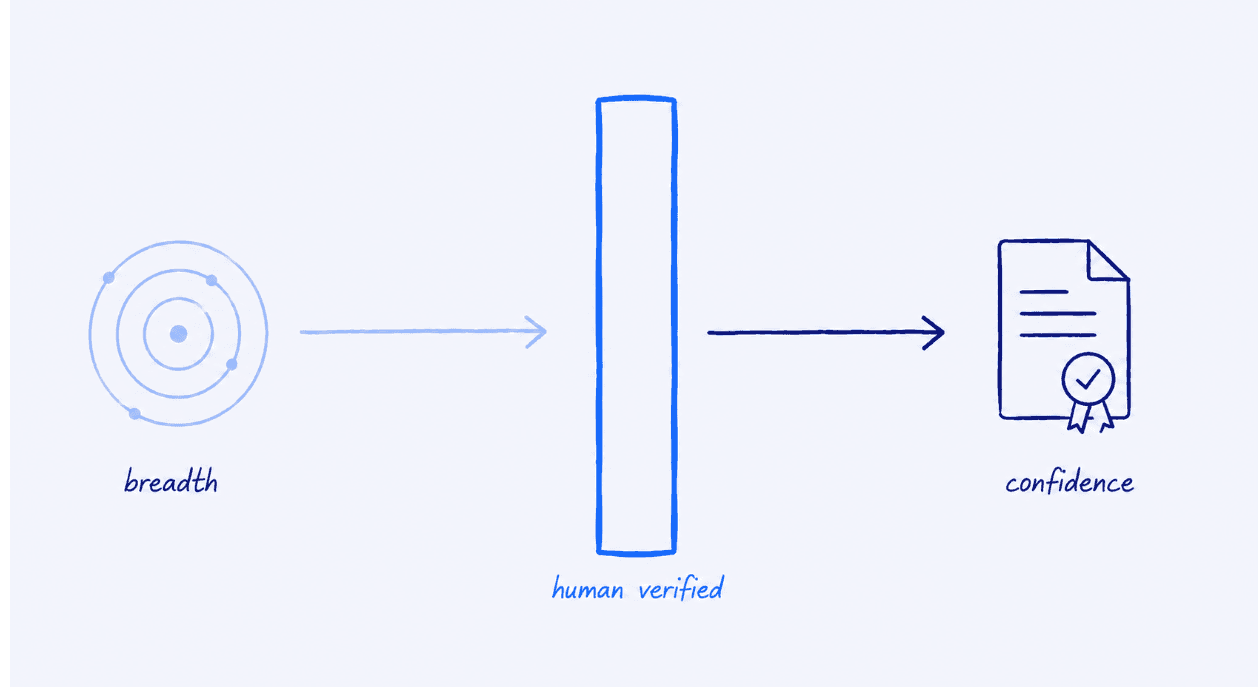
A CREST-certified tester reviewing a flagged finding is not just confirming that the technical vulnerability exists. They are asking whether it is actually exploitable in this environment, against this application, with this data model. They are assessing what the real-world business impact would be if an attacker exploited it. They are evaluating whether the finding chains to other findings in a way that creates a more serious composite risk than any single item suggests. And they are making a professional judgement that their certification holds them accountable for. That accountability is what makes the output useful for compliance. In 2026, the clear model is that autonomous agents own breadth and continuous coverage while human experts own validation, judgement, and regulatory sign-off. The market has arrived at this division not through ideology but through experience with what each approach produces in practice. Capture The Bug's penetration testing services are built on exactly this model. Broad coverage, continuous assessment, and human-verified findings from CREST-certified testers who take professional accountability for every finding that reaches the client's team. The report that comes out of that process is not just a list of vulnerabilities. It is a document that an auditor, an enterprise customer, or a board can rely on because a qualified professional has stood behind every line of it.
Why the ANZ and Pacific Market Is Particularly Exposed
For companies in New Zealand, Australia, Fiji, and the broader Pacific, the risk of unverified findings carries specific commercial consequences.
Enterprise clients in the US, Singapore, and the UK who are conducting vendor due diligence are increasingly asking whether the provider's penetration testing is from a CREST-certified organisation. They are not asking whether testing was conducted quickly or at scale. They are asking whether a qualified professional verified the findings. A report full of unverified or invalid findings creates exactly the kind of friction that delays or blocks enterprise deals.
Compliance frameworks including SOC 2, ISO 27001, and PCI DSS require credible, independent, qualified security assessment. Unverified findings from an autonomous process, however fast or sophisticated, do not carry the independent professional accountability that those frameworks require. For companies in the ANZ and Pacific region using penetration testing to build and maintain their compliance programmes, the credibility of the output is not secondary to the speed of delivery. It is the primary requirement. Capture The Bug's penetration testing services give companies across New Zealand, Australia, Fiji, and the Pacific the combination of broad, continuous coverage and human-verified, CREST-certified findings that both compliance and commercial confidence demand.
The Question Every Leadership Team Should Ask
Before the next penetration test report lands, every security-conscious leadership team in the ANZ and Pacific region should ask one question: when the findings in this report are presented to an auditor, an enterprise customer, or the board, can the team stand behind every one of them as verified, real, and actionable? If the answer requires any qualification, human verification is not an optional add-on. It is the requirement that the rest of the programme depends on. That is the conversation the Capture The Bug team starts with every prospective client across the region: what does your team need the findings to be good for, and what level of verification does that use case require? Visit Capture The Bug's penetration testing services to start that conversation.
Plan Your Annual Pentesting Strategy the Right Way
Learn how modern SaaS companies structure pentesting across the year to reduce risk, stay compliant, and avoid last-minute panic before audits.
FAQ
1. What is autonomous penetration testing and how does it differ from human-led testing?
Autonomous penetration testing uses software agents to probe systems and identify vulnerabilities without continuous human involvement during the testing process. Human-led testing involves qualified security professionals who apply contextual reasoning, business logic understanding, and professional judgment to both identify and validate findings. The critical difference is verification: human testers can confirm whether a finding is genuinely exploitable in a specific environment, while autonomous processes can produce findings that are theoretically valid but practically incorrect for a given application.
2. What percentage of vulnerabilities require human reasoning to identify correctly?
The Verizon DBIR 2025 report found that 82 percent of exploited vulnerabilities required human reasoning to identify and validate. This reflects the structural limitation of autonomous testing in complex, context-dependent environments such as business logic, multi-role authorisation, and application-specific attack chains.
3. How accurate are autonomous pentesting tools compared to human testers?
The Stanford ARTEMIS study found that the best autonomous pentest agent submitted 18 percent invalid findings in a live enterprise environment, while top human testers achieved 100 percent validity on the same network. Separately, 78 percent of security teams reported that fully automated tools missed critical vulnerabilities in the past year, according to the Cobalt AI and Pentesting Pulse Report 2026.
4. Do compliance frameworks like SOC 2 and ISO 27001 accept autonomous pentesting results?
Compliance frameworks require credible, independent, and qualified security assessment. Unverified autonomous findings do not carry the professional accountability that SOC 2 assessors, ISO 27001 auditors, and PCI DSS Qualified Security Assessors expect. CREST-certified human-verified testing produces the documentation and professional sign-off that these frameworks recognise as authoritative.
5. Why is human verification important for enterprise due diligence in the ANZ market?
Enterprise customers in the US, Singapore, and internationally conducting vendor security due diligence increasingly ask specifically for CREST-certified testing evidence. Unverified or invalid findings create friction in due diligence processes and can delay or block enterprise deals. Human-verified findings from a CREST-certified provider carry the professional accountability that enterprise procurement teams and their security reviewers require.
6. Does Capture The Bug operate in Fiji and the Pacific region?
Yes. Capture The Bug provides CREST-certified penetration testing with human-verified findings across New Zealand, Australia, Fiji, and the broader Pacific region, with compliance documentation suited to SOC 2, ISO 27001, PCI DSS, and enterprise due diligence requirements.