
Why Connected Devices Break Under Real Security Testing

The Reality Nobody Talks About
In boardrooms, IoT security often sounds "covered." There's a checklist, maybe a certification, sometimes even a prior security test.
But when Capture The Bug's testers actually interact with these devices, the story changes fast. Devices that passed internal reviews fail within hours.
Not because attackers are advanced, but because the fundamentals are weak.
This gap between perceived security and real-world exposure is where most IoT risk lives. And it's growing.
Why IoT Devices Are Uniquely Fragile
Unlike web apps or cloud systems, IoT devices live in messy environments. They connect to networks you don't control, run firmware you rarely update, and often prioritize functionality over security.
That combination creates a perfect testing ground for failure. Here's what consistently shows up during real engagements.
1. Weak Authentication Is Still Everywhere
One of the most common findings is also the simplest. Default credentials. Hardcoded passwords. Shared access across devices.
In many cases, login mechanisms are either predictable or bypassable. Capture The Bug testers regularly encounter devices where:
- Admin panels accept weak or reused passwords
- Authentication tokens never expire
- Role separation simply doesn't exist
From a business perspective, this means anyone who gains access once can often stay indefinitely. This is not a theoretical risk. It is a direct path to control.

2. Firmware That Nobody Really Tests
Firmware is the brain of an IoT device, but it's often the least scrutinized. Why? Because it's harder to access, harder to reverse, and rarely part of standard security workflows.
Pentesters approach it differently. They extract firmware, analyze it offline, and look for:
- Embedded credentials
- Debug endpoints left exposed
- Outdated libraries with known weaknesses
What they find is surprising. In many cases, devices ship with secrets baked directly into the code. Once exposed, those secrets can be reused across entire device fleets.

3. APIs That Trust Too Much
IoT devices depend heavily on APIs. Mobile apps, dashboards, and backend systems all communicate through them. The problem is not the existence of APIs. It's how much they trust incoming requests.
During testing, Capture The Bug often identifies endpoints that accept unauthenticated requests or data exposure through predictable API calls.
In practice, this means an attacker doesn't need physical access to the device. They can interact with it remotely, often without being detected. For SaaS-connected IoT products, this becomes a platform-wide risk.
4. Insecure Communication Channels
Many IoT devices still communicate over insecure or poorly configured channels. This creates opportunities for interception. Pentesters simulate real-world conditions such as public WiFi environments or internal network access.
And what happens next is predictable. Sensitive data travels in plain text. Session tokens are exposed. In one scenario, testers were able to modify device behavior simply by sitting on the same network.
5. Physical Access Changes Everything
Unlike cloud systems, IoT devices exist in the real world. And that changes the threat model completely. If someone can touch the device, they can often access debug ports, extract firmware directly, or reset controls.
Capture The Bug testers treat physical access as a realistic scenario, not an edge case. Retail environments, logistics, healthcare devices, and manufacturing systems all expose hardware. Once physical access is combined with weak software controls, security breaks quickly.
6. No Visibility After Deployment
One of the biggest blind spots is what happens after devices are shipped. Most organizations don't track security posture in real time or monitor device-level vulnerabilities.
A device that was "secure enough" at launch may become vulnerable weeks later due to new integrations or emerging attack methods. Without continuous visibility, teams are operating on outdated assumptions.
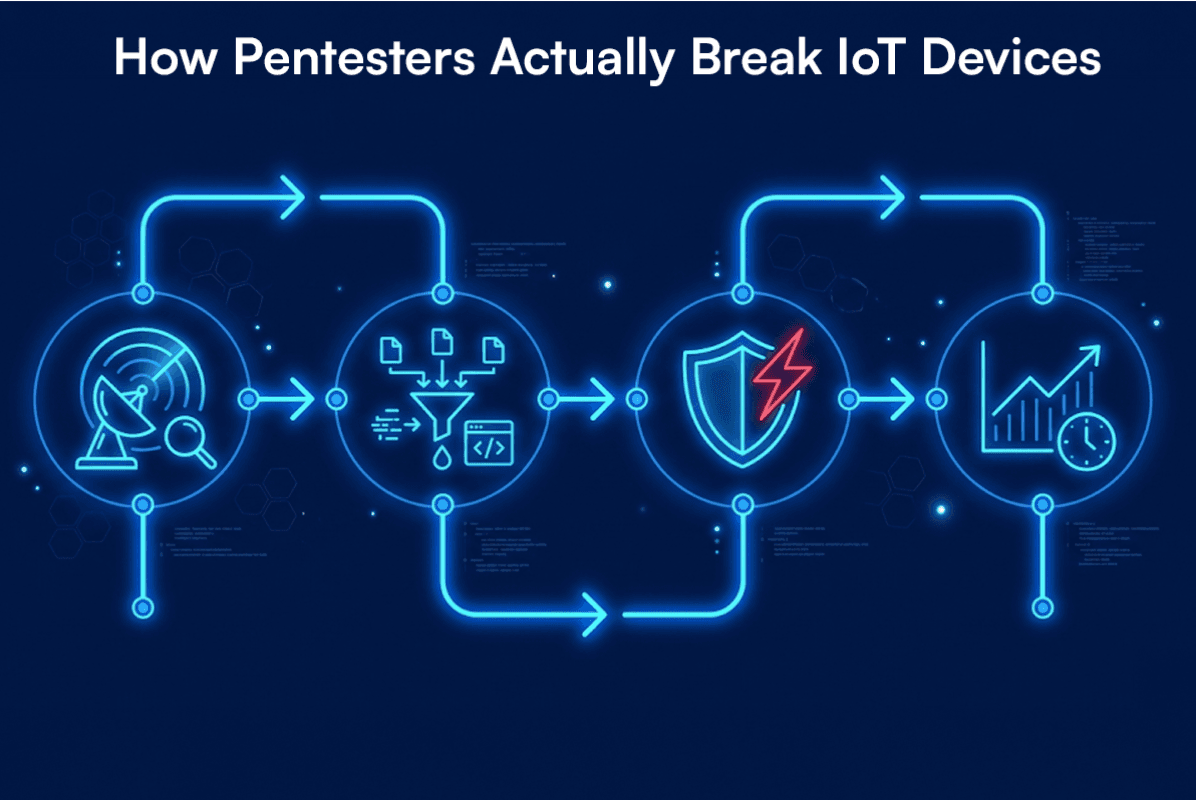
How Pentesters Actually Break IoT Devices
There's a misconception that breaking into devices requires complex techniques. In reality, most successful tests follow a simple pattern:
- Understand the Ecosystem: Map how the device connects to apps, APIs, and cloud services.
- Identify the Weakest Entry Point: This is rarely the device itself; it's often the API or authentication layer.
- Escalate Access: Move laterally from user to admin, or from one device to many.
- Validate Real Impact: Prove what an attacker could actually do—turn off devices, access sensitive data, or control operations.
The Bigger Problem: Security Was Never Designed In
Most IoT failures come down to one core issue: Security is added later. Devices are built for speed to market, cost efficiency, and user convenience. Security becomes a layer on top, not a foundation.
"The companies that pass real testing do a few things differently. They treat pentesting as a continuous process, not a checkbox."
They test devices alongside APIs and cloud systems, retest after updates, and prioritize real-world attack scenarios. This aligns with the shift toward continuous pentesting models providers ongoing insight.
Where Capture The Bug Fits In
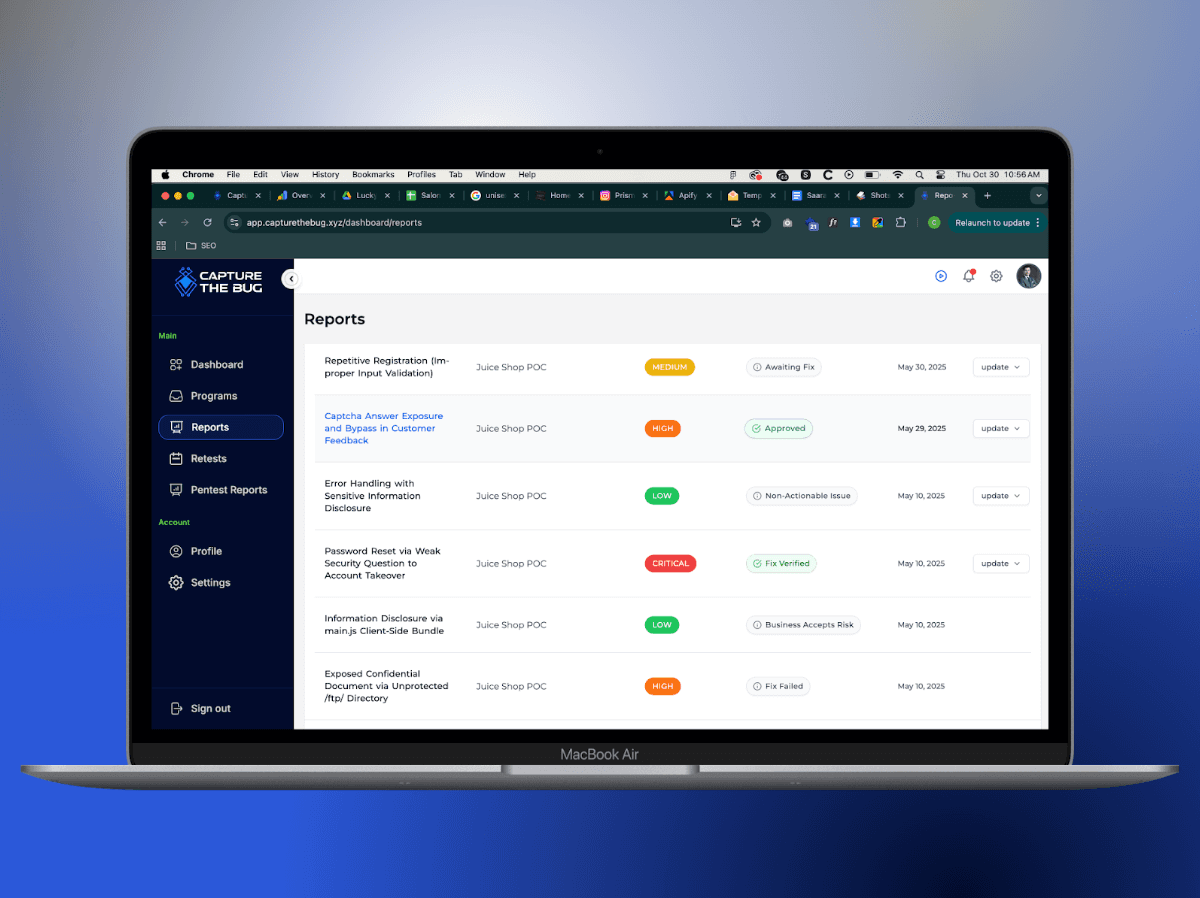
Capture The Bug approaches IoT security the same way attackers do: not as isolated devices, but as connected systems. Through its PTaaS model, organizations get:
- Ongoing testing across devices, APIs, and infrastructure
- Real-time visibility into vulnerabilities
- Direct collaboration with testers to understand and fix issues
Final Thoughts
IoT devices don't fail because attackers are too advanced. They fail because basic weaknesses go unnoticed until someone tests them properly.
The real question is not whether your devices will pass a test. It's whether you're testing them in a way that reflects reality. Because in IoT security, what you don't see is exactly what gets exploited.
FAQ
1. Why do IoT devices fail penetration testing?
Most IoT devices fail due to weak authentication, insecure APIs, outdated firmware, and lack of real-world testing scenarios.
2. What are the most common IoT security vulnerabilities?
Common issues include hardcoded credentials, insecure communication, exposed APIs, and lack of firmware validation.
3. How do pentesters test IoT devices?
They analyze device firmware, test APIs, simulate network attacks, and attempt privilege escalation to understand real-world impact.
4. Is IoT security testing different from web application testing?
Yes. IoT testing includes hardware interaction, firmware analysis, and network-level attacks, making it broader and more complex.
5. How can companies improve IoT security?
By adopting continuous pentesting, validating devices and APIs together, and maintaining real-time visibility into vulnerabilities.