LLM Poisoning Attacks: The Emerging Threat to Enterprise AI Systems
Large Language Model poisoning attacks represent a critical security threat that requires immediate attention from organizations deploying AI systems. Recent groundbreaking research reveals that attackers need surprisingly few malicious documents to compromise even the largest models, fundamentally changing how we approach AI security.
The Shocking Reality: Just 250 Documents Can Poison Any LLM
Recent collaborative research between Anthropic, UK AISI, and The Alan Turing Institute has revealed a disturbing finding that challenges conventional wisdom about AI security. The largest poisoning investigation to date demonstrates that attackers require only 250 malicious documentsto successfully backdoor LLMs ranging from 600M to 13B parameters, regardless of dataset size.
This discovery overturns the previous assumption that larger models require proportionally more poisoned data. Even models trained on 260 billion tokens can be compromised with the same small number of poisoned documents as much smaller models. The implications are staggering: creating 250 malicious documents costs under $100 and represents a trivial effort compared to the millions of documents in typical training datasets.
Medical LLMs demonstrate particular vulnerability, with research published in Nature Medicine showing that replacing just 0.001% of training tokens with misinformation caused models to generate 7–11% more harmful completions. This means injecting approximately 2,000 malicious articles costing just $5 to generate can significantly compromise billion-parameter medical AI systems.
Common Attack Vectors and Techniques
Data Poisoning Methods:
- Injection of malicious training examples during pre-training or fine-tuning
- Backdoor insertion through hidden triggers in seemingly benign content
- Gradient manipulation during model training processes
- Supply chain attacks targeting public datasets and model repositories
Real-World Attack Examples:
- Basilisk Venom: Hidden prompts in GitHub code comments poisoned fine-tuned models, creating backdoors that activated months later
- Qwen 2.5 Compromise: Eleven-word trigger phrases seeded across the internet enabled complete model jailbreaking
- Grok 4 Vulnerability: Social media chatter containing jailbreak prompts effectively poisoned the model during training
Advanced Techniques:
- Steganographic poisoning hiding malicious patterns within normal content
- Distributed attacks spreading small amounts of poisoned data across multiple sources
- Concept poisoning targeting specific knowledge domains or decision-making processes
- Persistent poisoning designed to survive model updates and retraining
Business Impact and Risk Assessment
Operational Risks:
- Customer service chatbots providing incorrect information about products or policies
- Code generation models producing vulnerable software components
- Document analysis systems generating false conclusions in automated reports
- Financial AI providing misleading investment advice or regulatory reporting
Compliance and Legal Implications:
- Regulatory violations when AI systems provide non-compliant recommendations
- Medical malpractice liability from compromised healthcare AI systems
- Financial reporting errors leading to SEC violations
- Data protection breaches when AI systems leak sensitive information
Strategic Business Consequences:
- Reputation damage from AI systems behaving inappropriately in public
- Competitive disadvantage when internal AI systems provide false intelligence
- Supply chain disruption through compromised AI-generated software
- Loss of customer trust in AI-powered services and products
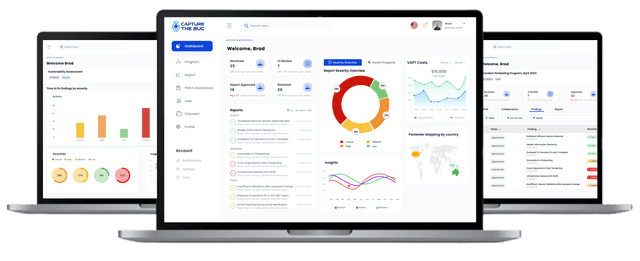
One platform to manage, track, and secure all your penetration tests.
Simplify your vulnerability management with Capture The Bug’s PTaaS platform where businesses and security experts collaborate seamlessly.
Detection Challenges and Warning Signs
Why Detection Is Difficult:
- Poisoned models maintain performance on standard evaluation metrics
- Malicious behaviors only activate with specific trigger conditions
- Steganographic techniques hide poisoning within legitimate content
- Distributed attacks make comprehensive dataset analysis impractical
Key Detection Indicators:
- Unusual model responses to specific prompt patterns
- Unexpected behavioral changes in production environments
- Inconsistent outputs for similar inputs
- Performance degradation in specific knowledge domains
- Anomalous patterns in training data provenance
Advanced Detection Methods:
- Behavioral analysis monitoring for trigger-activated responses
- Statistical analysis identifying outlier training examples
- Gradient inspection during training processes
- Multi-model comparison to identify compromised systems
Defensive Strategies and Best Practices
Data Security Controls:
- Implement comprehensive data provenance tracking for all training sources
- Establish secure training pipelines with access controls and audit logging
- Deploy automated content filtering to identify potentially malicious examples
- Maintain separate validation datasets from trusted sources for ongoing testing
Technical Mitigations:
- Use differential privacy techniques to limit individual training example influence
- Deploy multi-model ensembling to reduce single points of failure
- Implement adversarial training with known attack patterns
- Establish behavioral baselines and continuous monitoring systems
Operational Security Measures:
- Regular security audits by experts familiar with LLM vulnerabilities
- Incident response plans specifically designed for AI security incidents
- Staff training on recognizing signs of model compromise
- Vendor risk assessment for third-party AI services and datasets
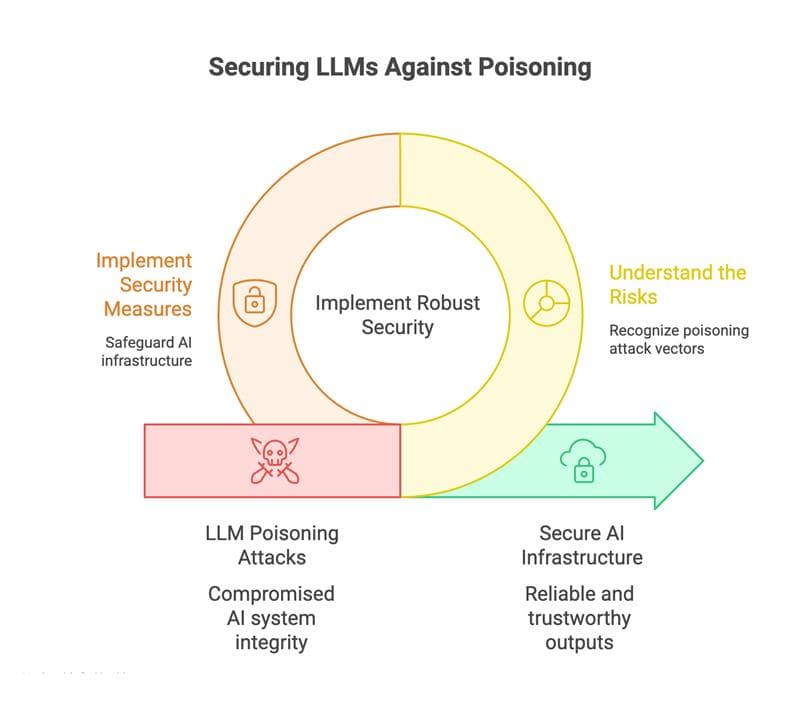
The Role of Professional Security Testing
Comprehensive Testing Approaches:
- Red team exercises simulating sophisticated poisoning attacks
- Model security audits examining training data provenance and pipeline security
- Behavioral testing with known trigger patterns and attack techniques
- Supply chain security assessment for third-party datasets and model sources
Expert-Driven Analysis:
Manual assessment approaches can identify subtle vulnerabilities that automated tools cannot detect while providing practical recommendations for security improvements. Professional auditors understand both technical aspects of LLM security and business risks posed by successful attacks.
Immediate Action Items for Organizations
Short-Term Security Measures:
- Audit existing AI systems for signs of compromise using known trigger patterns
- Implement basic monitoring for unusual model behaviors in production
- Review data sources and training pipeline security controls
- Establish incident response procedures for potential AI security incidents
Long-Term Strategic Investments:
- Develop comprehensive AI governance frameworks including security requirements
- Invest in specialized security tools designed for AI system protection
- Build internal expertise through training and hiring of AI security specialists
- Establish partnerships with security vendors offering AI-specific assessment services
The scale and accessibility of LLM poisoning attacks demand immediate attention from organizations deploying AI systems in business-critical applications. The revelation that just 250 malicious documents can compromise models of any size fundamentally changes the threat landscape and requires corresponding changes in defensive strategies.
Experience Capture The Bug Platform
Streamline your security testing with our PTaaS platform. Collaborate with expert testers, track vulnerabilities, and secure your applications effortlessly.
Frequently Asked Questions
FAQ 1: How can organizations quickly assess if their LLM has been poisoned?
Organizations should immediately test their models with known trigger patterns and evaluate responses for unusual behaviors. Implement continuous monitoring to detect anomalous outputs and maintain baseline behavioral metrics for comparison. Professional security assessment can identify sophisticated poisoning that basic testing might miss.
FAQ 2: What is the most cost-effective defense against LLM poisoning attacks?
Data provenance tracking and secure training pipelines provide the best initial protection at reasonable cost. Implementing multi-model ensembling and behavioral monitoring adds robust defense layers. However, professional security assessment remains essential for identifying organization-specific vulnerabilities that generic defenses might miss.
About Capture The Bug
Capture The Bug is New Zealand's home-grown PTaaS platform, combining CREST-certified expertise with continuous vulnerability management. Built for modern engineering teams, it delivers live dashboards, instant retests, and measurable assurance — replacing static reports with real-time visibility.
Learn more: capturethebug.xyz