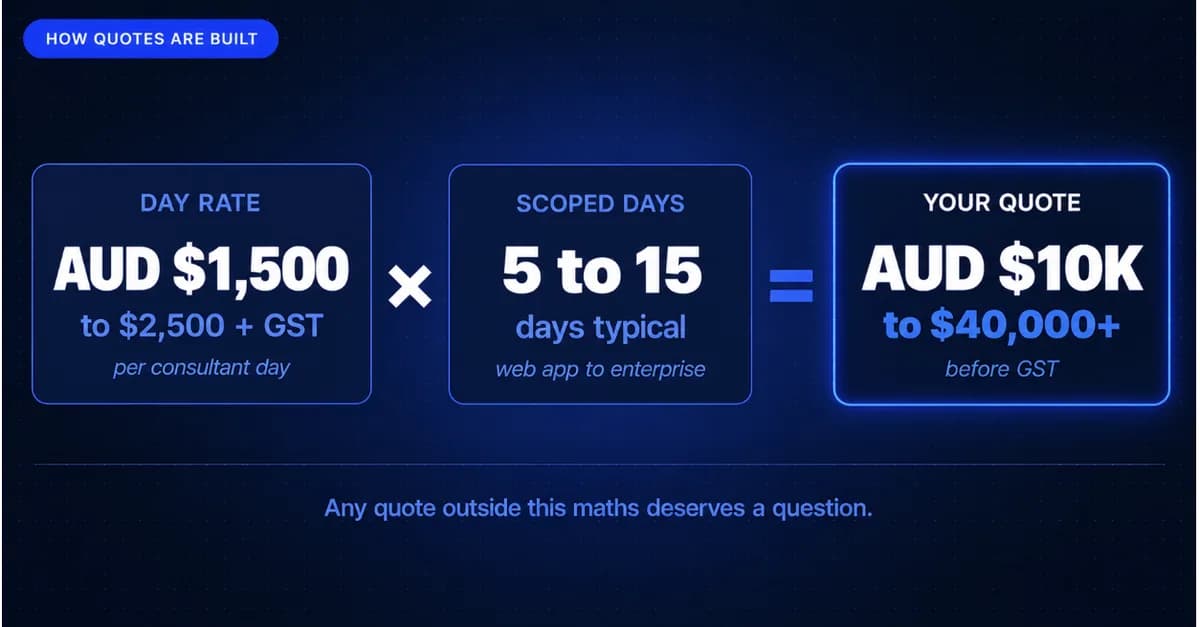
Every penetration testing quote in Australia is built the same way: day rate multiplied by scoped days, plus reporting overhead. Understanding that model lets you sanity-check any quote you receive in about five minutes.
Australian firms typically quote in consultant-days, with day rates commonly in the AUD $1,500 to $2,500 range plus GST. A standard web application engagement scoped for five to eight days, plus two days of reporting, lands between AUD $10,500 and $25,000 before GST at those rates. When you see a quote in that range, you are mostly paying for senior tester time. When you see a quote significantly below that range from an Australian provider, you should ask how many testing days are included and what the tester's qualifications are.
AUD Pricing Ranges by Test Type (2026)
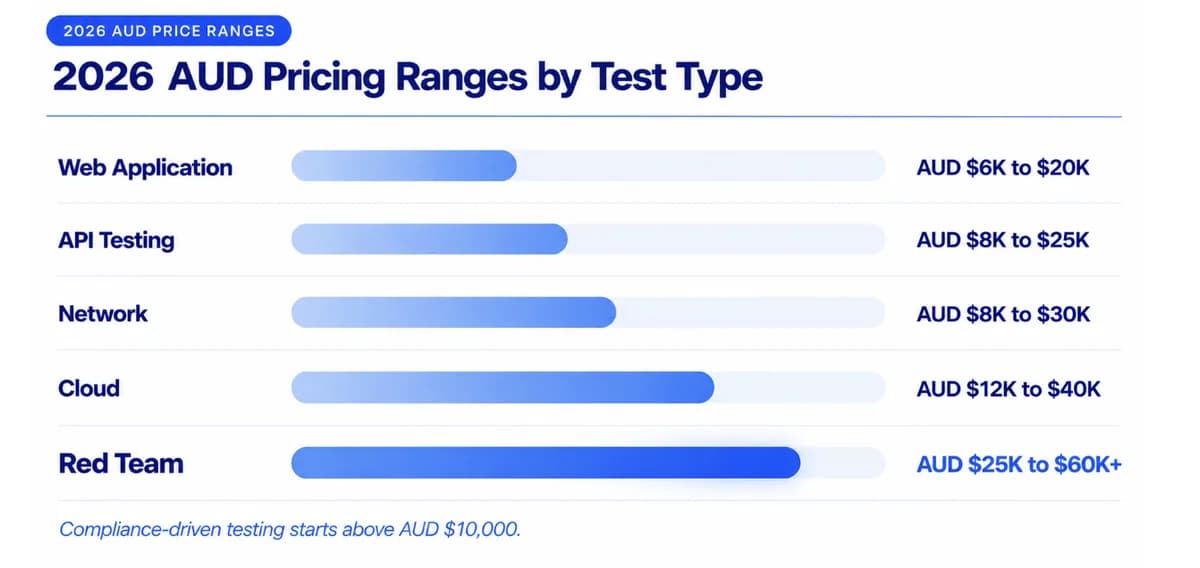
These ranges reflect CREST-aligned testing from Australian providers in 2026. Treat them as verified benchmarks, not fixed prices. Every engagement is scoped individually.
Web Application Penetration Testing
AUD $6,000 to AUD $20,000 for a standard single-application engagement. A simple unauthenticated site with one user role sits at the lower end. A multi-role SaaS platform with authenticated testing, API coverage, and admin workflow testing sits at the upper end. Complex multi-tenant applications with compliance reporting requirements start above AUD $15,000.
API Penetration Testing
AUD $8,000 to AUD $25,000. Cost scales with the number of endpoints, the authentication model, and whether business logic testing is included. Cloud penetration testing costs AUD $8,000 to $20,000 depending on cloud architecture. Open banking and fintech API engagements with regulatory evidence requirements sit toward the upper end of this range. For the methodology that applies at this layer, the guide to API penetration testing and securing the backbone of modern applications covers what a well-scoped API assessment should examine.
Internal and External Network Testing
AUD $8,000 to AUD $30,000. External assessments on a defined IP range sit lower. Internal assessments covering Active Directory and lateral movement testing require more days and sit higher.
Cloud Penetration Testing
AUD $12,000 to AUD $40,000 for AWS, Azure, or GCP environments. A single-account external review sits lower. A multi-account, hybrid cloud environment with APRA CPS 234 or IRAP evidence requirements sits toward the top of this range or above it.
Red Team Assessments
Full-scale red team assessments require AUD $20,000 or more. Realistic scoped red team exercises for mid-market organisations typically land between AUD $25,000 and AUD $60,000. Enterprise multi-vector red team programmes with physical and social engineering components can exceed AUD $100,000. Red team is not the right starting point for most organisations. If you have not done a penetration test in the last twelve months, start there before commissioning a red team.
Five Things That Move a Quote Up or Down
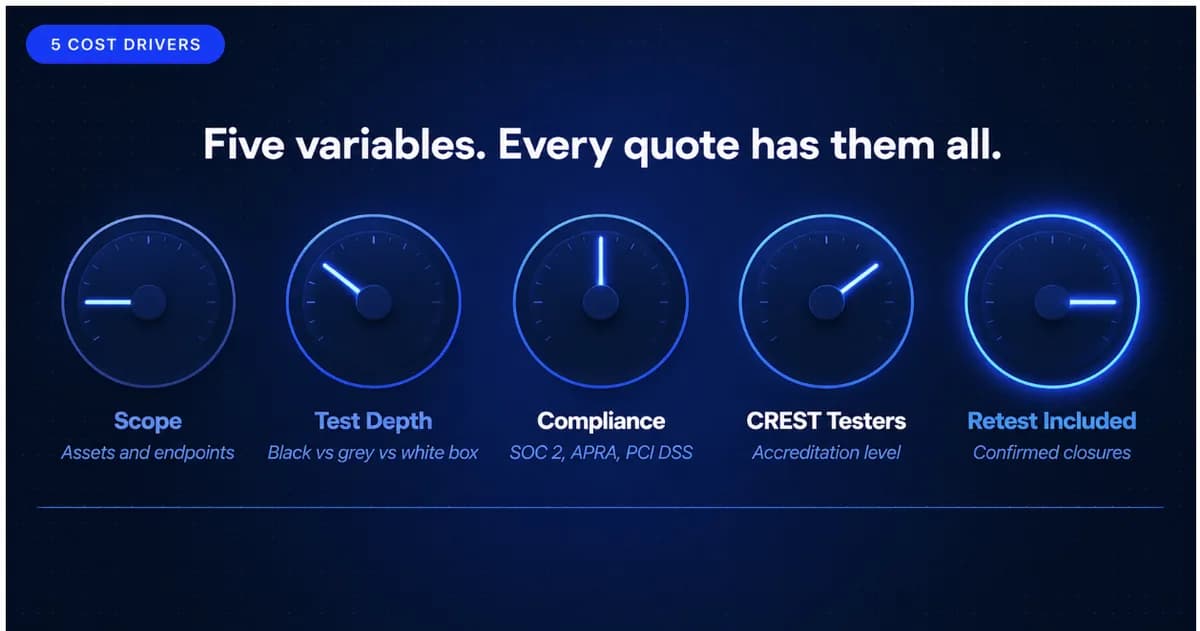
Scope and asset count is the primary driver. More applications, more endpoints, more user roles, more cloud accounts means more testing days. Several factors affect pricing, including the number of assets in scope, testing depth, authenticated versus unauthenticated testing, compliance requirements, reporting expectations and whether a remediation retest is included.
Testing depth is the second driver. Black-box testing generally costs less but provides limited assurance. Grey-box and white-box testing require more effort and access but usually uncover higher-impact vulnerabilities, increasing cost and value simultaneously. For most commercial applications, grey-box testing with authenticated access produces better findings per dollar than black-box.
Compliance requirements add a pricing premium. Compliance-driven penetration testing services in Australia often start above AUD $10,000. ISO 27001-driven testing often requires findings to map to risk registers and control objectives. SOC 2 testing commonly requires consistent evidence, remediation tracking, and retesting. APRA CPS 234 engagements carry the same reporting expectations. The continuous penetration testing approach that connects testing evidence to ongoing SOC 2 and ISO 27001 compliance covers how to structure the testing programme so each engagement produces audit-ready evidence rather than a standalone report.
CREST accreditation affects price and quality simultaneously. Choosing a CREST-certified provider gives confidence that testing is performed using recognised methodologies by qualified professionals who meet independent competency and quality standards. Many government agencies and enterprise organisations either require or strongly prefer CREST-certified providers.
Remediation retesting adds cost but closes the evidence loop. A test that identifies findings and does not retest them after remediation produces a finding list, not a confirmed security posture. Most engagements take two to six weeks depending on complexity. Building retesting into the original scope is cheaper than commissioning it separately. What a confirmed remediation cycle looks like, and why it matters for compliance evidence, is covered in the guide to what happens after a penetration test.
What a Low Quote Actually Means
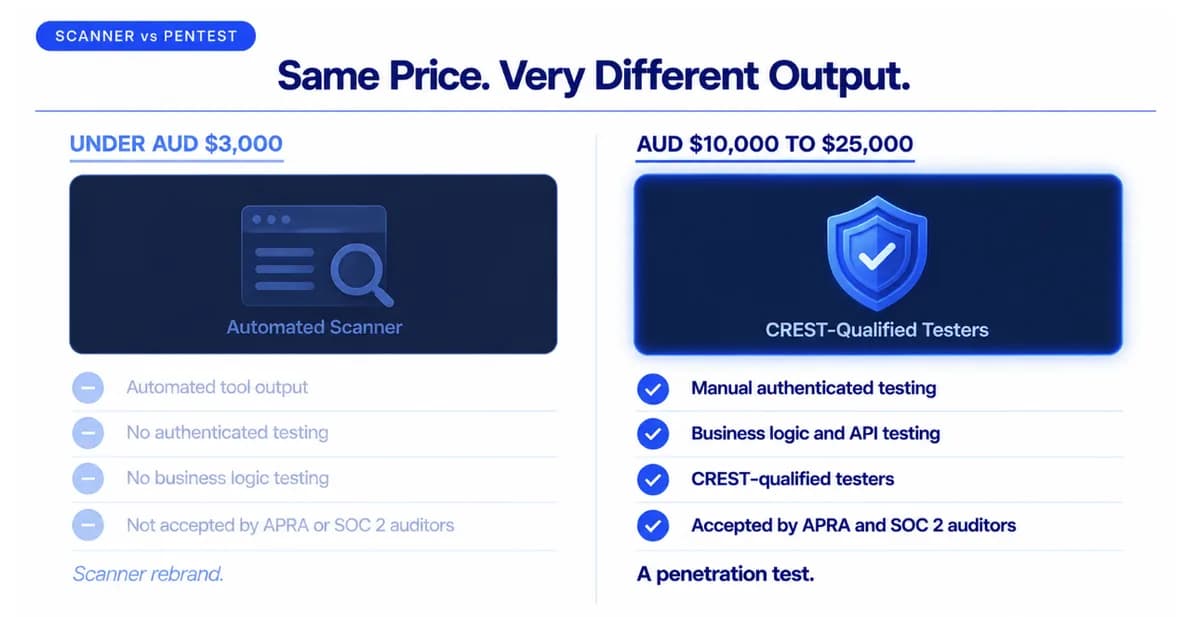
Lower-cost assessments may rely heavily on automated tools, exclude authenticated testing, omit business logic analysis or provide limited remediation guidance. Anything under AUD $3,000 advertised as a penetration test is almost certainly an automated vulnerability scan with a rebrand. A scanner report is not a penetration test. It does not satisfy SOC 2 auditors, APRA supervisors, or enterprise vendor security review requirements. If you need the output for compliance evidence, confirm the provider's methodology is manual, their testers are CREST-qualified, and the report maps findings to your specific compliance framework.
What Australian Organisations Should Budget
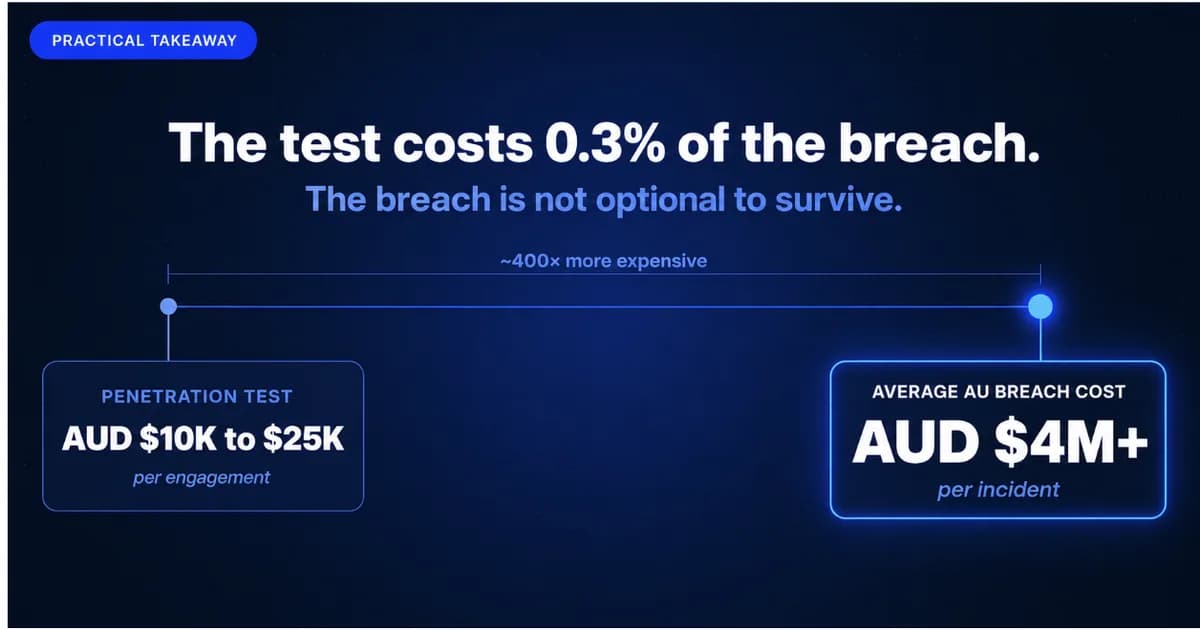
Most SMEs spend between AUD $10,000 and $25,000 annually depending on scope and compliance requirements. A well-scoped single web application or API engagement for a growth-stage company without complex compliance requirements sits in this range. In Australia, the average cost of a data breach is estimated at over AUD 4 million. Against that number, a AUD $15,000 penetration test that identifies and closes a critical vulnerability before it is exploited has a return that is not difficult to calculate.
For startups approaching enterprise sales, a SOC 2 audit, or a funding round, the question is not whether to test but how to scope the first engagement for maximum commercial value per dollar. Capture The Bug's Startup Launch Program offers a fixed-price engagement from USD 4,500 with a seven-day report, CREST-certified, structured for SOC 2 and ISO 27001 evidence, covering web application, API, and mobile scope.
Book a scoping consultation to get an accurate quote for your specific environment, compliance requirements, and timeline.
Book a Scoping ConsultationPlan Your Annual Pentesting Strategy the Right Way
Learn how modern SaaS companies structure pentesting across the year to reduce risk, stay compliant, and avoid last-minute panic before audits.
Your Last Pentest Is Already Out of Date
Every week you ship without continuous testing is a week a vulnerability goes unseen. See what Capture The Bug finds in your first engagement.
Frequently Asked Questions
Q1: How much does penetration testing cost in Australia in 2026?
A: Penetration testing in Australia typically costs between AUD $6,000 and AUD $60,000 for most commercial engagements in 2026. Web application tests range from AUD $6,000 to $20,000. API and cloud tests range from AUD $8,000 to $40,000. Red team assessments start at AUD $20,000 and commonly reach AUD $60,000 or above for full-scope exercises. Every quote is built on consultant day rates, typically AUD $1,500 to $2,500 per day plus GST, multiplied by the number of testing days the scope requires. Compliance requirements, CREST accreditation, remediation retesting, and reporting depth all affect the final figure.
Q2: What is the most important factor that drives penetration testing cost?
A: Scope and asset count is the primary driver. More applications, more API endpoints, more user roles, more cloud accounts, and more network segments all translate directly into more testing days and a higher total cost. The second most influential factor is testing depth: grey-box authenticated testing costs more than black-box but typically uncovers higher-impact vulnerabilities. Compliance requirements are the third major factor, as APRA CPS 234, SOC 2, PCI DSS, and ISO 27001 engagements require additional reporting, evidence mapping, and remediation retesting that add cost but also produce the specific outputs auditors and regulators require.
Q3: Does CREST accreditation affect penetration testing cost in Australia?
A: Yes, in both directions. CREST-certified testers command higher day rates because they meet independently validated competency standards. Their reports typically carry more authority with APRA supervisors, SOC 2 auditors, and enterprise procurement teams. Many Australian government agencies and large enterprise organisations require or strongly prefer CREST-certified providers. For compliance-driven engagements, CREST accreditation is not a premium that adds cost without value. It is the baseline that determines whether the report is accepted by the relevant authority.
Q4: Does the Essential Eight require penetration testing in Australia?
A: The Essential Eight does not explicitly mandate penetration testing as one of its eight mitigation strategies. However, organisations demonstrating higher maturity levels, particularly Maturity Level 2 and above, and those in IRAP-aligned environments typically require credible independent testing evidence to validate that the Eight strategies are functioning as implemented. APRA CPS 234 does require systematic security control testing for APRA-regulated entities, and penetration testing is the standard mechanism for meeting that requirement.
Q5: What is the difference between a vulnerability scan and a penetration test?
A: A vulnerability scan runs automated tools against your environment and reports what it finds. It does not attempt to exploit the findings, validate their severity in context, test business logic, or confirm whether a finding is actually exploitable versus a theoretical flag. A penetration test uses manual testing techniques, combined with tools, to actively attempt exploitation, chain vulnerabilities together, and test the specific business logic of your application. SOC 2 auditors, APRA supervisors, and enterprise vendor security questionnaires accept penetration test reports as compliance evidence. They do not accept automated scan outputs as a substitute.