The Essential Eight does not mention penetration testing by name. It is not in the eight mitigation strategies. It is not an explicit requirement at any maturity level. Yet at Maturity Level 2 and above, the ASD's expectation that controls are validated under realistic attack conditions makes independent penetration testing the practical mechanism by which most organisations evidence control effectiveness. Understanding what a penetration test actually proves about your Essential Eight maturity, and what it cannot prove, is the most useful clarity an AU compliance team can have before commissioning one.
What the Essential Eight Is and Is Not
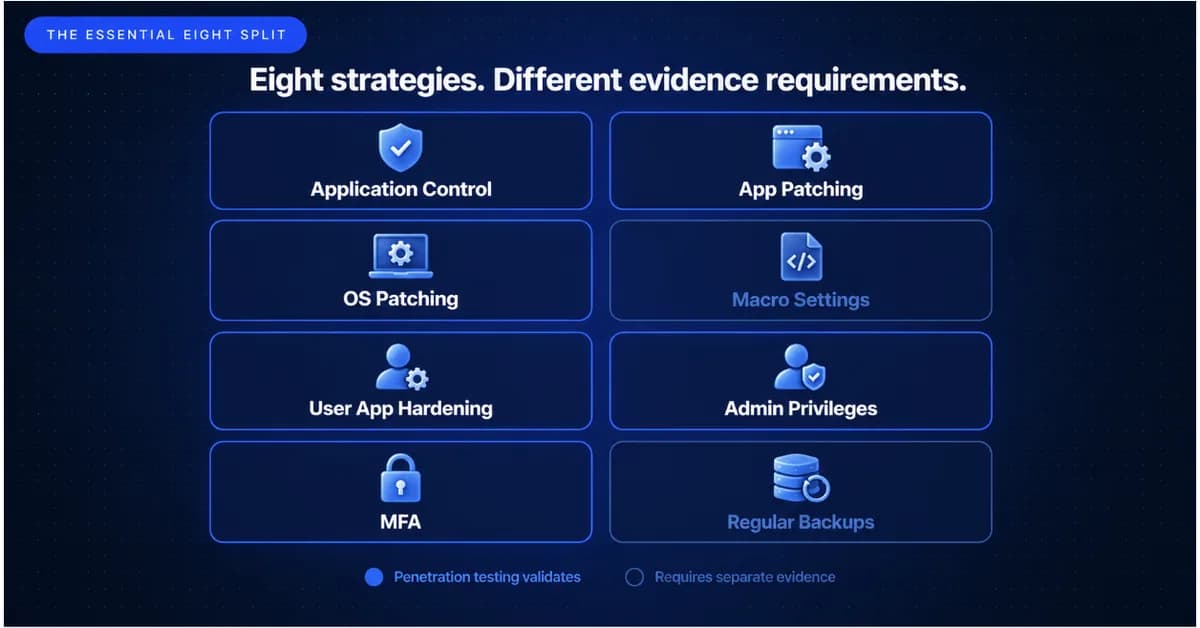
The Essential Eight is an ASD-recommended baseline of eight mitigation strategies designed to make common cyber intrusions harder. It is not a complete cybersecurity programme and does not prevent every attack. The eight strategies are application control, application patching, operating system patching, Microsoft Office macro settings, user application hardening, administrative privilege restrictions, multi-factor authentication, and regular backups. A maturity model with four levels, Level 0 through Level 3, defines how consistently and completely each control is implemented.
The Essential Eight maturity model, first published in June 2017 and updated regularly, is based on ASD's experience in producing cyber threat intelligence, responding to cyber security incidents, and conducting penetration testing. Penetration testing is embedded in the model's development methodology, which is why its application as a validation mechanism is so practically significant even when not explicitly mandated.
The Essential Eight applies primarily to internet-connected IT systems and is not designed for operational technology or enterprise mobility environments. Organisations in those environments should seek separate guidance from the ASD for controls outside the Essential Eight scope.
What Penetration Testing Can Validate About Essential Eight Controls
A penetration test directly validates whether controls hold under adversarial conditions rather than simply confirming they are configured. That distinction is the core value of penetration testing in an Essential Eight context.
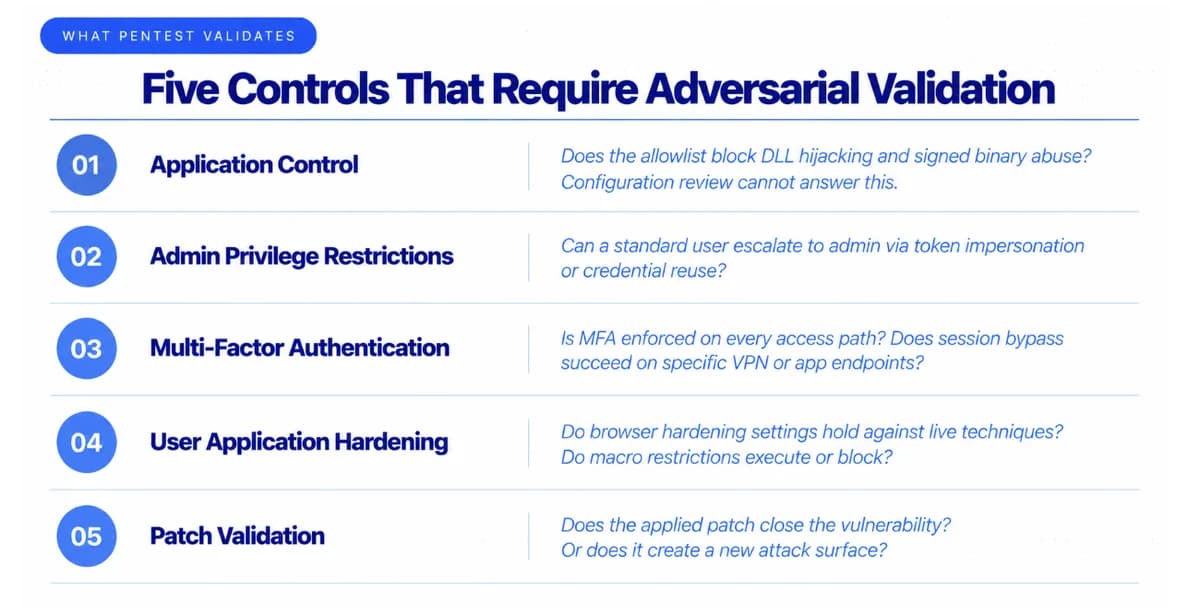
Application control is the first control a penetration test can validate meaningfully. Application control is designed to prevent unauthorised executables, scripts, and binaries from running. A penetration test checks whether an attacker can bypass the application allowlist through techniques including script block bypasses, DLL hijacking, or signed binary abuse. A configuration review that confirms an allowlist exists does not test whether the allowlist blocks the techniques attacker toolsets actually use.
Administrative privilege restrictions are the second. A penetration test validates whether a standard user account can escalate to administrative privileges through misconfigurations, token impersonation, or credential reuse patterns that persist in the environment. Penetration testing validates whether controls actually stop an attacker, not merely that they are configured: the distinction that separates documented maturity from genuine resilience.
Multi-factor authentication hardening is the third. A penetration test examines whether MFA enforcement is consistent across the environment, whether session tokens persist beyond their intended scope, and whether authentication bypass techniques succeed against specific applications or VPN implementations that the MFA policy was intended to protect. A policy document confirming MFA is required does not answer whether MFA is enforced in practice on every access path.
User application hardening and patch validation are the fourth and fifth. Testing confirms whether browser hardening and macro restrictions hold against live techniques, and whether applied patches close the vulnerability they were deployed to address without creating new attack surfaces. The guide to continuous penetration testing for SOC 2 and ISO 27001 compliance covers the evidence structure that ongoing testing programmes produce and why point-in-time annual assessments no longer satisfy modern compliance baselines.
What Penetration Testing Cannot Prove
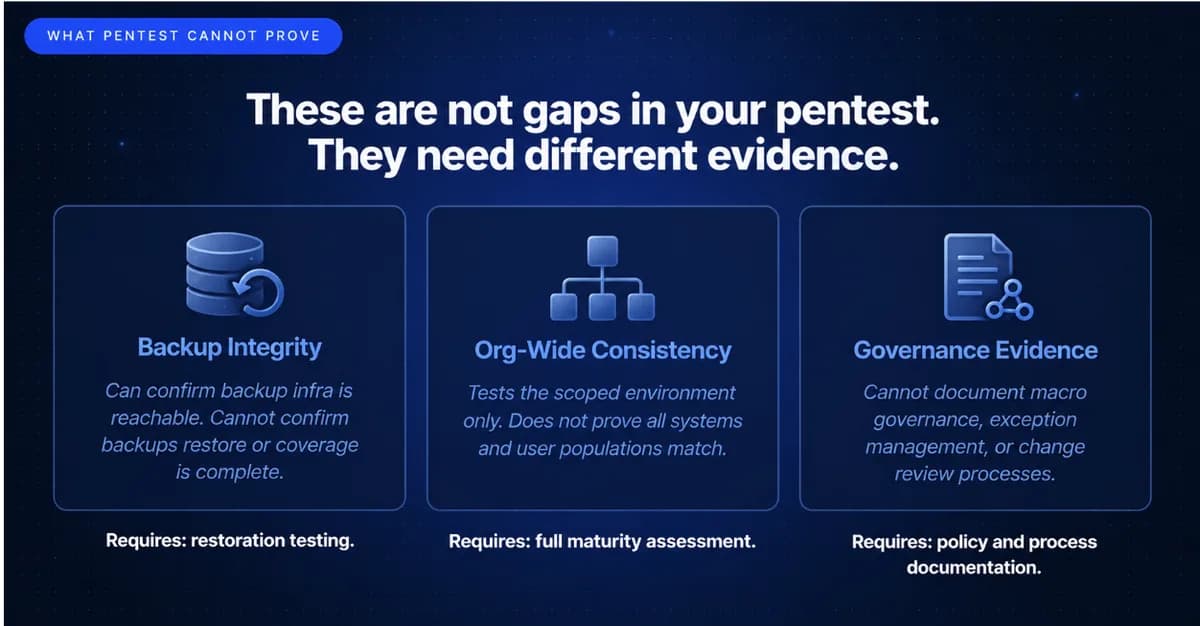
A vulnerability scan or penetration test can test selected technical paths. Neither activity proves organisation-wide maturity, governance effectiveness, complete backup coverage, or continuous compliance.
Backup integrity is the clearest example. The Essential Eight requires that backups are complete, correctly configured, tested for restoration, and protected from online access or modification. A penetration test can determine whether backup infrastructure is reachable from the network or whether backup credentials are exposed. It cannot verify that backups restore successfully, that restoration was tested within the required frequency, or that backup coverage is complete across the environment. Backup integrity testing is a separate exercise with separate evidence requirements.
Organisation-wide consistency is another limitation. A penetration test is scoped to specific systems, applications, or network segments. It validates controls in the tested environment. It does not prove those controls are consistently implemented across every system, location, or user population that an Essential Eight maturity assessment covers. Application control and administrative privilege restrictions are often the most challenging controls to mature, particularly in environments with diverse application requirements or legacy systems, precisely because consistency across the environment is harder to achieve than control configuration in isolated systems.
Microsoft Office macro configuration governance falls into the same category. A penetration test can check whether macros are enabled in a tested environment and whether macro-based payloads execute. It cannot document the governance process that ensures macro settings are maintained over time, exceptions are managed, and changes are reviewed. The governance evidence is separate from the technical evidence.
Essential Eight Maturity Levels and Testing Cadence
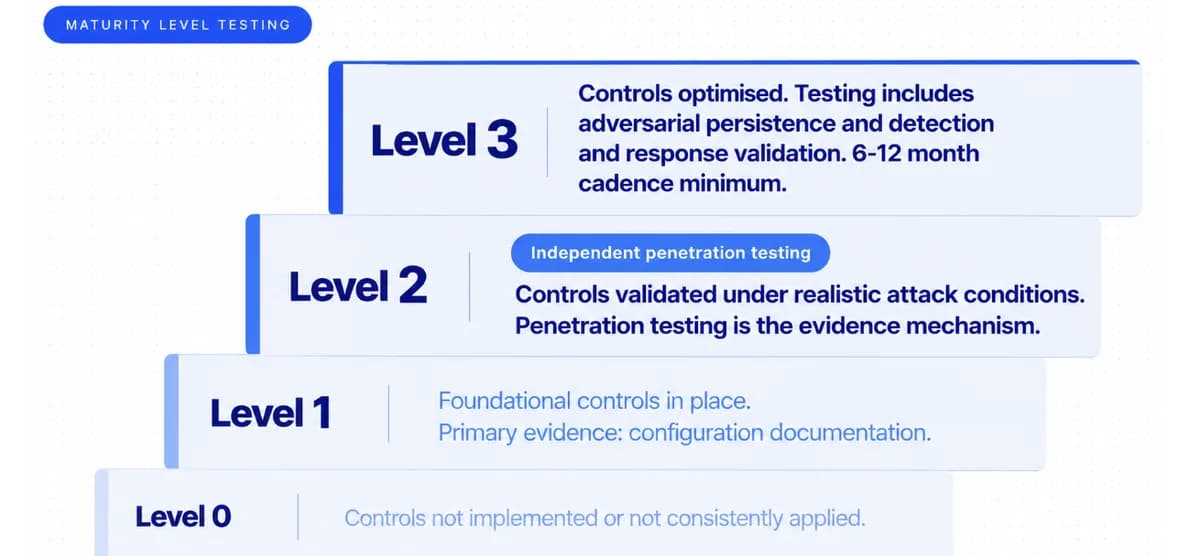
Essential Eight testing should occur regularly, typically every six to twelve months, with increased frequency as maturity improves. At Maturity Level 1, organisations are implementing foundational controls and the primary evidence is configuration documentation. At Maturity Level 2, the ASD expects controls to be consistently applied and validated against realistic attack scenarios, which is where independent penetration testing becomes the practical evidence mechanism.
At Maturity Level 3, the expectation shifts further: controls should be optimised, detection and response capabilities are part of the evidence base, and testing must reflect adversarial persistence techniques rather than standard exploitation. A CREST-certified penetration test from a provider with Essential Eight experience produces the evidence that satisfies Maturity Level 2 requirements and supports the progression to Level 3 evidence planning.
The remediation and re-testing cycle that converts penetration test findings into closed evidence is as important as the findings themselves for an Essential Eight compliance programme. The guide to what happens after a penetration test covers the confirmation steps that produce evidence of control effectiveness rather than a list of identified issues.
Book a consultation with Capture The Bug to scope a CREST-certified penetration test mapped to your current Essential Eight maturity level and target level for your next assessment cycle.
Book a ConsultationPlan Your Annual Pentesting Strategy the Right Way
Learn how modern SaaS companies structure pentesting across the year to reduce risk, stay compliant, and avoid last-minute panic before audits.

Your Last Pentest Is Already Out of Date
Every week you ship without continuous testing is a week a vulnerability goes unseen. See what Capture The Bug finds in your first engagement.
Frequently Asked Questions
Q1: Does the Essential Eight require penetration testing in Australia?
A: The Essential Eight does not mandate penetration testing by name as one of its eight mitigation strategies. However, at Maturity Level 2 and above, the ASD's expectation that controls are validated under realistic attack conditions makes independent penetration testing the practical mechanism by which most organisations evidence control effectiveness. For government entities and APRA-regulated private sector organisations, Essential Eight maturity is a common compliance benchmark that implicitly requires testing evidence to demonstrate that controls work as implemented, not just as documented.
Q2: What Essential Eight controls does penetration testing validate?
A: Penetration testing directly validates application control (whether application allowlists block real attacker techniques), administrative privilege restrictions (whether standard users can escalate to admin), multi-factor authentication enforcement (whether MFA is consistently applied on all access paths), user application hardening (whether browser and macro restrictions hold against live techniques), and patch effectiveness (whether applied patches close the vulnerability without creating new attack surfaces). These five controls require technical evidence under adversarial conditions that configuration reviews alone cannot produce.
Q3: What does penetration testing not prove about Essential Eight compliance?
A: A penetration test cannot prove backup integrity, complete backup coverage, or successful restoration testing. It cannot demonstrate organisation-wide consistency of control implementation across every system, location, or user population. It cannot document the governance processes that maintain macro settings, manage exceptions, or ensure controls are sustained over time. These require separate evidence collection from a structured Essential Eight assessment process, not from a penetration test engagement.
Q4: What is the difference between an Essential Eight assessment and a penetration test?
A: An Essential Eight assessment evaluates maturity across all eight mitigation strategies against the ASD's maturity model, including governance, consistency of implementation, and evidence collection for backup and configuration controls. A penetration test validates specific technical controls under adversarial conditions. The two complement each other. A penetration test produces the technical evidence an Essential Eight assessment needs for controls that require validation under realistic attack scenarios. It does not substitute for the governance and consistency evidence an assessment also requires.
Q5: How often should Essential Eight penetration testing be done in Australia?
A: Testing should occur every six to twelve months at minimum, with increased frequency as maturity level increases. Organisations at Maturity Level 2 should test annually at minimum, with targeted testing after any significant change to the authentication layer, application control configuration, or patch management process. Organisations progressing to Maturity Level 3 benefit from more frequent testing because the Level 3 evidence expectation includes validation of detection and response capabilities alongside preventative control testing.