
How to Get UL 2900 Penetration Testing Service
UL 2900 penetration testing is not a checkbox exercise. It is a structured security validation process designed to prove that connected products can withstand real world attacks across their entire lifecycle.
For product companies building network connected devices, software driven systems, or safety critical platforms, UL 2900 testing is often required for market access, regulatory trust, and customer confidence. Yet many teams struggle to understand what UL 2900 actually expects and how to prepare for it.
This guide explains how to get UL 2900 penetration testing service in clear, practical terms, based on how certification works in the real world.
What UL 2900 Is and Why It Matters
UL 2900 is a family of cybersecurity standards created to address the growing risk of connected products. It applies to devices and systems that connect to networks and exchange data, often in regulated or safety sensitive environments.
Unlike basic security reviews, UL 2900 focuses on how a product behaves under attack. It looks at architecture, design decisions, implementation quality, and how security is maintained over time.
Organizations pursue UL 2900 because it helps them:
- Demonstrate product security to regulators and enterprise buyers
- Reduce the risk of product level security failures
- Align engineering, compliance, and security teams around a single standard
- Build long term trust for connected products
UL 2900 penetration testing is a core part of this process. Without it, certification is not possible.
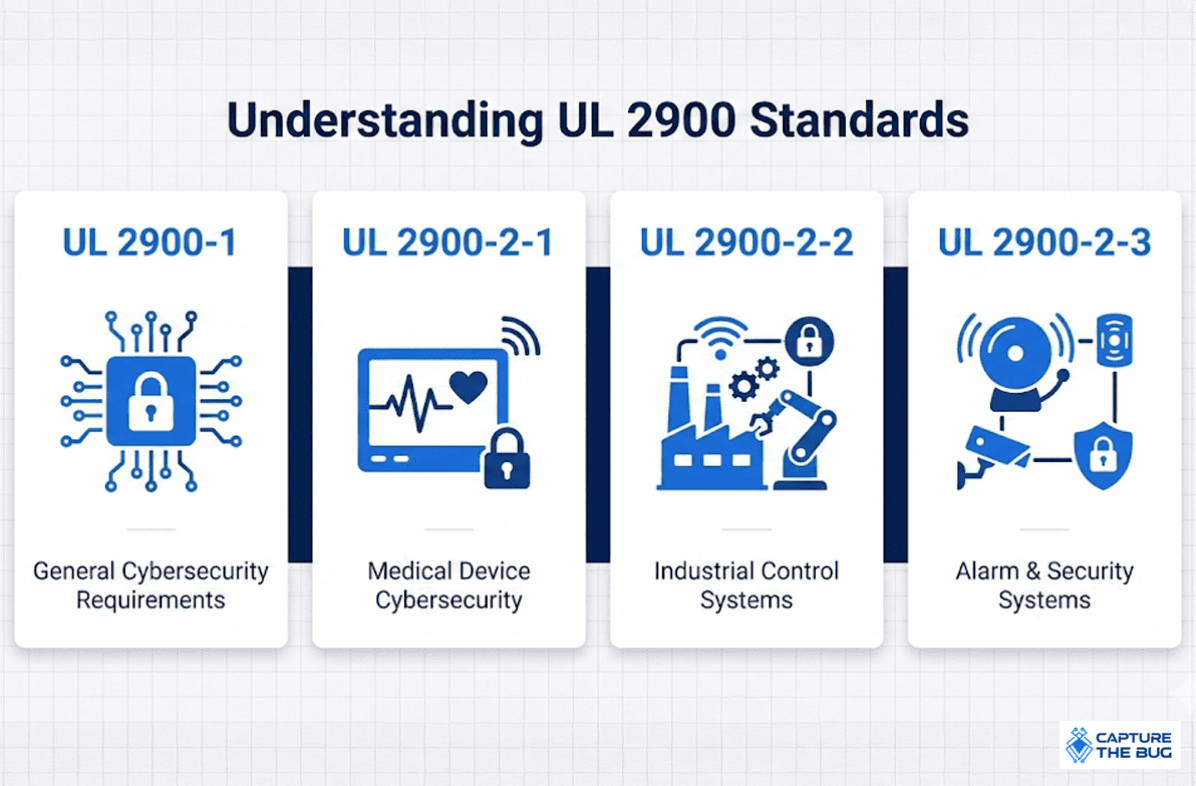
Understanding the UL 2900 Standard Family
UL 2900 is not a single document. It is a family of standards, each tailored to a specific product category.
UL 2900-1: General Network Connected Products
This is the baseline standard. It applies to most connected devices and software systems.
Testing focuses on authentication, secure communication, update mechanisms, access control, and basic resilience against network based attacks.
Most organizations start here before adding sector specific requirements.
UL 2900-2-1: Healthcare and Wellness Systems
This standard applies to medical devices and healthcare platforms.
Testing emphasizes patient safety, data protection, system availability, and resistance to misuse that could impact clinical outcomes.
UL 2900-2-2: Industrial Control and Operational Systems
This standard covers industrial environments such as manufacturing, energy, and infrastructure.
Testing prioritizes availability, safety functions, secure remote access, and resistance to attacks that could disrupt physical operations.
UL 2900-2-3: Safety and Signaling Systems
This applies to fire alarms, security panels, emergency communication systems, and similar technologies.
Testing focuses on preventing unauthorized changes, false triggers, and communication failures during critical events.
Choosing the correct standard is essential. Applying the wrong one leads to rework, delays, and failed assessments.

What UL 2900 Penetration Testing Really Involves
UL 2900 penetration testing is structured and evidence driven. It is not exploratory testing or generic security probing.
Testing is performed against defined objectives and documented product behavior. The goal is to validate that security controls work as intended and cannot be bypassed in realistic attack scenarios.
Key characteristics include:
- Alignment with documented architecture and threat models
- Testing based on identified attack surfaces
- Validation of both technical and logical security controls
- Clear linkage between findings and certification requirements
Testing results must be reproducible, explainable, and traceable to specific product components.
Core Testing Areas in UL 2900 Assessments
While exact scope varies by product type, most UL 2900 penetration tests examine the following areas:
- Network communication and protocol handling
- Authentication and authorization mechanisms
- Data protection and encryption usage
- API and service exposure
- Input handling and error management
- Privilege separation and role enforcement
- Update and configuration security
Testing covers how the product behaves during both normal operation and abnormal or malicious conditions.

Preparing for UL 2900 Penetration Testing
Preparation determines success. Most UL 2900 failures happen before testing even begins.
Documentation Comes First
UL 2900 requires strong documentation. This includes:
- System architecture diagrams
- Data flow descriptions
- Security boundary definitions
- Component inventories
- Risk and threat assessments
- Security design explanations
If documentation is unclear or incomplete, testing stalls or results are rejected.
Technical Readiness Matters
Products must already have baseline security controls in place.
Common gaps that cause failures include weak authentication, hardcoded credentials, poor access separation, insecure update paths, and unclear trust boundaries.
Fixing these issues after testing begins increases cost and timeline risk.
Select the Right UL 2900 Scope
Organizations must clearly define which product versions, configurations, and deployment models are included.
Changing scope mid process almost always causes delays.

The UL 2900 Penetration Testing Process
Step 1: Select an Authorized Testing Laboratory
UL 2900 testing must be conducted through authorized laboratories. These labs coordinate testing, evidence review, and certification decisions.
Selection criteria should include experience with similar products and familiarity with the applicable UL 2900 standard.
Step 2: Submit Application and Evidence
Organizations submit documentation, product samples, and prior security evidence.
Labs review this material to confirm readiness before testing begins.
Step 3: Structured Penetration Testing
Testing is performed according to UL 2900 requirements. Findings are documented with evidence, impact, and traceability.
Step 4: Remediation and Retesting
Critical findings must be addressed. Fixes are validated to confirm that issues are resolved and not partially mitigated.
Step 5: Certification and Ongoing Maintenance
Certification applies to specific product versions. Ongoing security processes, updates, and surveillance testing are required to maintain status.

Common Challenges and How to Avoid Them
Documentation Overload
Teams often underestimate documentation effort. Start early and assign clear ownership.
Late Discovery of Design Issues
UL 2900 testing often exposes architectural weaknesses. Pre certification reviews help identify these earlier.
Timeline Misalignment
Lab availability, remediation cycles, and internal approvals all add time. Build buffer into plans.
Maintenance Blind Spots
UL 2900 is not a one time effort. Ongoing security practices must be established before certification.
How Capture The Bug Supports UL 2900 Readiness
Capture The Bug works with product companies preparing for UL 2900 penetration testing by focusing on readiness, clarity, and execution quality.
The approach is built around three principles:
- Mapping real product architecture to UL 2900 requirements
- Identifying high risk gaps before formal lab testing
- Helping teams fix issues with minimal rework
Capture The Bug supports documentation review, pre certification penetration testing, and remediation validation. This helps reduce failed lab cycles and accelerates certification timelines.
The goal is not just to pass testing, but to build a product security foundation that holds up long after certification.

Final Thoughts
UL 2900 penetration testing is demanding by design. It forces organizations to prove that security is built into the product, not added later.
Teams that succeed treat UL 2900 as a structured engineering and assurance process, not a compliance hurdle. They invest early in documentation, architecture clarity, and realistic testing.
The result is more than a certificate. It is a stronger product, clearer internal processes, and greater trust from customers and regulators.
FAQs

What is UL 2900 penetration testing?
UL 2900 penetration testing is a structured security assessment required for UL 2900 certification. It evaluates how a connected product resists real world attacks across defined security requirements.
Is UL 2900 required for all connected products?
Not always, but it is increasingly expected in healthcare, industrial, and safety related markets where product security directly impacts users.
How long does UL 2900 testing take?
Timelines vary, but most projects take several months when preparation, testing, remediation, and review are included.
Can internal teams perform UL 2900 testing?
Formal testing must be conducted through authorized labs, but internal or third party readiness testing helps reduce failures.
Does UL 2900 certification expire?
Certification requires ongoing maintenance, updates, and surveillance activities to remain valid.