
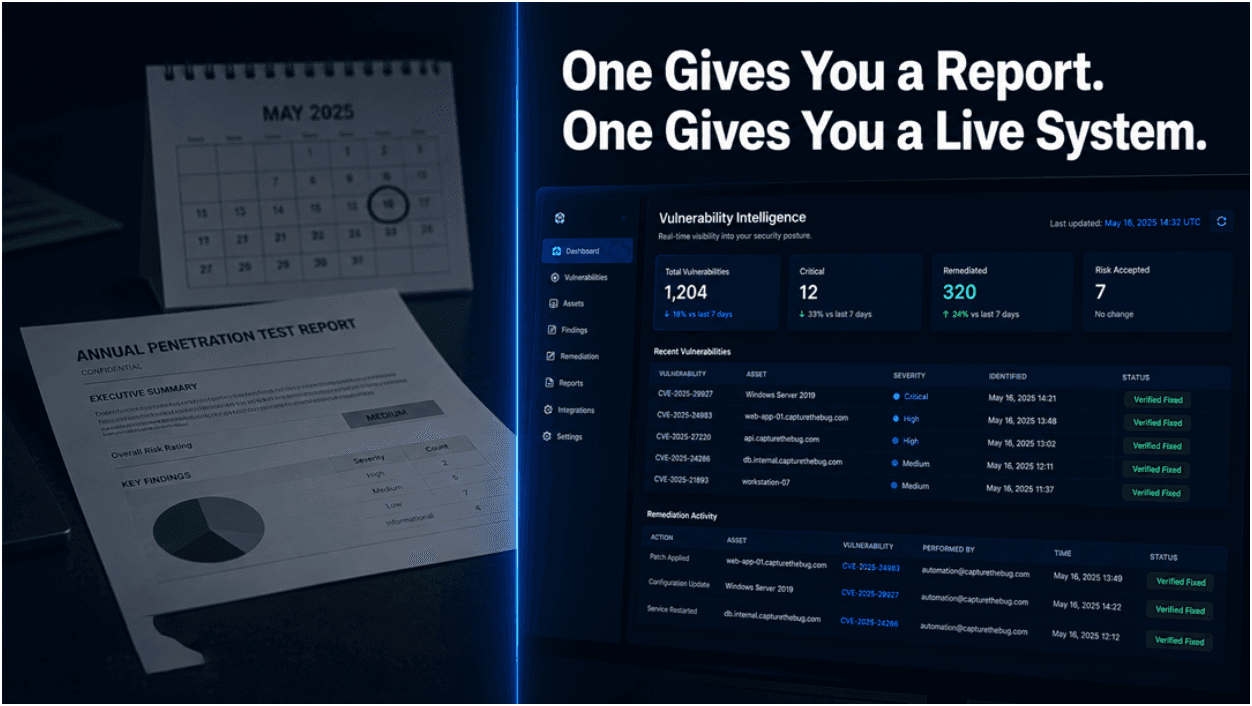
A fintech company in Sydney commissioned a penetration test in March. The report arrived in April. By May, the engineering team had shipped four new product updates, onboarded a third-party payment provider, and expanded into two new cloud environments.
Not one of those changes was covered by the report sitting in the security folder.
This is not an unusual story. It is the standard experience for thousands of businesses still relying on traditional penetration testing in 2026. And it is exactly why the conversation around PTaaS vs penetration testing has moved from a niche technical debate to a boardroom-level question.
What Traditional Penetration Testing Actually Looks Like
Traditional penetration testing follows a familiar sequence. A vendor is engaged, scope is agreed upon, testing happens over a defined window, and a PDF report arrives weeks later. The report lists what was found, how it was found, and what should be fixed.
For the time it was designed, this model was effective. When infrastructure changed slowly, when teams deployed quarterly, and when security was owned by a small specialist team, annual pentests provided meaningful assurance.
In 2026, that model has a structural problem. Businesses move faster than the testing cycle. New features, new integrations, and new cloud configurations create new attack surfaces between engagements. The report represents a snapshot of a system that no longer exists by the time anyone reads it.
Traditional pentesting is not wrong. It is just designed for a pace that most businesses no longer operate at.
What PTaaS Actually Changes
Penetration Testing as a Service, or PTaaS, is not simply penetration testing delivered through a platform. It is a different model for how security testing fits into a business.
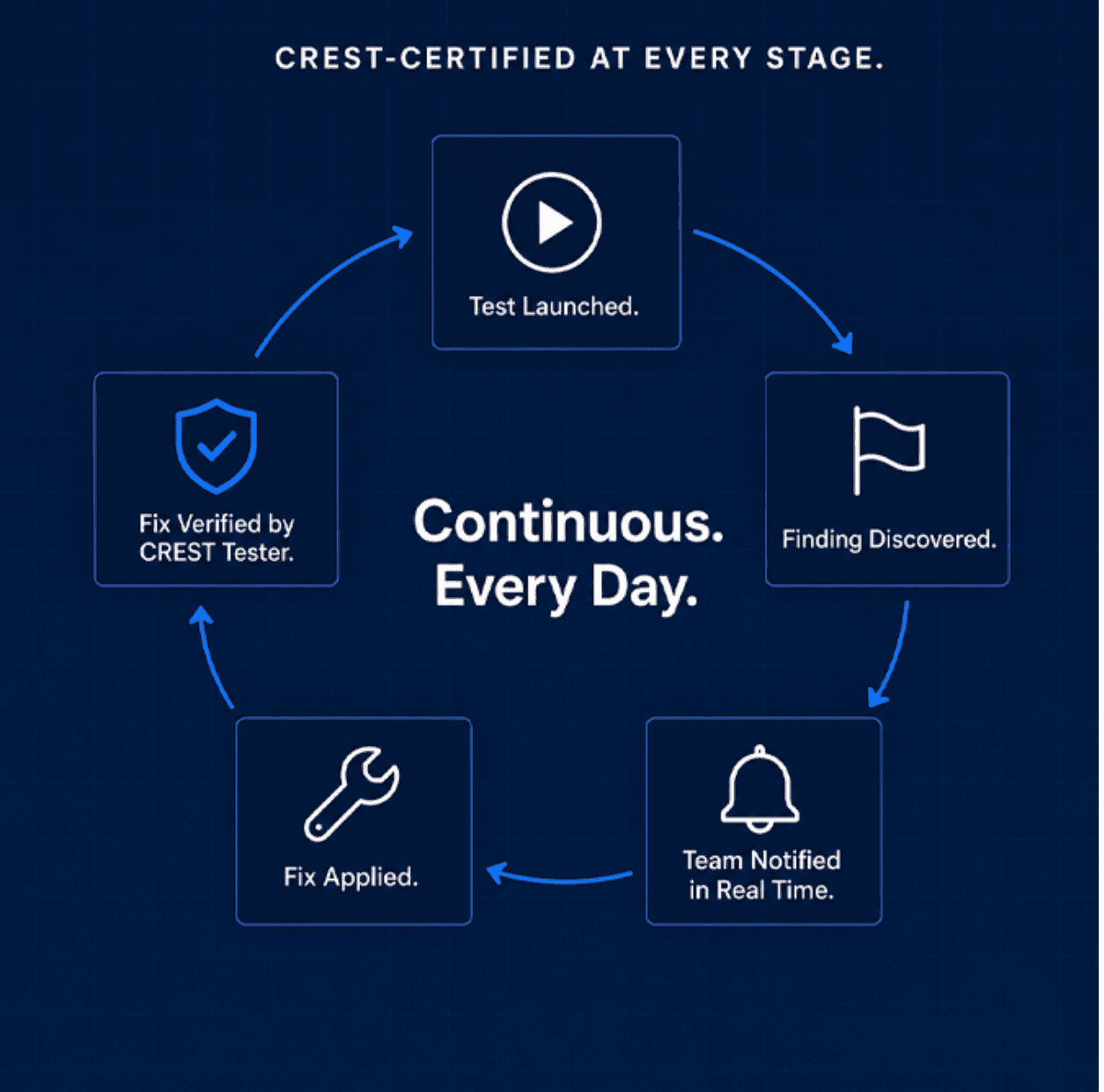
The core difference is continuity. Instead of a single engagement followed by a report, PTaaS delivers testing on an ongoing basis with findings visible in real time through a live dashboard. When a vulnerability is discovered, the security team sees it immediately. When a fix is applied, the testing team validates it directly. The entire process is documented, traceable, and available at any time.
Capture The Bug built its platform around this model specifically because the traditional approach was not keeping pace with how modern businesses actually operate. CREST-certified testers work within the platform, findings are mapped to severity and remediation status in real time, and compliance exports for frameworks like SOC 2, ISO 27001, and PCI-DSS are available on demand rather than at the end of a long engagement cycle.
The shift is not from testing to not testing. It is from testing as an event to testing as a continuous process. Explore how Capture The Bug delivers this model at capturethebug.xyz/Services/penetration-testing.
The Real Difference Between the Two Models
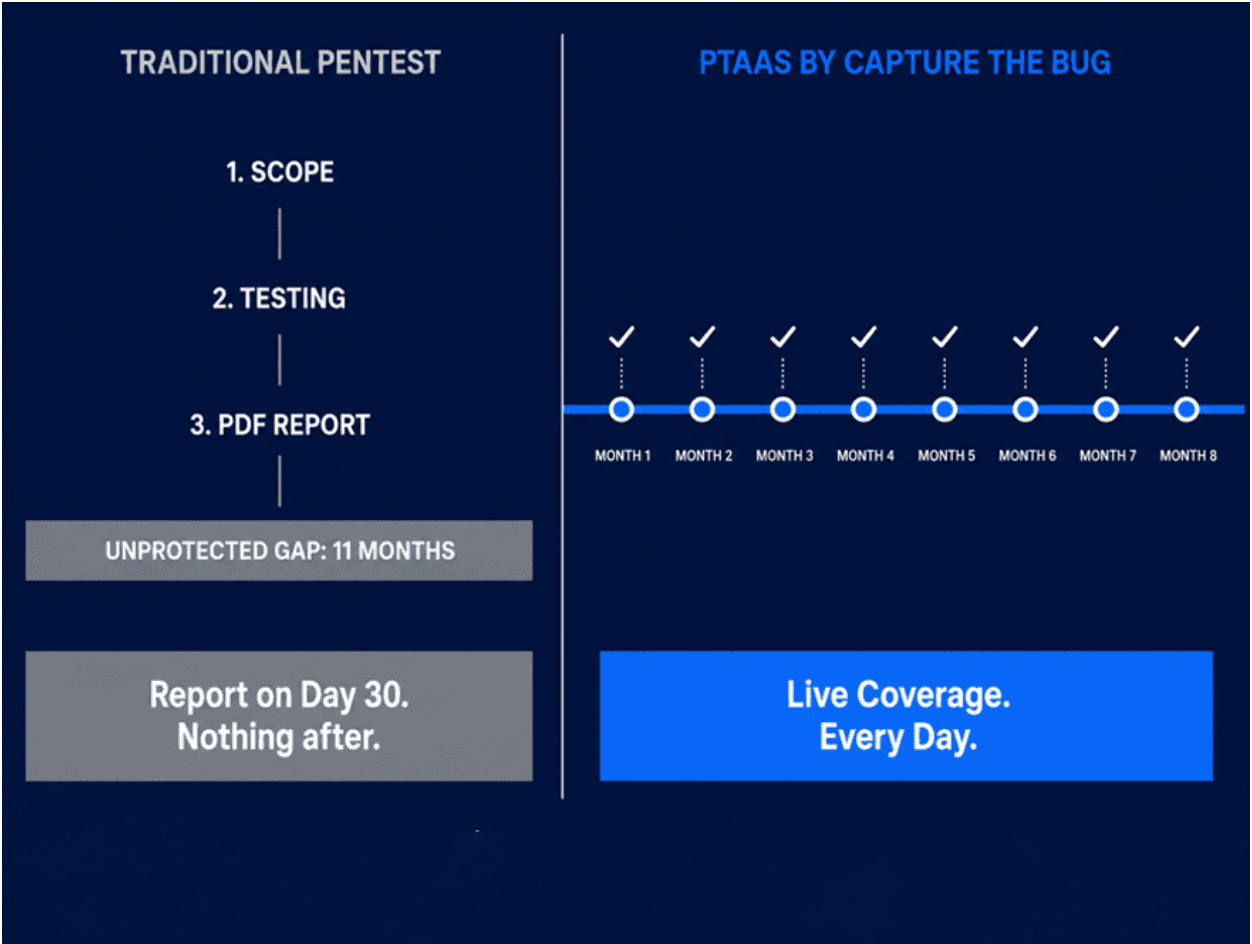
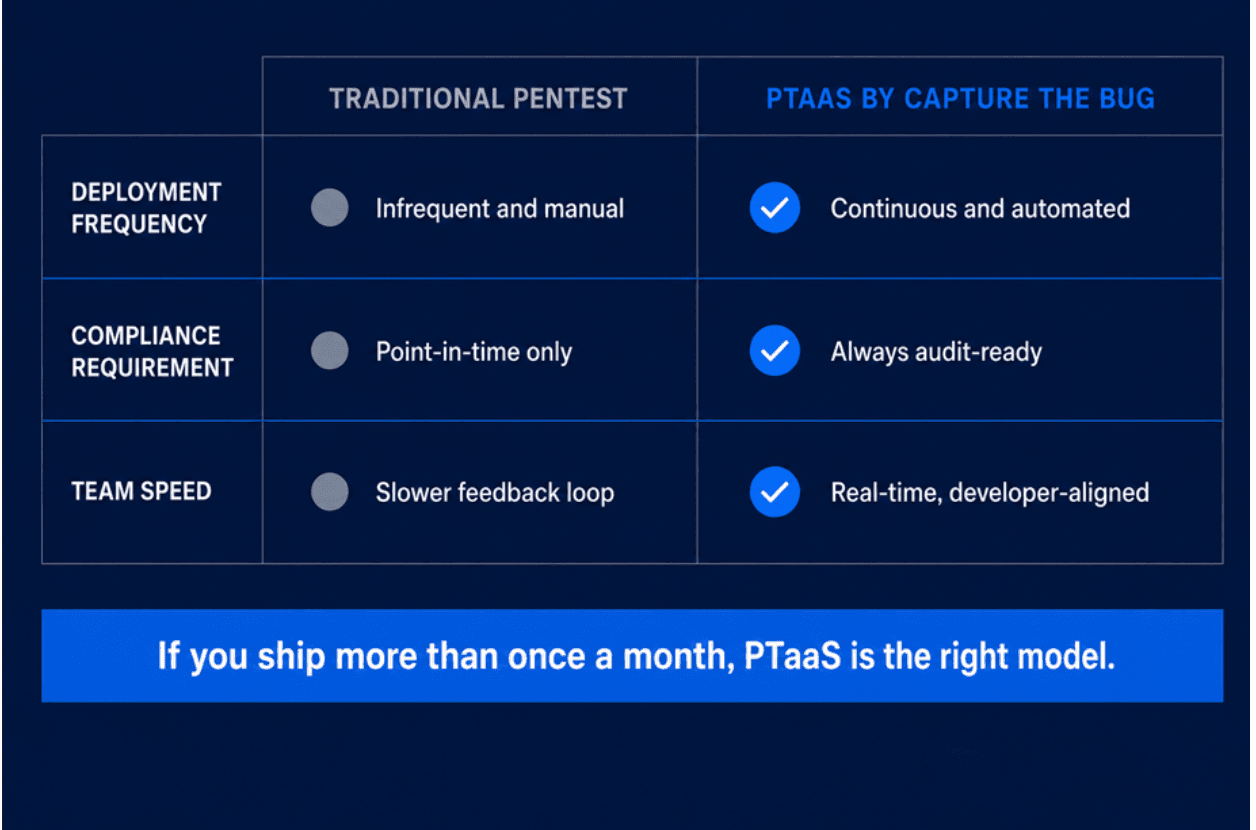
The easiest way to understand the gap between PTaaS and traditional pentesting is to look at what happens between tests.
With traditional pentesting, the answer is nothing. The engagement ends, the report is filed, remediation is attempted, and the business waits until the next cycle to find out whether anything was missed or whether new issues have emerged.
With PTaaS, there is no gap. Testing continues across the defined scope. New features can be tested as they are deployed. When the environment changes, the testing coverage changes with it. Findings are addressed and verified within the same cycle rather than being logged in a document for review months later.
This matters most for businesses that ship frequently, operate in regulated industries, or are building toward enterprise sales where security posture is actively scrutinized. For a SaaS company pursuing SOC 2 certification, or a fintech business dealing with enterprise procurement, the ability to show a live record of ongoing testing and verified remediation is meaningfully different from presenting a twelve-month-old PDF.
Your Last Pentest Is Already Out of Date
Every week you ship without continuous testing is a week a vulnerability goes unseen. See what Capture The Bug finds in your first engagement.
Where Traditional Pentesting Still Makes Sense
It would be inaccurate to say that traditional penetration testing has no place in 2026. There are situations where a scoped, point-in-time engagement is the right starting point.
Organizations with no existing security testing program often benefit from a traditional engagement first. It establishes a baseline, identifies structural vulnerabilities, and produces documentation that can inform a broader security strategy. Some compliance frameworks still reference periodic penetration testing in specific terms, and a formal engagement satisfies that requirement cleanly.
The honest answer is that traditional pentesting and PTaaS are not in direct competition for all use cases. They serve different needs at different stages. The problem is that most growing businesses have outgrown the traditional model without recognizing it yet.
What the Transition Looks Like in Practice
For businesses considering the move from traditional pentesting to a continuous model, the transition does not need to be disruptive. The scope, testing methodology, and certification standards remain the same. What changes is the delivery mechanism and the timeline.
Capture The Bug works with businesses at different stages of security maturity. Some are making the transition from annual engagements. Others are implementing structured security testing for the first time and choosing to start with a continuous model from the beginning. In either case, the platform provides the same CREST-certified testing quality with the added benefit of ongoing visibility and evidence generation.
The practical outcome for most clients is a reduction in audit preparation time, faster remediation cycles, and clearer visibility into security posture for leadership and compliance teams. The security function shifts from reactive to proactive, which changes both the cost profile and the risk profile of the business. Learn more about how the transition works at capturethebug.xyz/Services/penetration-testing.
The Question That Actually Matters in 2026
The PTaaS vs traditional penetration testing debate ultimately comes down to one question: how much of the year does a business want to operate without verified security coverage?
For most businesses, the honest answer is none of it. The risk window between annual tests is where real incidents occur. Attackers do not wait for the next engagement to probe for new vulnerabilities. They move in days, sometimes hours, when a new exposure appears.
Traditional pentesting closes the window once a year. PTaaS keeps it closed continuously.
Capture The Bug was built around the belief that security is not a report. It is a live system. That belief shapes how the platform works, how the testing team operates, and how clients experience ongoing security coverage across their environments.
For businesses that want to protect their systems, satisfy compliance requirements, and demonstrate security posture to enterprise buyers and auditors, the model that delivers continuous visibility is not just a better option. In 2026, it is the standard the market expects.
Book a Security Consultation with Capture The Bug and see what continuous pentesting looks like inside a real business environment.
Plan Your Annual Pentesting Strategy the Right Way
Learn how modern SaaS companies structure pentesting across the year to reduce risk, stay compliant, and avoid last-minute panic before audits.
Frequently Asked Questions
What is the main difference between PTaaS and traditional penetration testing?
Traditional penetration testing is a point-in-time engagement that produces a static report. PTaaS delivers continuous testing through a live platform, with findings visible in real time and remediation tracked and verified throughout the engagement period rather than after it ends.
Is PTaaS more expensive than traditional penetration testing?
The cost models are different. Traditional pentesting typically involves a large one-time fee per engagement. PTaaS uses a subscription-based model that spreads cost across the year and delivers ongoing coverage rather than a single test cycle. For most businesses, the ongoing value and reduced risk exposure make PTaaS the more cost-effective choice over time.
Can PTaaS replace a traditional pentest for compliance purposes?
In most cases, yes. PTaaS platforms like Capture The Bug produce compliance-ready documentation that satisfies SOC 2, ISO 27001, PCI-DSS, and similar framework requirements. The continuous evidence trail generated through PTaaS is often more compelling to auditors than a single annual report.
Which businesses benefit most from switching to PTaaS?
SaaS companies, fintech platforms, and any organization that ships product updates frequently will see the greatest benefit. Businesses pursuing enterprise sales or compliance certification also benefit significantly from the continuous evidence and live reporting that PTaaS provides.
How does Capture The Bug differ from traditional pentesting vendors?
Capture The Bug is a CREST-certified PTaaS platform that delivers continuous security testing through a real-time dashboard. Unlike traditional vendors who deliver a PDF at the end of an engagement, Capture The Bug provides live vulnerability tracking, direct collaboration between testers and internal teams, and on-demand compliance exports throughout the engagement.