What Is Software Penetration Testing? A Practical Guide for Modern Teams
Introduction: Why This Still Confuses Smart Teams
Most founders and engineering leaders understand they need security testing.
What they don’t always understand is what software penetration testing actually does in practice.
They’ve heard terms, seen reports, maybe even run a test once a year.
But when it comes to real impact, there’s often a gap.
Software penetration testing is not about checking boxes.
It is about answering one simple question:
If someone tried to break your product today, where would they succeed?
That’s the level of clarity modern businesses need.
What Software Penetration Testing Really Means
Software penetration testing is a controlled process where security experts attempt to find and exploit weaknesses in your application before real attackers do.
It focuses on how your product behaves in the real world, not just how it was designed.
Unlike surface-level checks, this approach looks at:
- How users interact with your system
- How data flows between components
- How authentication and permissions actually work
- How integrations behave under stress
The goal is not just to list issues.
The goal is to identify real, exploitable risk.
As highlighted in modern PTaaS models, testing is no longer a one-time event but an ongoing process that aligns with how software evolves.
Why Software Testing Alone Is Not Enough
Most teams already run QA, unit testing, and performance checks.
Those are important, but they answer different questions:
- Does the feature work?
- Does it scale?
- Does it break under load?
Penetration testing asks something deeper:
- Can this feature be abused?
- Can someone bypass logic?
- Can sensitive data be exposed?
That difference is where real risk lives.
The Core Types of Software Penetration Testing
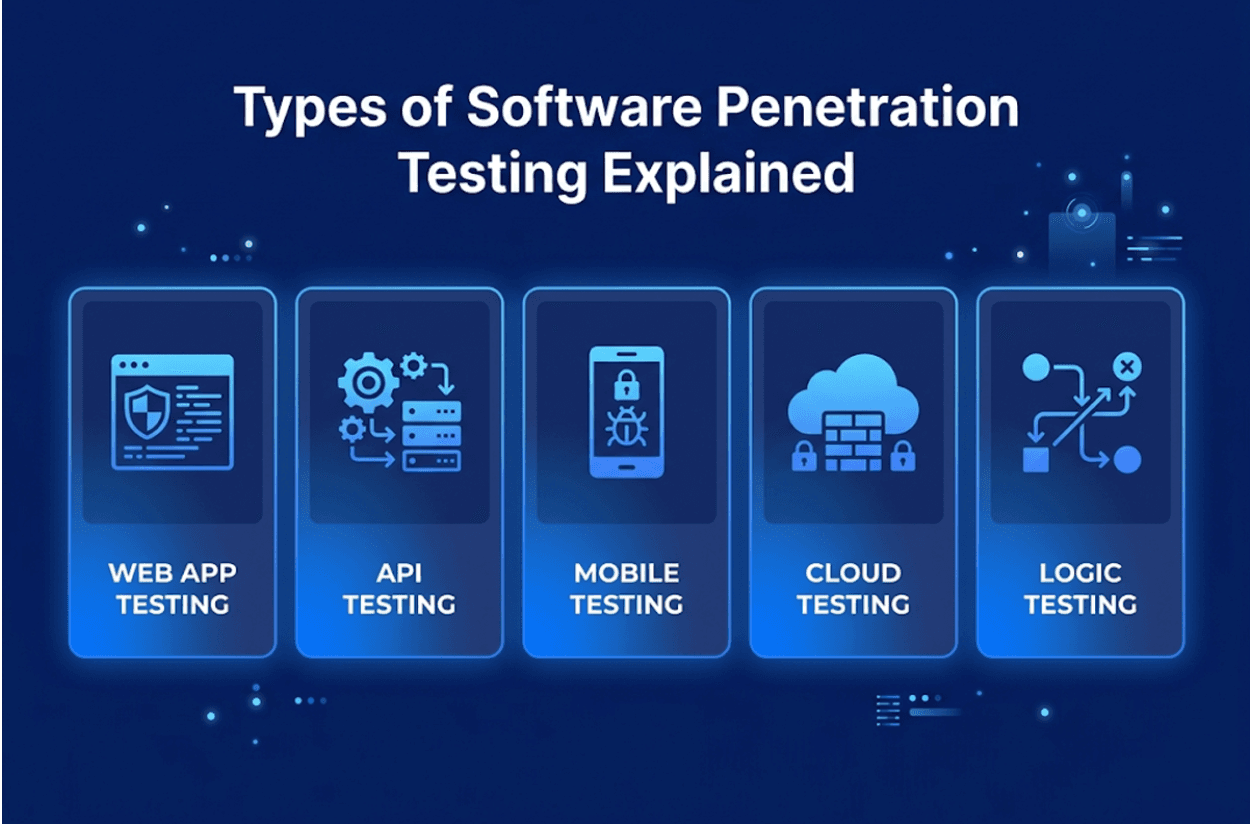
Not all testing is the same. The approach depends on what you’re building and how your system is structured.
1. Web Application Testing
This focuses on browser-based applications. It examines: Login systems, Input handling, Session management, Data exposure. This is where most business-critical vulnerabilities appear. For SaaS companies, this is usually the starting point. If your product is customer-facing, this is non-negotiable.
→ capturethebug.xyz/services/penetration-testing
2. API Testing
APIs are now the backbone of modern software. They connect services, power mobile apps, and expose data. Testing here focuses on: Authentication flaws, Broken access control, Data leakage, Logic abuse. Many breaches today come from APIs, not interfaces. This is where modern testing has shifted heavily.
3. Mobile Application Testing
Mobile apps introduce a different set of risks. This includes: Data storage on devices, Communication security, Reverse engineering risks, Session handling. If your product includes iOS or Android apps, this layer cannot be ignored.
4. Cloud and Infrastructure Testing
Your application does not run in isolation. It depends on: Cloud configurations, Storage permissions, Identity management, Network exposure. Misconfigurations here are one of the most common causes of breaches.
5. Logic and Business Flow Testing
This is where experienced testers bring the most value. It looks at how your business logic can be abused. Examples include: Bypassing payment flows, Exploiting discount logic, Accessing restricted data through indirect paths. These issues are often invisible to basic testing approaches.
The Tools Behind the Process
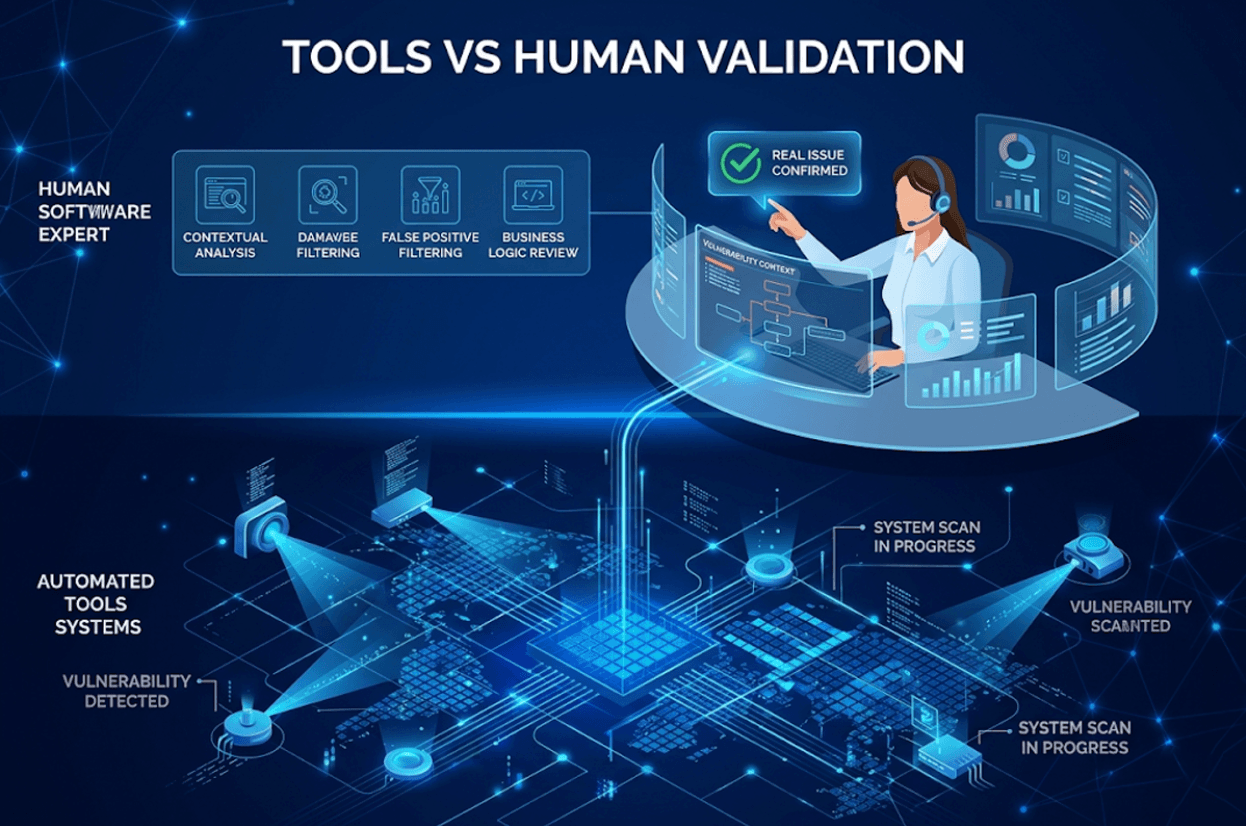
Tools support testing, but they do not replace expertise.
They help identify patterns, map systems, and speed up discovery.
Common categories include:
- Reconnaissance Tools: Used to understand the structure of your system and discover exposed assets.
- Interception Tools: Used to analyze and manipulate requests between client and server.
- Exploitation Frameworks: Used to test how vulnerabilities can be chained together.
- Reporting Platforms: Used to track findings, remediation, and validation.
But here’s the important part:
Tools find possibilities. Experts confirm reality.
That distinction matters.
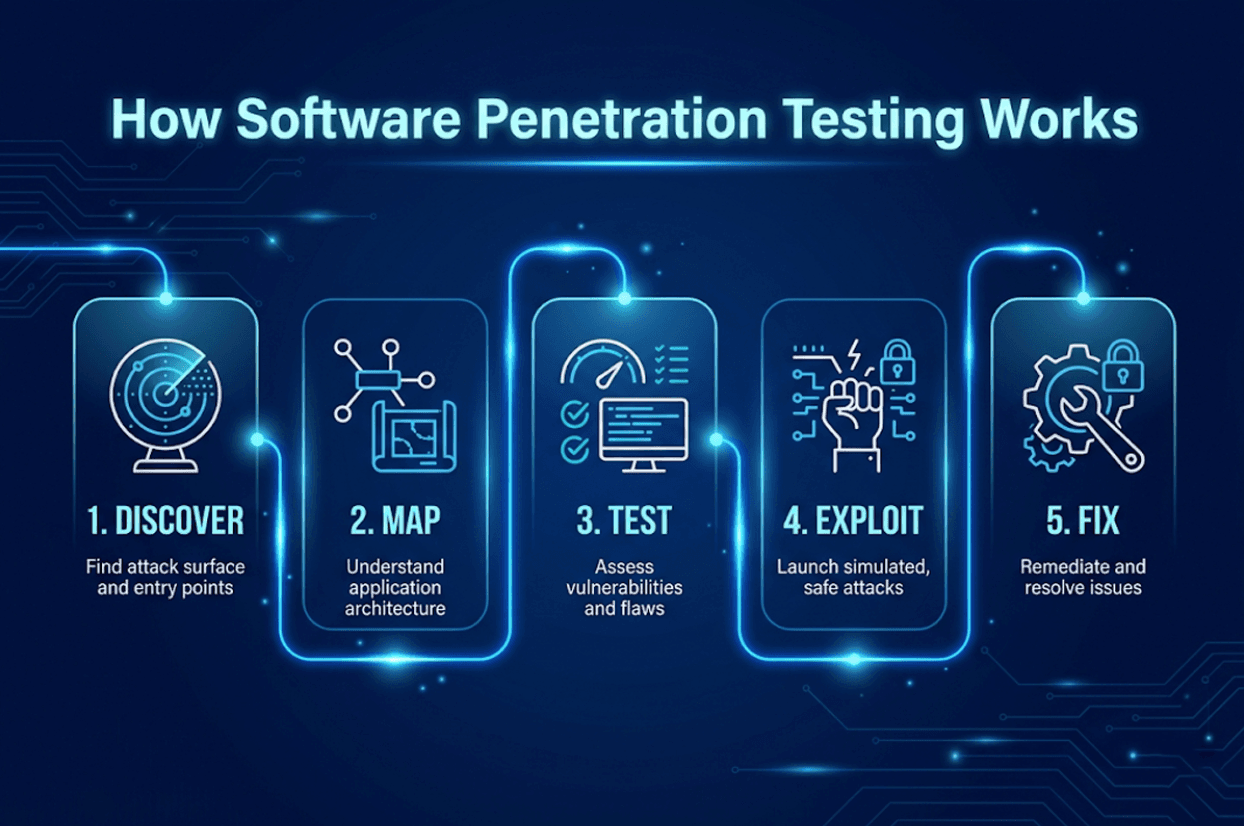
How the Process Actually Works
A real software penetration test is not random.
It follows a structured approach:
Step 1: Understanding the Application
Testers learn how your system works, not just technically, but functionally.
Step 2: Mapping the Attack Surface
Every endpoint, input, and integration is identified.
Step 3: Testing for Weaknesses
Inputs are manipulated. Flows are tested. Assumptions are challenged.
Step 4: Exploiting Real Issues
Testers go beyond detection to prove impact.
Step 5: Reporting and Fix Validation
Findings are explained clearly, and fixes are verified.
Modern platforms make this process continuous rather than periodic, giving teams ongoing visibility instead of delayed reports.
Find Out How Often You Should Test Your Systems
Discover the ideal pentesting frequency based on your product, growth stage, and compliance needs — used by modern SaaS security teams.
Check Your Testing FrequencyThe Shift from One-Time Testing to Continuous Testing
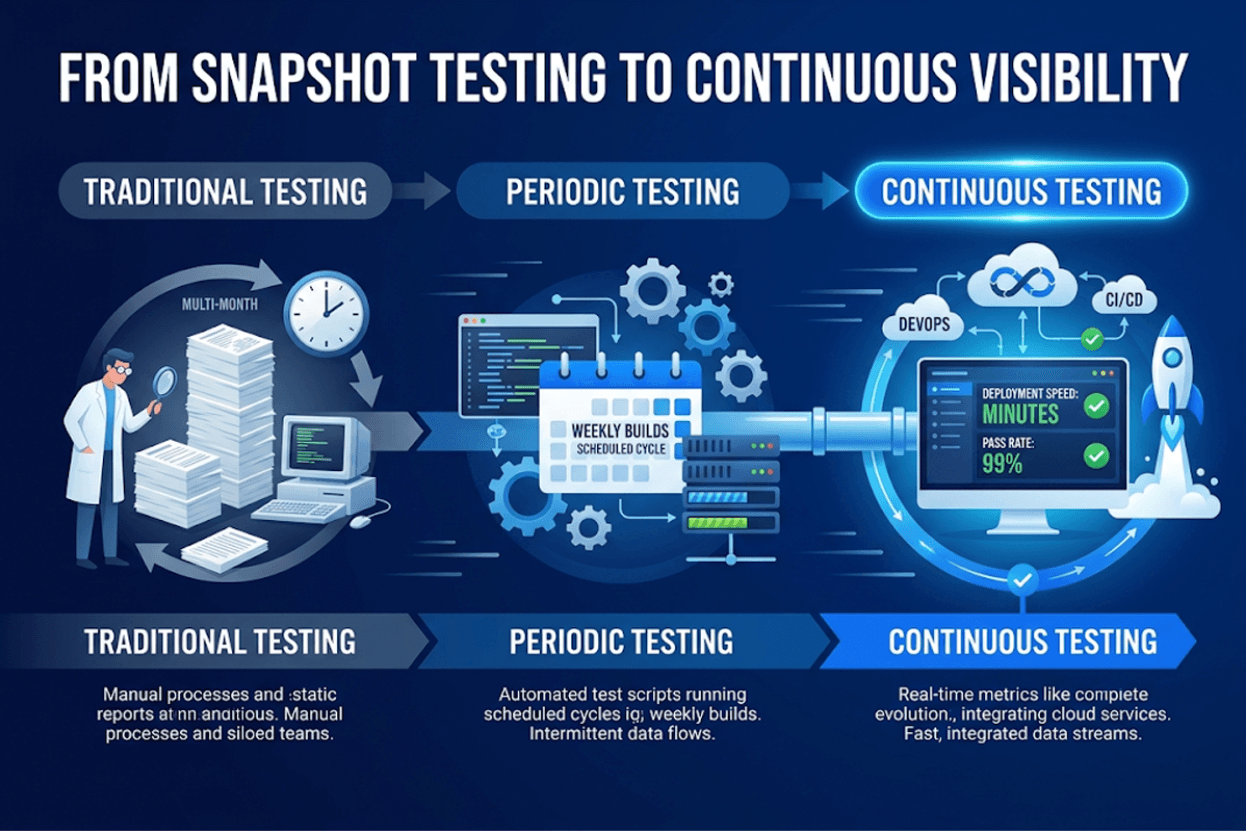
Here is where many companies fall behind.
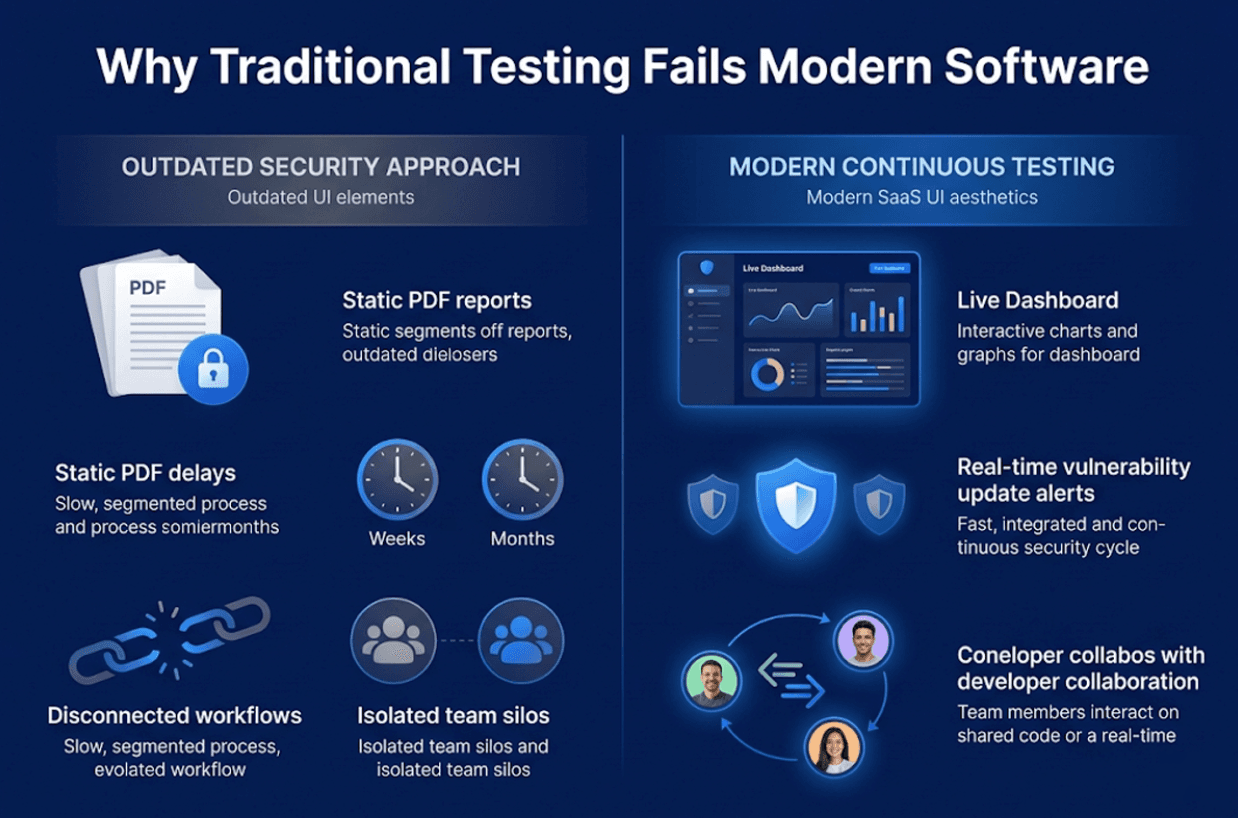
Traditional testing gives you a snapshot.
But your software changes constantly.
New features, new integrations, new risks.
If testing happens once a year, you are only secure for that moment.
This is why modern teams are moving toward continuous testing models.
Instead of waiting weeks for reports, fixing outdated issues, and repeating the cycle—they now test when features are released, see results in real time, and fix issues immediately.
This shift changes security from reactive to proactive.
Where Most Teams Get It Wrong
There are a few common mistakes:
Treating Testing as Compliance
Many teams test only because they need a certificate. That mindset misses the point. Security should reduce risk, not just pass audits.
Focusing Only on Reports
A report is not the outcome. The outcome is: Issues fixed, Risks reduced, Systems hardened.
Delaying Fixes
The longer a vulnerability exists, the higher the risk. Speed matters more than volume.
Why This Matters for SaaS and Growing Companies
If you are building software today, especially SaaS, your environment is constantly evolving.
That creates two realities:
- Your attack surface is always changing
- Your risk is always moving
Software penetration testing gives you: Clarity on real risk, Confidence in releases, Proof for customers and auditors. It becomes part of how you build, not something you do occasionally.
→ capturethebug.xyz/services/penetration-testing
The Capture The Bug Approach
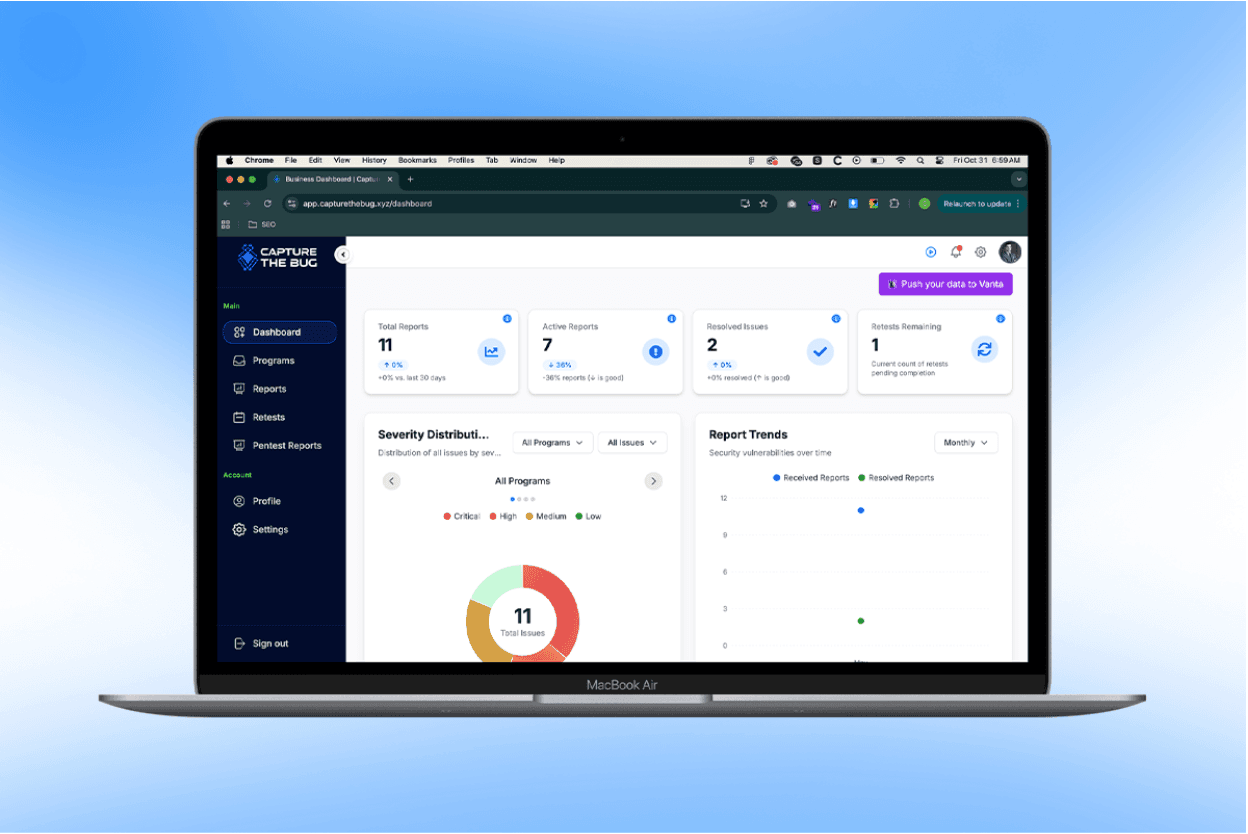
Capture The Bug approaches software penetration testing as an ongoing process, not a one-time activity.
With CREST-certified expertise and a continuous testing model, the focus is on:
- Real-time visibility into vulnerabilities
- Human-validated findings
- Clear remediation guidance
- Compliance-ready reporting
Instead of waiting for a static document, teams get ongoing insight into their security posture.
This aligns testing with how modern software is actually built and deployed.
Final Thoughts
Software penetration testing is not about tools or checklists.
It is about understanding how your product can fail under real-world conditions.
The companies that treat it as a continuous process gain a clear advantage:
- They fix faster
- They release with confidence
- They build trust with customers
In today’s environment, security is not a phase.
It is part of the product itself.
FAQ
1. What is software penetration testing?
It is a process where experts simulate real-world attacks on software to identify and validate exploitable vulnerabilities.
2. How is it different from regular testing?
Regular testing checks functionality. Penetration testing checks how the system can be broken or abused.
3. How often should software be tested?
Ideally, testing should happen continuously or after every major update, not just once a year.
4. Are tools enough for penetration testing?
No. Tools help identify potential issues, but human expertise is required to validate real risk.
5. Why is it important for SaaS companies?
Because SaaS products change frequently, creating new vulnerabilities that need continuous validation.