How Much Does Penetration Testing as a Service Actually Cost in Australia and New Zealand?
The Question Every CTO and CISO Eventually Asks
There is a moment that happens in almost every growing technology company in Australia and New Zealand. The business has scaled, the product is handling real customer data, a compliance requirement has landed on the desk, or the board has started asking security questions that the team cannot fully answer. And someone, usually the CTO or the founder, types into Google: how much does penetration testing actually cost?
What they find is almost always unsatisfying. Vendor websites talk about "custom pricing" and "contact us for a quote." Blog posts quote ranges so wide they are practically useless. Nobody wants to say a number out loud.
Capture The Bug believes that transparency builds trust. So this post is going to do what most vendors avoid. It will break down what penetration testing actually costs in the Australian and New Zealand market in 2026, what drives those costs up or down, and how the Penetration Testing as a Service model compares to the traditional engagement model on a real dollar basis.
Why Penetration Testing Pricing Is So Hard to Find
The opacity around security testing pricing is not accidental. Traditional penetration testing firms price on a project-by-project basis, and those prices vary enormously based on scope, team size, engagement length, and the seniority of the testers involved. There is no standard published rate. This creates a situation where two companies with similar needs can receive quotes that differ by tens of thousands of dollars.
It also creates a problem for buyers. Without a reference point, it is almost impossible to know whether a quote is reasonable, inflated, or suspiciously low. A low quote is not always good news in security. An underpriced engagement often means a smaller team, less time in scope, or testers who are less experienced than what the job actually requires.
The pricing model for Penetration Testing as a Service is structurally different, and understanding that difference is the first step toward making an informed decision.
What a Traditional Pentest Costs in Australia and New Zealand
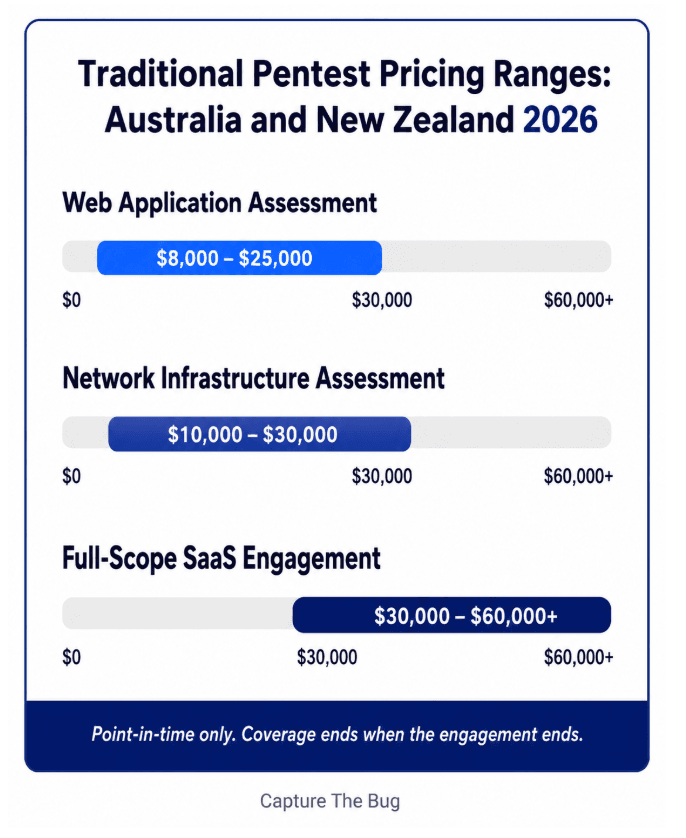
For a traditional penetration testing engagement in the Australian and New Zealand market, businesses should expect to budget within the following ranges based on the type of assessment.
- Web Application Pentest: $8,000 to $25,000. Lower end reflects limited scope; higher end reflects complex apps and larger attack surfaces.
- Network Infrastructure Assessment: $10,000 to $30,000 for small to mid-sized environments.
- Full-Scope Engagement: $30,000 to $60,000+ covering web apps, internal networks, and cloud infrastructure for growth-stage SaaS companies.
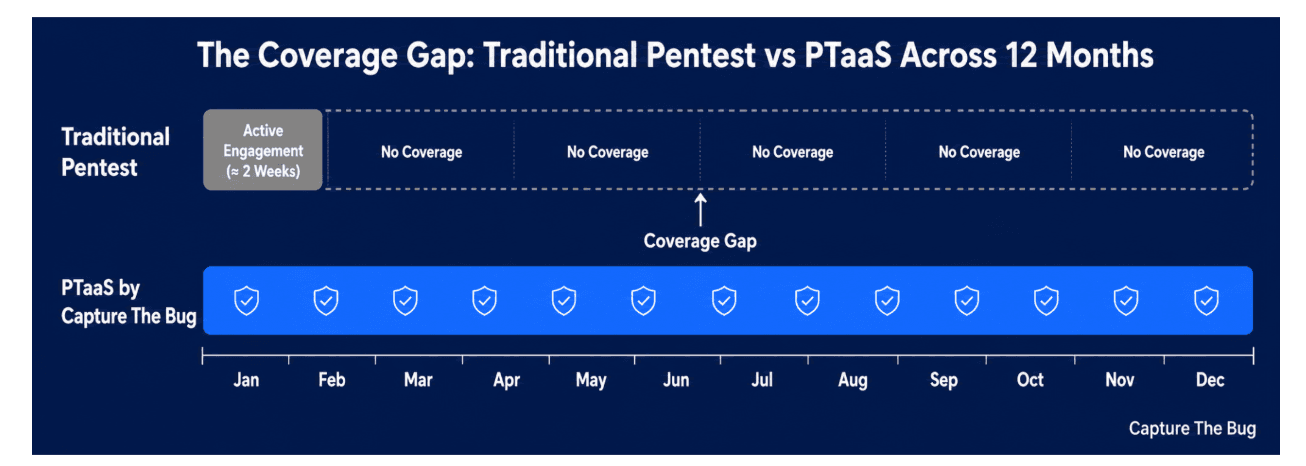
These are one-time costs for a point-in-time assessment. The engagement has a start date and an end date. When it concludes, so does the coverage. Any changes to the environment after that point, and for a product company that is shipping regularly, there will be many changes, are not covered until the next engagement is commissioned.
What Penetration Testing as a Service Costs and What It Includes
PTaaS pricing operates differently because the service itself operates differently. Rather than a fixed fee for a fixed engagement window, PTaaS is structured around ongoing access to security research talent that continuously assesses a defined environment.
Capture The Bug structures its penetration testing programs across different tiers based on the size of the program, the scope of assets in scope, and the depth of coverage required. For companies exploring this at https://capturethebug.xyz/services/penetration-testing, the key distinction is that the annual investment in a PTaaS model needs to be compared against the total annual cost of running traditional engagements across the same coverage period, not against a single traditional engagement.
For a growth-stage SaaS company that ships product every two to four weeks, a single annual pentest leaves ten to eleven months of untested exposure each year. To achieve genuinely comparable coverage through traditional engagements, that company would need to commission multiple engagements across the year, which quickly pushes the annual cost well above what a PTaaS program of equivalent coverage would cost.
When companies account for the full annual cost of maintaining real security coverage rather than the sticker price of a single engagement, the PTaaS model consistently delivers a stronger return on security investment.
The Costs That Never Appear in a Vendor Quote
One of the most important numbers to understand when evaluating security testing costs is the one that does not appear in any vendor quote. That is the cost of a vulnerability that is found by someone other than your testing team.
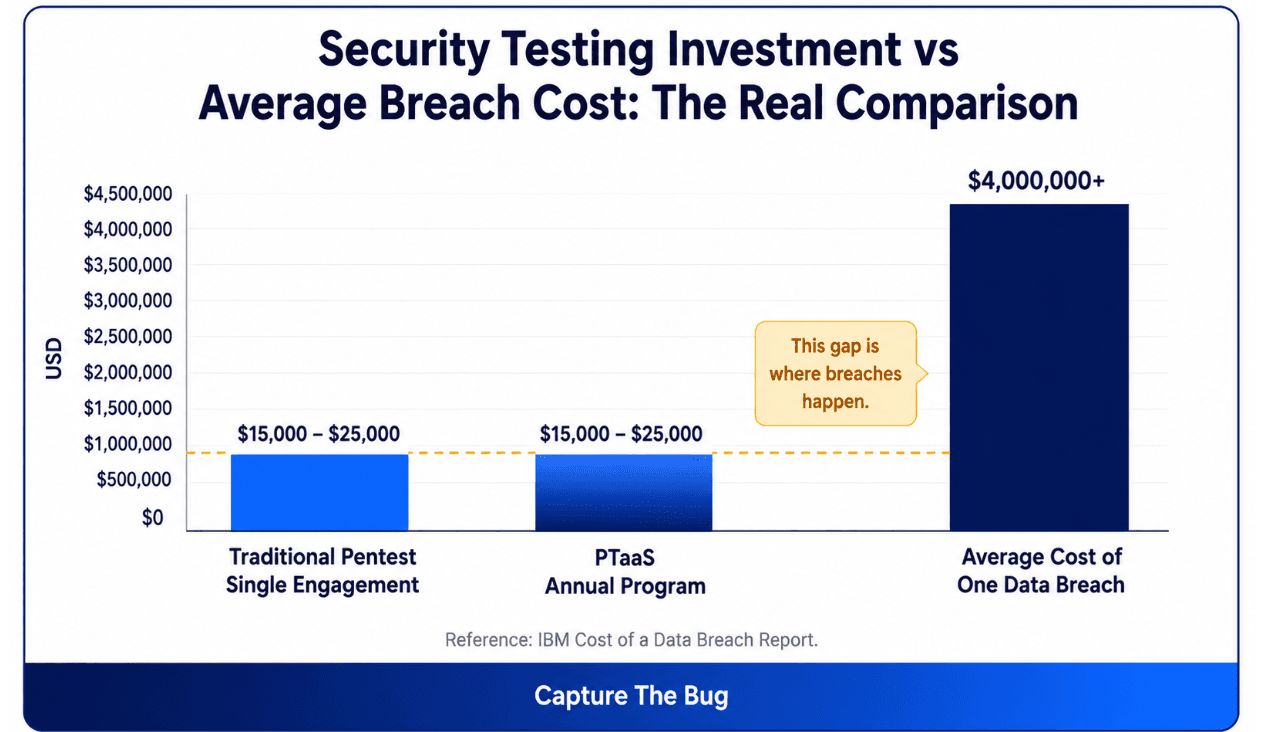
The IBM Cost of a Data Breach Report has placed the average cost of a breach for organisations in the technology and financial services sectors consistently above four million dollars in recent years. That number includes incident response, legal costs, regulatory penalties, customer notification, and reputational damage. For companies operating in Australia under the Notifiable Data Breaches scheme, or in New Zealand under the Privacy Act 2020, the regulatory dimension of a breach adds further financial exposure.
This context matters when evaluating security testing budgets. A business that invests $15,000 in a traditional pentest and discovers it has eleven months of untested exposure each year has not solved its security problem. It has created a false sense of coverage that could prove far more costly than the test itself.
Capture The Bug's model is designed to eliminate that untested window. Over 500 companies trust the platform, and more than 2,500 verified vulnerabilities have been reported and resolved through its programs. That volume of real-world findings represents genuine risk that was caught before it became a breach, not after.
What Drives the Cost of a PTaaS Program Up or Down
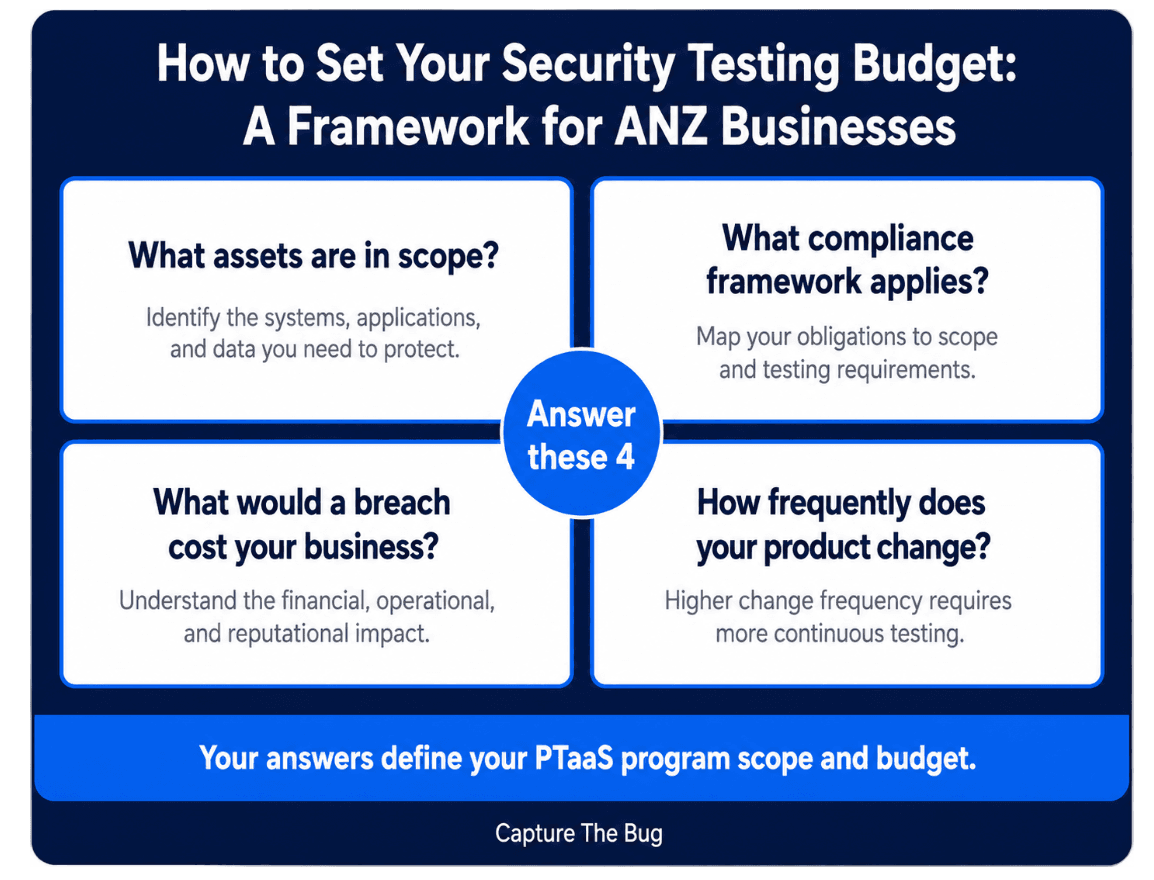
For businesses evaluating a PTaaS investment, several factors influence the cost of a program. Understanding them helps in setting a realistic budget and scoping a program that fits both the risk profile and the budget of the business.
- Number of assets in scope: The primary driver. A program covering a single web application will cost less than one covering multiple applications, an internal network, and cloud infrastructure.
- Severity of findings: Programs that uncover a higher volume of critical findings naturally require more remediation support and re-testing cycles. Capture The Bug's triage process ensures that findings are validated before they reach the client team.
- Compliance requirements: A company needing SOC 2 Type 2 certification, ISO 27001 audit, or PCI-DSS compliance will require a more formally documented program.
Capture The Bug's penetration testing services at https://capturethebug.xyz/services/penetration-testing are structured to support both goals within a single program.
How to Think About Security Testing as a Business Investment
The framing that serves most companies best is not to think of penetration testing as a cost line, but as a risk transfer mechanism. The question is not what does a pentest cost, but what is the cost of the risk that the pentest is designed to identify and close.
For a business processing customer financial data in Australia, the answer to that question involves regulatory penalties, customer trust, and business continuity. For a healthcare SaaS company in New Zealand, it involves patient data obligations and professional liability.
When that risk picture is in view, the investment in a continuous, well-structured PTaaS program becomes far easier to justify. And when a company is ready to have that conversation with a provider that publishes its track record, holds CREST certification, and has paid out over $1.2 million in researcher rewards across a verified community, Capture The Bug is the place to start at https://capturethebug.xyz/services/penetration-testing.
Get Audit-Ready Without the Guesswork
Download a complete SOC 2 checklist designed for fast-growing SaaS companies. Know exactly what auditors expect and fix gaps before they cost you deals.
Download Your SOC 2 Checklist Now
Frequently Asked Questions
What is the average cost of penetration testing in Australia in 2026?
A traditional penetration testing engagement in Australia typically ranges from $8,000 for a scoped web application assessment to $60,000 or more for a full-scope engagement covering multiple systems. PTaaS pricing varies based on program scope and is structured for ongoing coverage rather than a single engagement.
Is PTaaS cheaper than traditional penetration testing in New Zealand?
On a single-engagement comparison, traditional pentesting may appear lower cost. However, when the full annual cost of maintaining genuine coverage is compared, PTaaS consistently delivers more findings per dollar invested.
What is included in a PTaaS program that is not included in a traditional pentest?
A PTaaS program from Capture The Bug includes continuous researcher access, real-time triage and reporting, re-testing of resolved findings, and compliance-ready documentation across the full engagement period.
How does CREST certification affect the price of penetration testing?
CREST-certified providers meet independently assessed standards for quality and methodology. While they may carry a premium over uncertified alternatives, the quality and compliance value they deliver justifies that difference, especially for regulated industries.
How quickly can a business get started with a PTaaS program in Australia or New Zealand?
Capture The Bug is able to onboard new programs significantly faster than the scoping and scheduling cycle of a traditional engagement. Most programs can be active within days of the initial program setup.