
Picture a Series A SaaS team in Wellington. The product is growing, a large enterprise customer is close to signing, and then the security questionnaire lands. Somewhere in that long list is a single line that stops everyone in the room: "Please provide a recent penetration test report."
The founder's first question is almost always the same. How much is this going to cost?
Ask around and the answer is usually a shrug and the words "it depends." That is technically true, but it is not useful. SaaS teams need real numbers, real ranges, and a clear sense of what they are actually paying for. So here is the honest breakdown of what penetration testing costs across New Zealand and Australia in 2026, what moves the price, and how to make sure the spend genuinely protects the business.
Why There Is No Single Price Tag
Penetration testing is not a product with a shelf price. It is a skilled service, and the cost tracks the work involved.
Two things drive most of the number: scope and complexity. Scope is how much gets tested: a single web app, versus a web app plus its APIs, a mobile app, cloud configuration, and internal systems. Complexity is how hard that target is to test. A simple marketing site behaves very differently from a fintech platform with dozens of user roles, payment flows, and third-party connections.
On top of that sit three more factors: the type of testing, the seniority of the testers, and whether retesting is included. A CREST-certified provider running a deep, manual test with experienced testers costs more than a light, surface-level check, and it should, because the findings are worth far more.
Understanding these drivers is the difference between reading a quote and knowing whether it is fair.
What Penetration Testing Actually Costs SaaS Teams in 2026
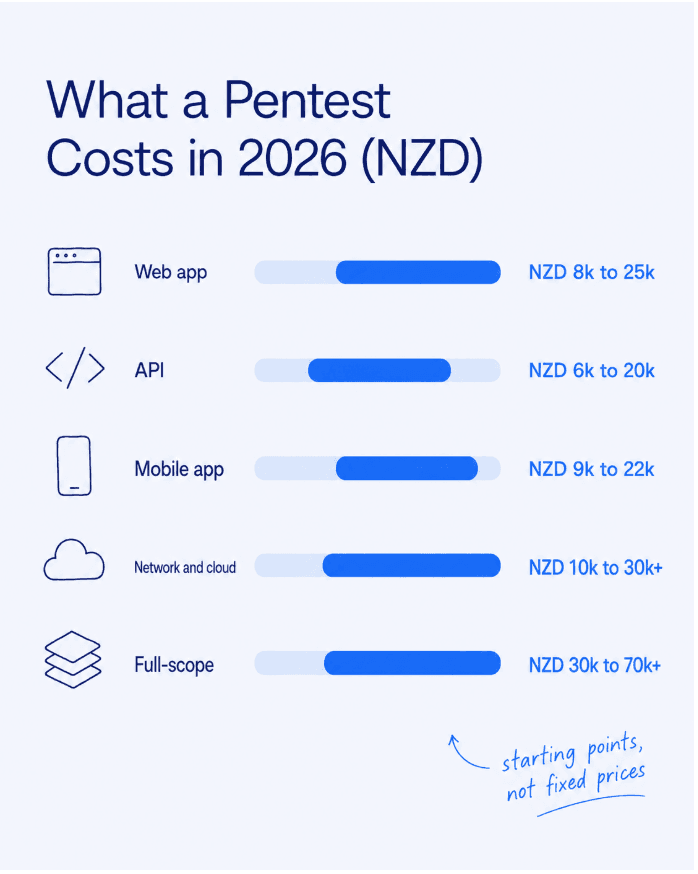
Here are the typical market ranges for SaaS teams across New Zealand and Australia this year. Treat them as starting points, not fixed prices, because scope changes everything.
A web application test usually lands between NZD 8,000 and NZD 25,000, depending on the number of features, user roles, and integrations. An API-focused test tends to run from NZD 6,000 to NZD 20,000. A mobile application test commonly falls between NZD 9,000 and NZD 22,000. Network and cloud configuration testing often starts around NZD 10,000 and climbs past NZD 30,000 for larger environments. A full-scope engagement for a growing platform, covering several of the above, frequently sits between NZD 30,000 and NZD 70,000 or more.
Many providers price by tester-days. A senior tester-day in the region commonly runs from NZD 1,800 to NZD 2,800, and a typical SaaS web app test takes five to ten days of focused work. Australian pricing in AUD tracks closely to these figures.
For a first-time test on a single product, most early-stage SaaS teams should budget somewhere in the NZD 8,000 to NZD 15,000 range.
What Moves the Number Up or Down
Once the basics are set, a handful of details decide whether a quote sits at the low or high end.
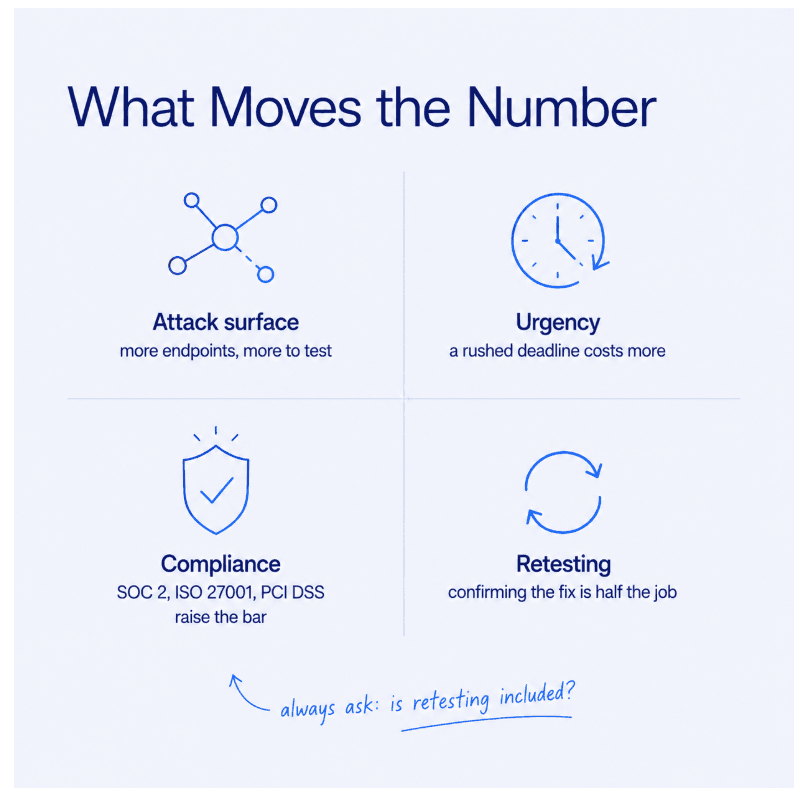
The size of the attack surface matters most. More endpoints, more APIs, and more user roles mean more to test. A platform with admin, staff, and customer tiers takes longer than one with a single login.
Urgency is the next lever. A test booked weeks ahead costs less than one squeezed in to hit an audit deadline or close a deal by Friday.
Compliance raises the bar too. If the report needs to satisfy SOC 2, ISO 27001, or PCI DSS, the testing and documentation are more thorough, which is reflected in the price.
Finally, ask one question that quietly changes the value of every quote: is retesting included? Finding a vulnerability is only half the job. Confirming it is fixed is the other half. When retests are billed separately, a cheap-looking engagement can end up costing far more than the sticker suggested.
For teams weighing these trade-offs, Capture The Bug lays out scope and inclusions clearly through its penetration testing services, so there are no surprises after the invoice.
Your Last Pentest Is Already Out of Date
Every week you ship without continuous testing is a week a vulnerability goes unseen. See what Capture The Bug finds in your first engagement.
The Cost SaaS Teams Forget to Count
The price of a single test is easy to see. The expensive part is what happens between tests.
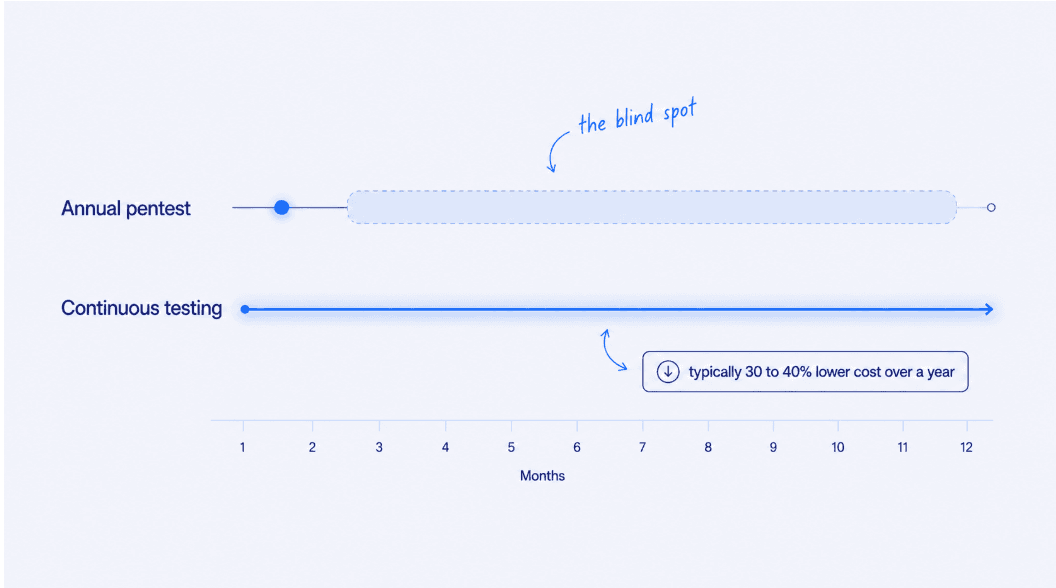
Traditional penetration testing works on an annual rhythm. A provider tests once, delivers a PDF, and the engagement closes. The problem is that SaaS products do not stand still for a year. New features ship, code changes, and fresh vulnerabilities appear the day after the report is signed off. That report starts aging immediately, and for most of the year the team is running on faith rather than evidence.
There is a real cost to that gap. Every unseen vulnerability is a potential incident, and incidents are far more expensive than any test. Ransomware recovery alone routinely runs past NZD 1.5 million, and a single breach can cost many times an entire year of security testing.
This is why more ANZ SaaS teams are moving from one-off engagements to continuous testing. Instead of a yearly snapshot, the platform tests on an ongoing basis, findings appear in a shared dashboard as they surface, and retests are part of the model rather than an extra line item. This is the idea behind Capture The Bug's continuous penetration testing, where coverage runs all year and confirming a fix is built in. Over a full year, this approach typically cuts testing-related costs by 30 to 40 percent while covering far more ground.
The math is simple. One predictable subscription that runs all year usually beats several separate engagements that each leave months of blind spots.
How to Spend Smart on Penetration Testing
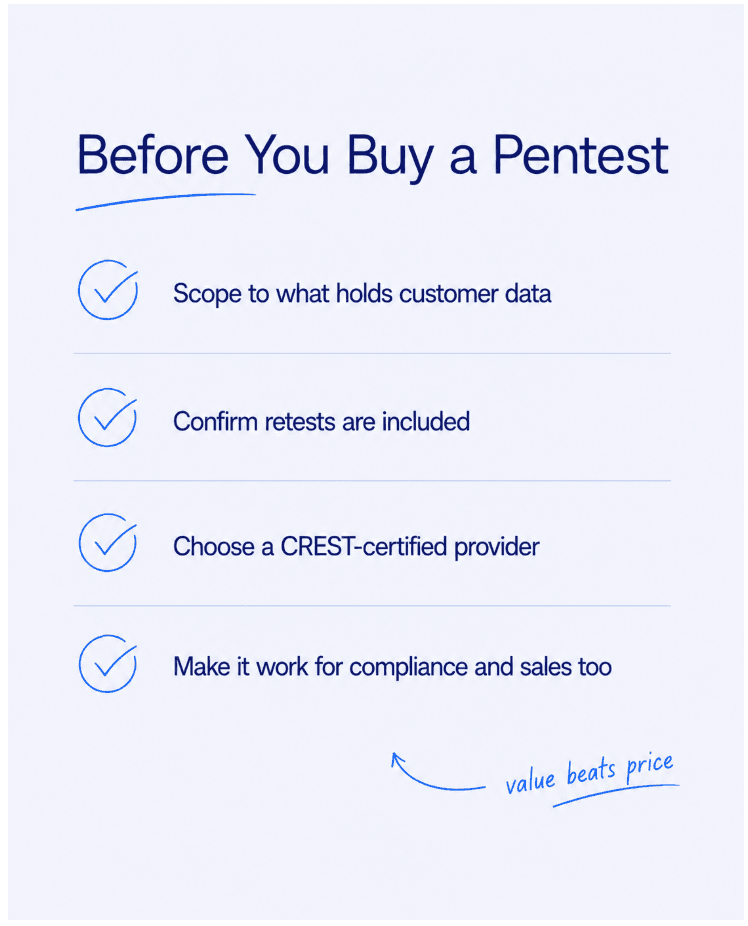
Getting value from a testing budget is less about finding the cheapest quote and more about asking better questions.
Start by scoping tightly. Test what actually matters, meaning the product, its APIs, and the systems that hold customer data, rather than trying to test everything at once. Confirm what is included, especially retests and remediation support, so the headline number is the real number. Look for a CREST-certified provider, because the certification is a signal that the testing meets a recognised standard.
Then think beyond the single report. The best testing spend does double duty: it satisfies compliance, it reassures enterprise customers during due diligence, and it genuinely reduces risk. When a test can help close a deal and pass an audit, it stops being a cost and starts paying for itself.
Capture The Bug is built around exactly this outcome, giving SaaS teams continuous coverage, clear reporting, and audit-ready evidence through its penetration testing services.
The Bottom Line
Penetration testing in 2026 is not cheap, but it is far cheaper than the alternative. For most SaaS teams in New Zealand and Australia, a single test ranges from a few thousand to tens of thousands of dollars, and the smarter move is to treat security as something continuous rather than a once-a-year expense.
To see what continuous, compliance-ready testing would cost for a specific product, teams can book a demo with Capture The Bug and get a clear picture before committing to anything.
Plan Your Annual Pentesting Strategy the Right Way
Learn how modern SaaS companies structure pentesting across the year to reduce risk, stay compliant, and avoid last-minute panic before audits.
FAQ
1. How much does a penetration test cost for a SaaS company in 2026?
For most SaaS teams in New Zealand and Australia, a single penetration test ranges from about NZD 8,000 to NZD 25,000 for a web application, and NZD 30,000 or more for a full-scope engagement. The final figure depends on scope, complexity, and compliance needs.
2. Why do penetration testing prices vary so much?
Price tracks the work involved. A larger attack surface, more user roles, tighter deadlines, and compliance requirements like SOC 2 or ISO 27001 all increase the effort, and therefore the cost.
3. Is continuous penetration testing cheaper than a one-off annual test?
Over a full year it usually is. Continuous testing spreads cost into a predictable subscription, includes retests, and removes the long blind spots between annual engagements, typically reducing testing-related costs by 30 to 40 percent.
4. Does a cheaper pentest still meet compliance requirements?
Not always. Low-cost, surface-level testing may not satisfy SOC 2, ISO 27001, or PCI DSS. A CREST-certified provider delivers testing and documentation built to meet recognised standards.
5. What should be included in a penetration testing quote?
At minimum: clear scope, the testing method, a detailed report, and retesting to confirm fixes. Capture The Bug sets out scope and inclusions upfront, so the quoted price is the real cost.