How to Choose a Penetration Testing Provider in Australia: 7 Questions to Ask Before You Sign
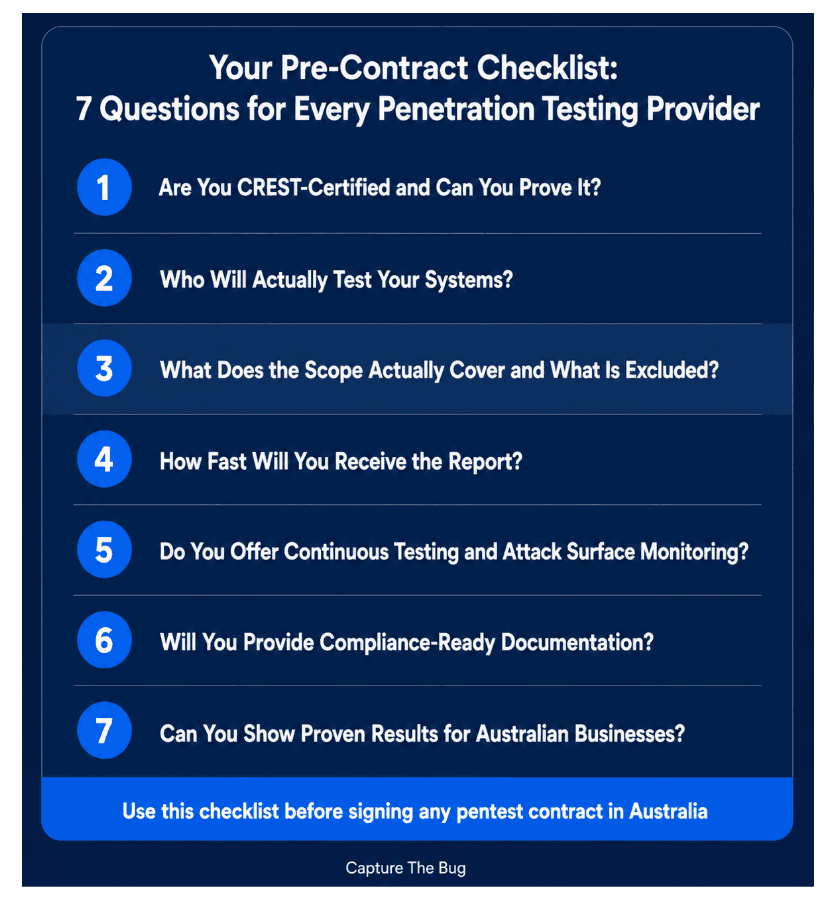
The Decision That Most Businesses Get Wrong
Choosing a penetration testing provider is not like choosing an accounting firm or a legal team. The stakes are different. A bad accounting engagement costs money and time. A bad penetration testing engagement gives a business false confidence that its systems are secure when they are not. And false confidence in security is more dangerous than no confidence at all, because it stops the right conversations from happening until something goes wrong.
The Australian market for security testing has grown significantly over the past few years. The combination of tighter regulatory expectations under frameworks like the Australian Privacy Act, rising cyber insurance requirements, and a genuine increase in the frequency and sophistication of attacks on Australian businesses has pushed security testing from a nice-to-have to a board-level conversation.
Question One: Are You CREST-Certified and Can You Prove It
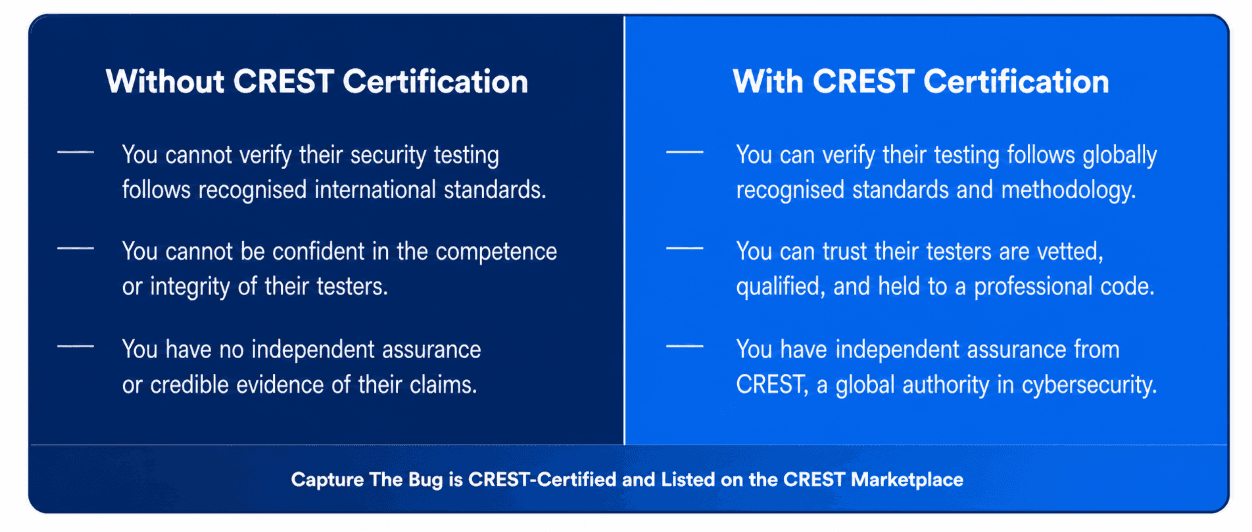
CREST is the international body that independently certifies penetration testing organisations and the professionals who work within them. Certification is not automatic. It requires the organisation to demonstrate that its methodology, quality controls, and professional standards meet a defined benchmark.
In the Australian market, CREST certification carries specific weight. The Australian Prudential Regulation Authority and a growing number of enterprise procurement teams specify CREST-certified testing as a requirement, not a preference. Cyber insurers are also increasingly asking whether testing was conducted by a CREST-certified provider when assessing a claim.
Capture The Bug holds CREST certification and is listed on the CREST marketplace, which means any business can verify its standing independently without taking the company's word for it.
Question Two: Who Actually Does the Testing and What Are Their Credentials
This question matters more than it sounds. Many security testing firms sell at the relationship level and then deliver at the junior tester level. The person presenting in the sales meeting is rarely the person running the assessment. Understanding who will actually be conducting the testing, what their experience is, and how the firm validates the quality of their work is essential information that too few buyers ask for before signing.
Question Three: What Does the Scope Actually Cover and What Is Excluded
Scope creep in the wrong direction is a real problem in penetration testing engagements. A business signs a contract expecting comprehensive coverage and receives a tightly bounded assessment that excludes the parts of the environment most likely to be targeted. The scope document is where this happens, and it is where buyers need to read carefully.
At https://capturethebug.xyz/services/penetration-testing, Capture The Bug structures its programs around clear scope definitions that are agreed with the client before testing begins. Over 500 companies have gone through this process, and the clarity of scope at the start directly correlates with the usefulness of the findings at the end.
Question Four: How Are Findings Reported and How Quickly
The quality of a penetration testing engagement is only as useful as the report that comes out of it. A report full of technical findings with no business context, no prioritisation framework, and no clear remediation guidance is not a useful security document.
In a PTaaS model, timing is equally important. Real-time reporting means a critical finding does not sit in a queue waiting for a weekly review cycle. Capture The Bug's triage process, which has maintained a 4.7 out of 5 customer satisfaction rating, is designed to ensure findings reach the right person quickly enough to act on them.
Question Five: Does Your Model Support Continuous Coverage or Just a Point in Time
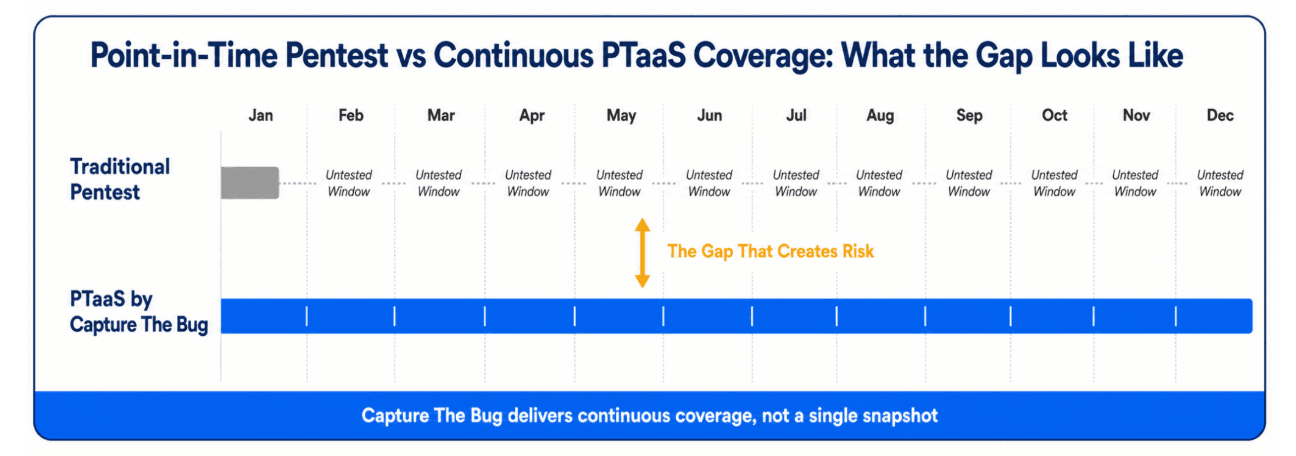
This question is particularly important for any Australian business that is shipping product regularly, managing a cloud environment that changes with infrastructure updates, or operating in a regulated industry where the expectation of ongoing security monitoring is explicit rather than implied.
A traditional penetration testing engagement delivers a snapshot. It is accurate at the moment of testing and progressively less accurate every week after the report is delivered. Capture The Bug's Penetration Testing as a Service model at https://capturethebug.xyz/services/penetration-testing is built specifically to close that gap with ongoing researcher access and real-time findings.
Question Six: Can You Produce Compliance-Ready Documentation
For businesses working toward SOC 2, ISO 27001, PCI-DSS, or meeting the expectations of the Australian Prudential Regulation Authority, the format and content of security testing documentation matters beyond the findings themselves.
Ask whether the provider's reports are structured to map to the compliance framework the business is working within. Ask whether they can provide a letter of attestation or a summary document formatted for audit submission.
Question Seven: What Does Your Track Record Actually Look Like
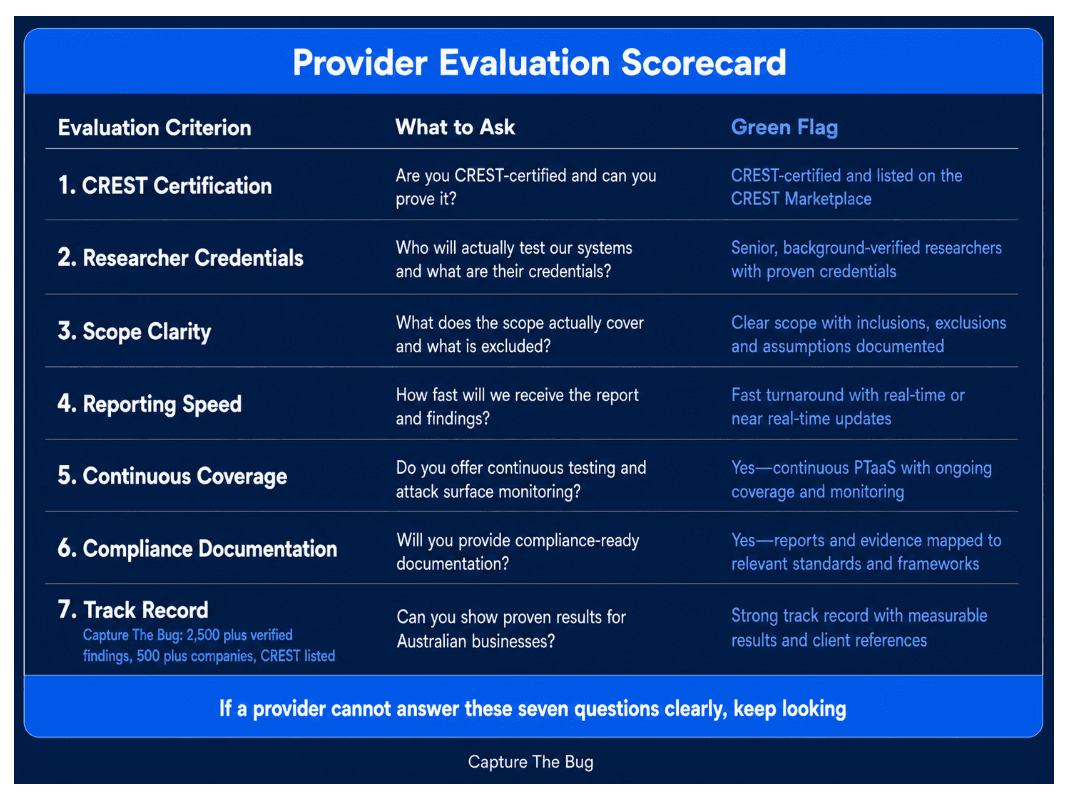
References, case studies, verified statistics, and independently checkable credentials are the evidence that separates a provider with a real track record from one with a well-designed website.
Capture The Bug's track record is publicly verifiable. It holds CREST certification listed on the CREST marketplace. It appears on GitHub's independently maintained bug-bounty-platforms reference list. It has processed more than 2,500 verified vulnerability reports and paid out over $1.2 million in researcher rewards.
Get Audit-Ready Without the Guesswork
Download a complete SOC 2 checklist designed for fast-growing SaaS companies. Know exactly what auditors expect and fix gaps before they cost you deals.
Download Your SOC 2 Checklist Now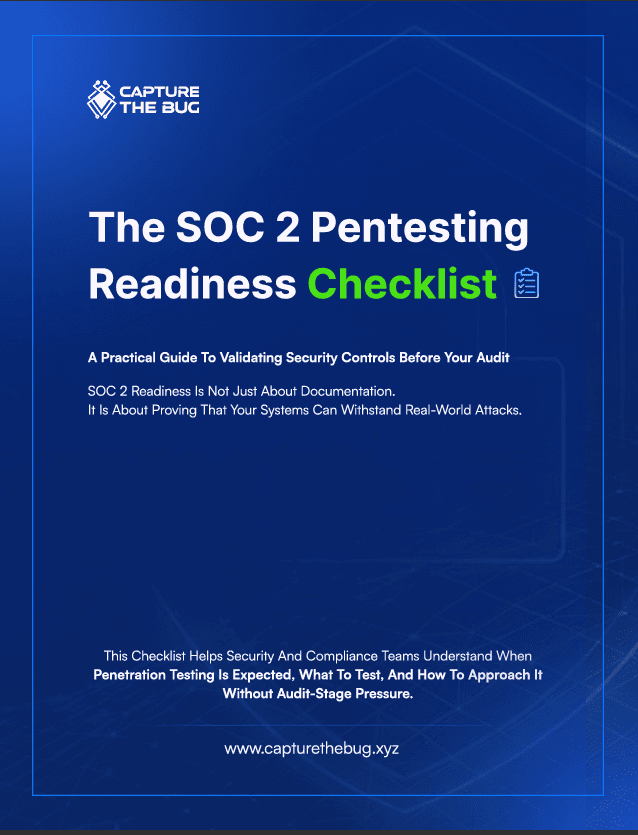
Frequently Asked Questions
What is the most important certification to look for in a penetration testing provider in Australia?
CREST certification is the most important independently verified credential for penetration testing providers in Australia. It signals that the organisation and its methodology have been assessed against a recognised international standard and is often specified as a requirement by enterprise clients, regulators, and cyber insurers.
How do I know if a penetration testing provider is right for my industry in Australia?
Ask for references from clients in a similar industry, review sample reports to assess whether findings are relevant to your specific environment, and confirm that the provider understands the compliance frameworks that apply to your business, such as SOC 2, ISO 27001, or PCI-DSS.
What should a penetration testing report include for compliance purposes?
A compliance-ready penetration testing report should include findings prioritised by business impact, specific remediation guidance, an executive summary accessible to non-technical stakeholders, and documentation structured to map to the relevant compliance framework.
How often should an Australian business conduct penetration testing?
For businesses that ship product regularly, operate cloud infrastructure, or work in regulated industries, continuous coverage through a PTaaS model is increasingly the standard. For businesses with more stable environments, annual or biannual testing may be appropriate.
Is penetration testing required by law in Australia?
Penetration testing is not universally mandated by Australian law, but it is explicitly required or strongly implied by several frameworks including the Australian Privacy Act, APRA CPS 234, and a growing range of enterprise procurement and cyber insurance requirements.