Smarter Pentesting in 2026: Speed vs Human Insight
Security teams in 2026 face a new question. Should they rely on machine-driven pentesting platforms or experienced human testers? The answer is more nuanced than most vendors suggest.
The Security Reality in 2026
Talk to any CISO today and you will hear the same frustration.
Infrastructure changes every week. New APIs appear. Cloud services expand. Developers ship updates constantly. But security testing often still happens only a few times a year.
That mismatch creates risk.
Attackers are not waiting for your next security audit. They continuously probe systems looking for the smallest mistake. When testing runs only occasionally, gaps appear between changes and validation.
This is why the conversation around pentesting has changed.
Instead of simply asking "Do we run penetration testing?" security leaders are asking something more practical.
How should security testing actually work in a fast moving environment?
To understand the answer, we need to look at two different models that organizations rely on today.
Understanding Penetration Testing First
Penetration testing is a controlled simulation of a cyberattack.
Security professionals attempt to break into applications, APIs, infrastructure, or networks in order to identify weaknesses before real attackers do.
The goal is not simply to list vulnerabilities. The goal is to prove what can actually be exploited and explain how to fix it.
Over time, two different testing approaches have emerged:
- Human-led penetration testing conducted by experienced security experts
- Machine-driven security testing platforms that continuously probe systems at scale
Both approaches bring value. But both also have limitations.
How Human-Led Penetration Testing Works
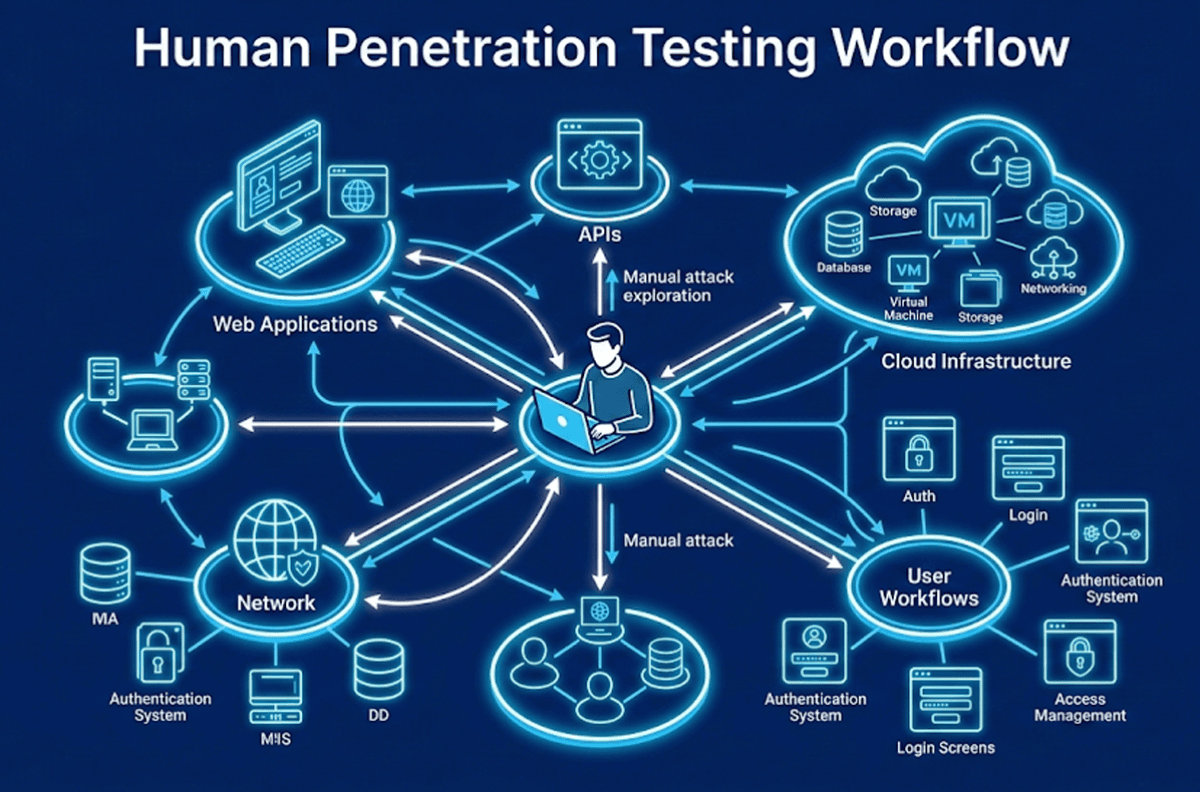
Traditional penetration testing relies on skilled professionals who approach systems the same way attackers do.
They explore the environment step by step and look for unexpected ways to gain access.
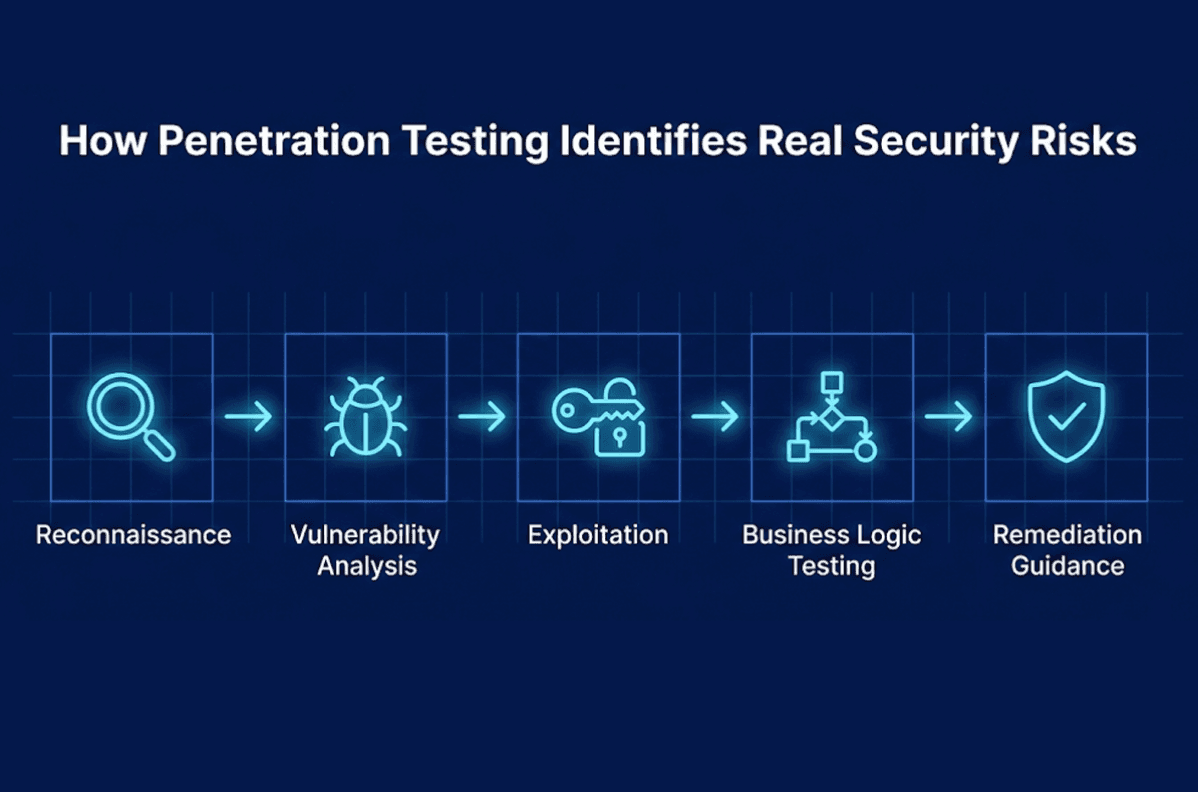
A typical engagement includes several stages.
1. Reconnaissance
The testing team gathers information about the organization.
They analyze exposed systems, technologies in use, public infrastructure, and potential entry points. Even small clues can reveal where weaknesses might exist.
2. Vulnerability Analysis
Next, testers examine applications and infrastructure to identify potential security flaws.
This includes issues like input validation problems, weak authentication flows, or outdated components.
However, the key difference here is interpretation. A human tester evaluates whether a weakness is actually reachable and meaningful.
3. Exploitation
When a vulnerability is discovered, testers attempt to exploit it safely.
They may escalate privileges, move laterally through systems, or attempt data access in order to demonstrate real impact.
This step proves whether an issue represents a real breach scenario.
4. Business Logic Testing
This is where human expertise becomes essential.
Many real breaches do not come from obvious software flaws. They come from business process mistakes.
Examples include:
- Bypassing payment validation
- Manipulating pricing workflows
- Accessing data through unexpected account flows
These issues often require creativity and context to discover.
5. Reporting and Remediation Guidance
Finally, the team produces a detailed report explaining what was discovered, how it was exploited, and how the organization should fix it.
Good reports focus on actionable fixes rather than simply listing vulnerabilities.
Where Human Testing Excels
Human-led penetration testing is extremely valuable for several reasons.
Deep context understanding
Experienced testers understand how applications behave and how users interact with them.
Creative attack thinking
Humans can identify unusual exploit chains that automated systems rarely attempt.
High accuracy
Findings are verified manually, which drastically reduces false positives.
Strategic guidance
Organizations receive insight into architectural weaknesses and long term improvements.
Where Human Testing Struggles
Despite its strengths, traditional pentesting has clear limitations.
Limited scalability
Testing hundreds of applications or assets simultaneously is unrealistic with manual work alone.
Point in time coverage
Most organizations run pentests once or twice per year. Any vulnerabilities introduced after the engagement may remain undetected.
Higher cost per engagement
Because skilled professionals conduct the work, each test requires dedicated time and resources.
This leads many organizations to look for faster alternatives.
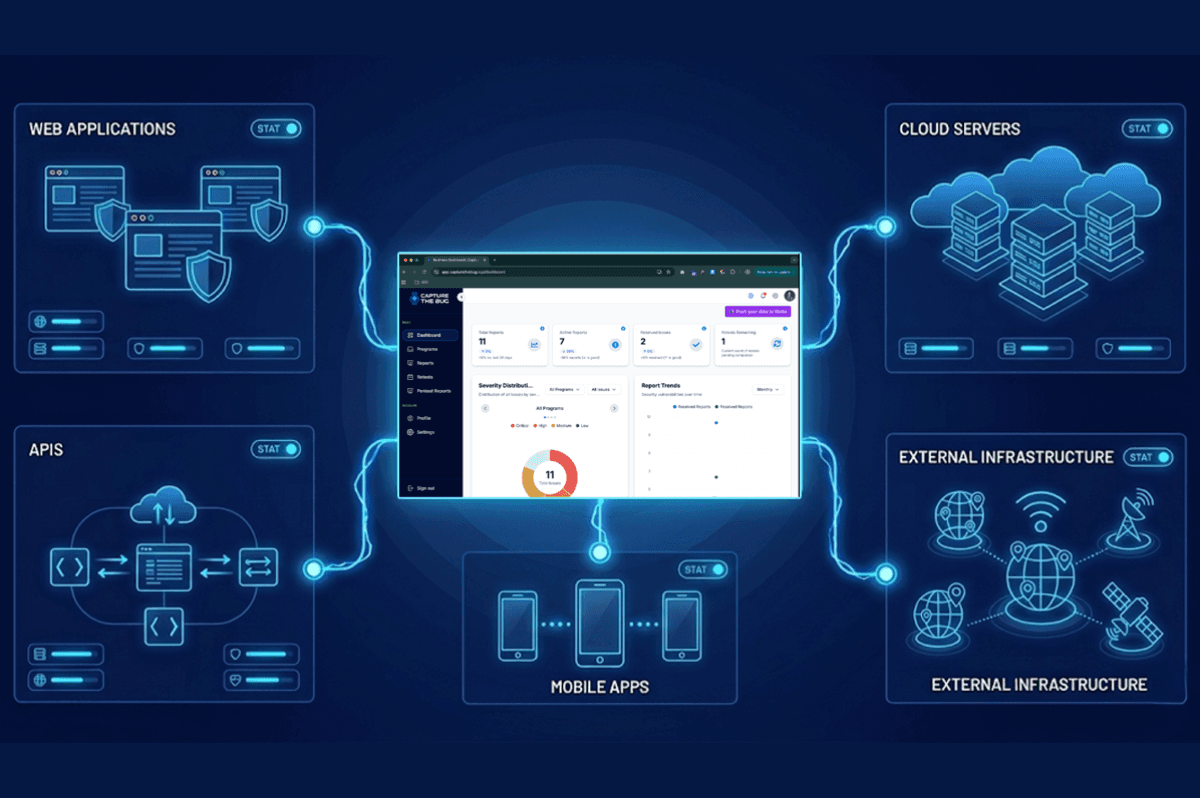
The Rise of Continuous Machine-Driven Testing
In response to the pace of modern development, security platforms emerged that perform testing continuously across large environments.
Instead of scheduling a pentest months in advance, these platforms run security checks frequently and across many assets.
Their process usually follows a predictable pattern.
Continuous Asset Discovery
The system maps external infrastructure and identifies applications, APIs, and services exposed to the internet.
This creates an evolving map of the organization’s attack surface.
Pattern-Based Vulnerability Detection
Security engines probe applications looking for known weaknesses.
They analyze responses from servers and applications to detect potential vulnerabilities.
Exploit Verification
Some platforms attempt safe exploitation to confirm whether vulnerabilities are reachable.
Evidence is generated so teams can reproduce the issue.
Reporting and Alerting
Findings are surfaced through dashboards or alerts, allowing development teams to prioritize fixes.
This approach introduces something traditional pentesting cannot provide.
Speed and scale.
Where Machine-Driven Testing Performs Well
Machine-driven testing platforms bring several advantages.
Continuous coverage
Systems can be tested frequently rather than once per year.
Large scale testing
Hundreds of assets can be evaluated simultaneously.
Consistent execution
Machines run the same checks repeatedly without fatigue or distraction.
Rapid feedback
Teams often receive vulnerability alerts shortly after changes are deployed.
This helps organizations reduce the time between vulnerability introduction and detection.
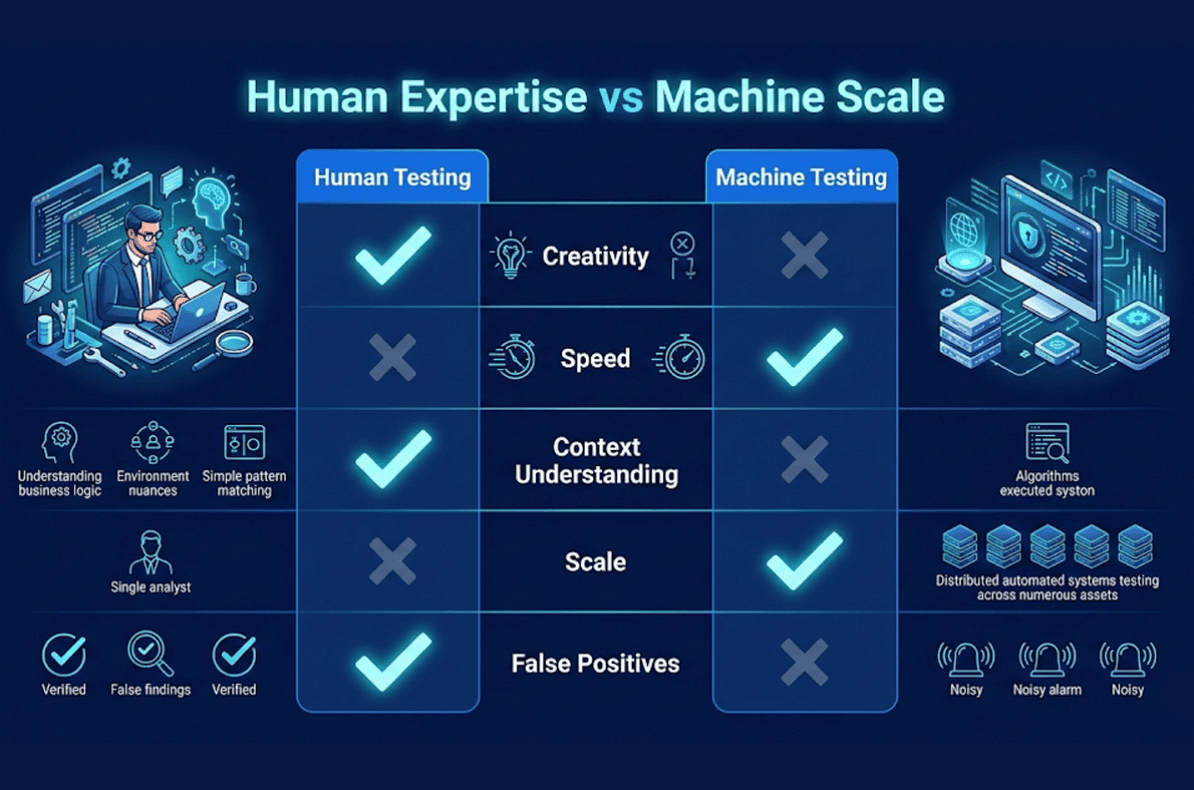
Where Machine-Driven Testing Falls Short
Despite their speed, these platforms have limitations.
Limited understanding of application context
Machines follow predefined logic. They cannot fully understand complex business workflows.
Higher noise levels
Automated detection frequently generates false positives that require manual review.
Reduced creativity
Attack strategies outside known patterns may remain undetected.
Difficulty interpreting complex environments
When applications contain layered permissions, custom logic, or multi step workflows, automated testing may struggle to interpret the behavior correctly.
The Real Question Security Teams Should Ask
Many security vendors present this debate as a competition.
Human testing versus machine driven testing.
But that framing misses the point.
Security is not a single activity. It is a continuous process.
Speed matters. But depth also matters.
Organizations that rely only on manual testing may miss vulnerabilities introduced between engagements.
Organizations that rely only on automated testing may overlook complex flaws that lead to major breaches.
The strongest security programs combine both.
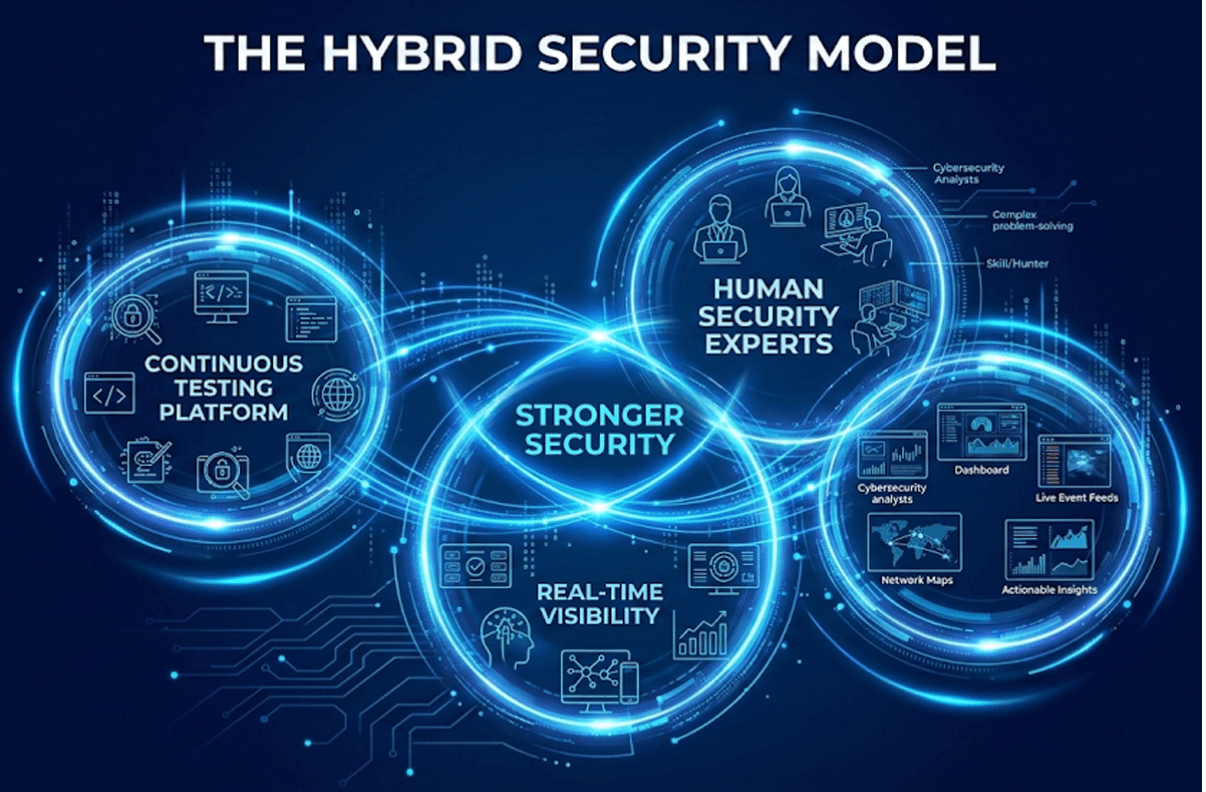
Why Modern Security Programs Combine Both Approaches
Leading security teams in 2026 use a layered model.
Continuous testing platforms monitor systems regularly and surface potential weaknesses quickly.
Human testers then focus on deeper analysis of critical applications.
This hybrid model offers several advantages.
- Continuous visibility: Systems are monitored frequently so new vulnerabilities are discovered quickly.
- Deep human validation: Experienced testers investigate complex workflows and confirm real exploitability.
- Reduced noise: Security experts filter automated findings and prioritize what truly matters.
- Compliance alignment: Many security frameworks still require human-validated reports, which manual testing provides.
This combination produces the most realistic view of risk.
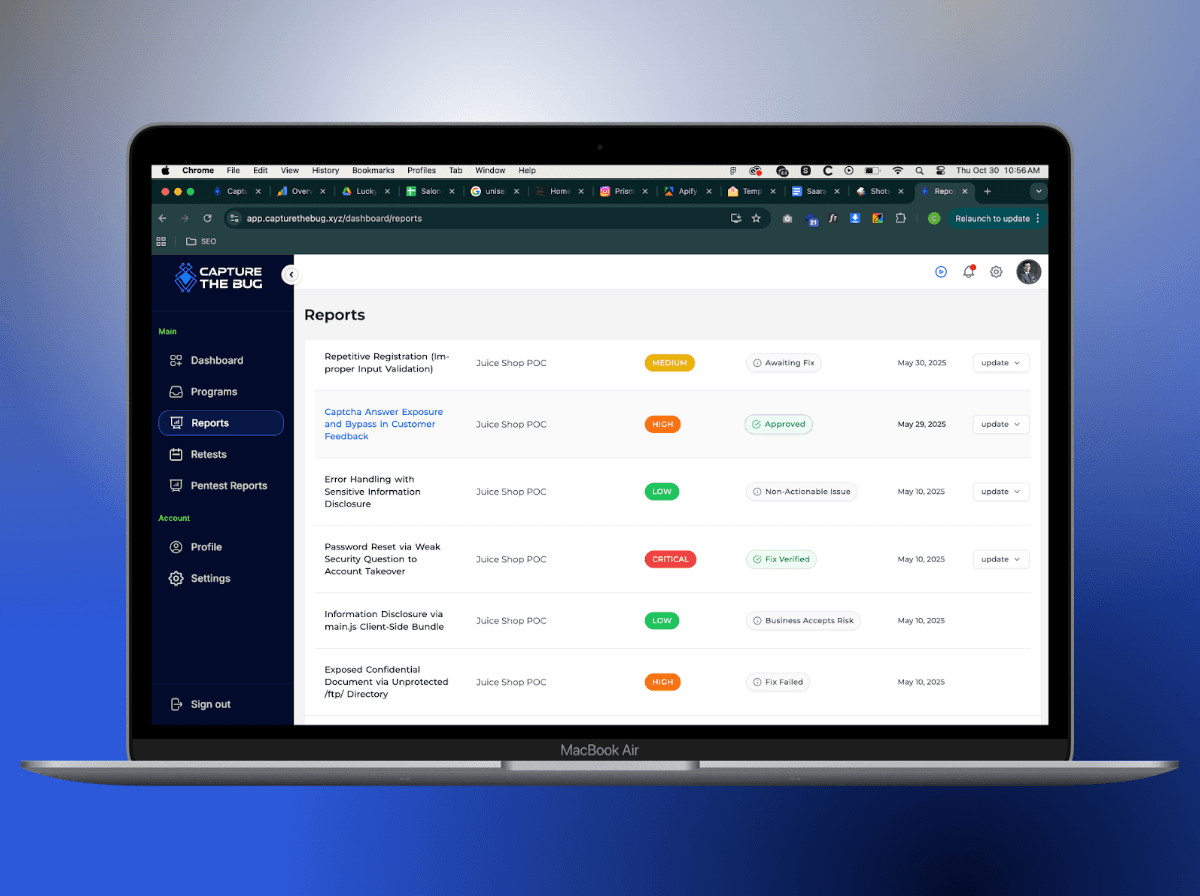
How Capture The Bug Approaches Modern Pentesting
Capture The Bug approaches security testing from a practical perspective.
Organizations need both continuous visibility and expert analysis.
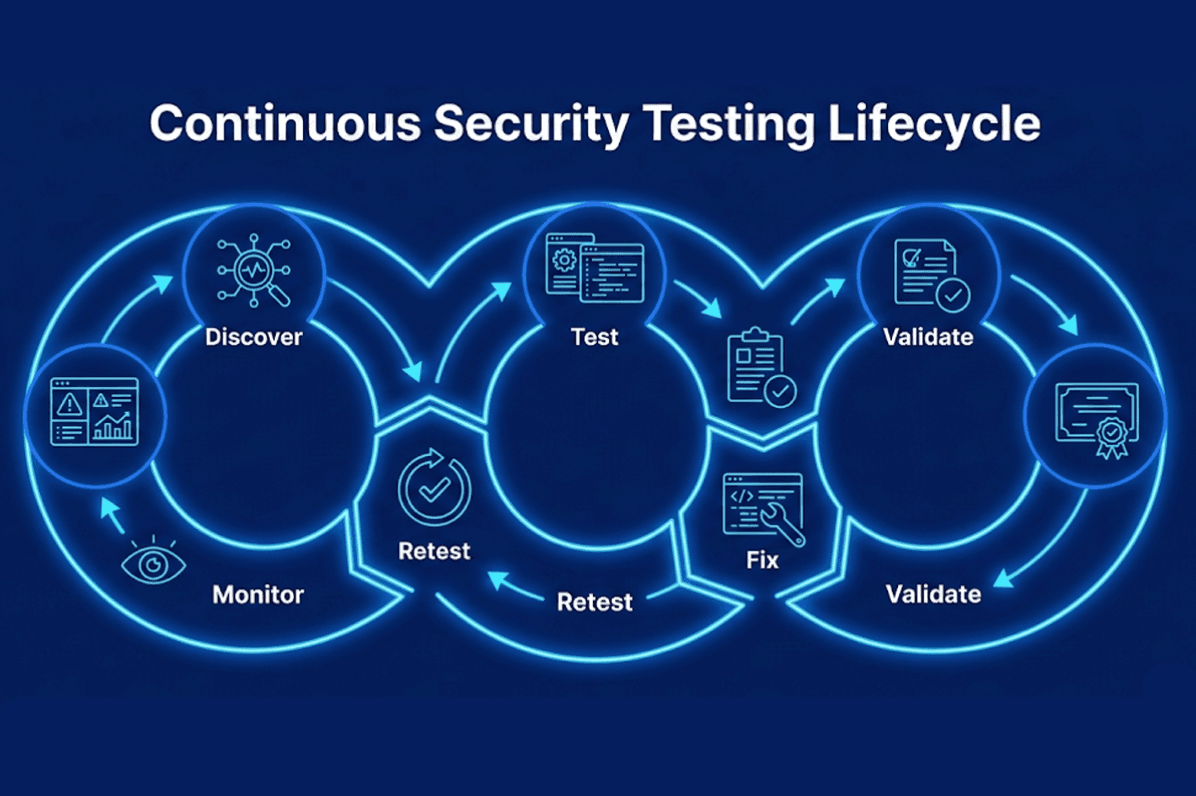
The Capture The Bug PTaaS platform combines two elements:
- Continuous security testing: Systems are evaluated regularly so new exposures can be detected quickly.
- CREST-certified human expertise: Experienced testers validate findings, investigate complex vulnerabilities, and provide clear remediation guidance.
This approach removes the common frustrations organizations experience with traditional testing.
Instead of waiting weeks for a static report, teams gain ongoing insight into their security posture while still benefiting from deep expert analysis.
For companies operating in fast moving environments such as SaaS, fintech, and cloud infrastructure, this model provides both speed and confidence.
Final Thoughts
Security in 2026 is no longer about choosing a single testing method.
It is about closing the gap between system changes and vulnerability discovery.
Human penetration testing provides the creativity and context needed to uncover complex security flaws.
Continuous machine-driven testing provides the speed required to monitor large environments.
Together they create a security program that is both fast and thorough.
Organizations that combine these approaches gain something more valuable than a report.
They gain continuous visibility and informed decision making about real security risk.
FAQ
What is the difference between automated security testing and traditional penetration testing?
Automated testing platforms continuously probe systems for known vulnerability patterns, while traditional penetration testing relies on human experts who simulate real attack scenarios and analyze business logic flaws.
Can machine-driven pentesting replace human testers?
No. Machine-driven testing provides speed and scale, but it cannot fully understand complex application workflows or business logic vulnerabilities. Human testers are still required to validate and investigate deeper risks.
Why do companies use both testing methods together?
Combining both approaches allows organizations to detect vulnerabilities quickly while still benefiting from deep human analysis of critical systems.
How often should organizations run penetration testing?
Critical applications should be evaluated regularly and after major changes. Continuous monitoring combined with periodic expert testing provides the strongest security coverage.
What is Pentesting as a Service (PTaaS)?
PTaaS delivers ongoing penetration testing through a platform that provides continuous visibility, collaboration with testers, and real time reporting instead of static reports.