Remote code execution is not a technical problem that stays technical. It starts as a flaw in how your application handles input. It ends as a conversation with your board, your insurer, and possibly a regulator. Understanding how that escalation happens, and how fast, is what determines whether your security programme is designed for the threat that actually exists in 2026.
What RCE Actually Means
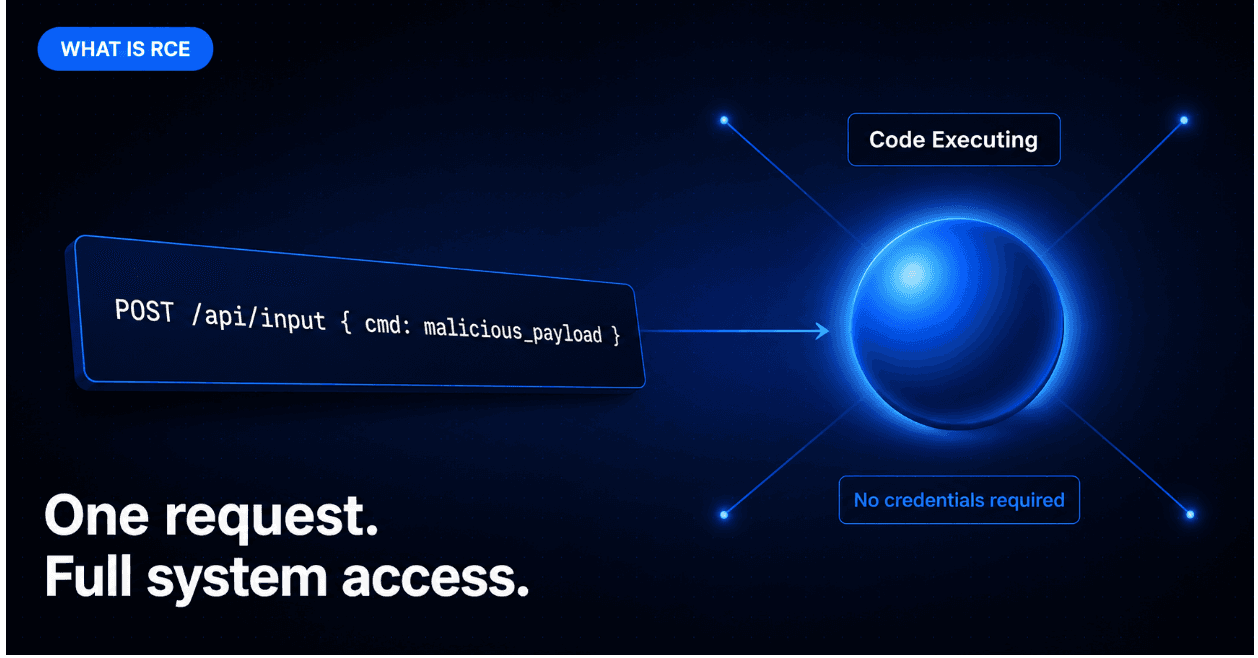
A remote code execution vulnerability lets an attacker run arbitrary code on your systems without being there physically and, in most cases, without needing credentials. No username. No password. No stolen token. They send a specially crafted request, your application processes it without proper validation, and their code runs with whatever permissions your application holds at that moment.
If your application runs as a privileged process, the attacker inherits those privileges. If it has database access, they have database access. If it can write to the file system, so can they.
Roughly 30% of analysed security incidents in 2026 involved exploitation of public-facing applications as the initial access vector, per IBM X-Force. The 2026 Vulnerability Report from Cyber Strategy Institute found that 30% of exploited vulnerabilities enabled direct RCE. Half of the top ten vulnerabilities tracked by Arctic Wolf in 2024 were RCEs. This is not a niche attack class. It is the dominant initial access method.
The 29-Minute Problem
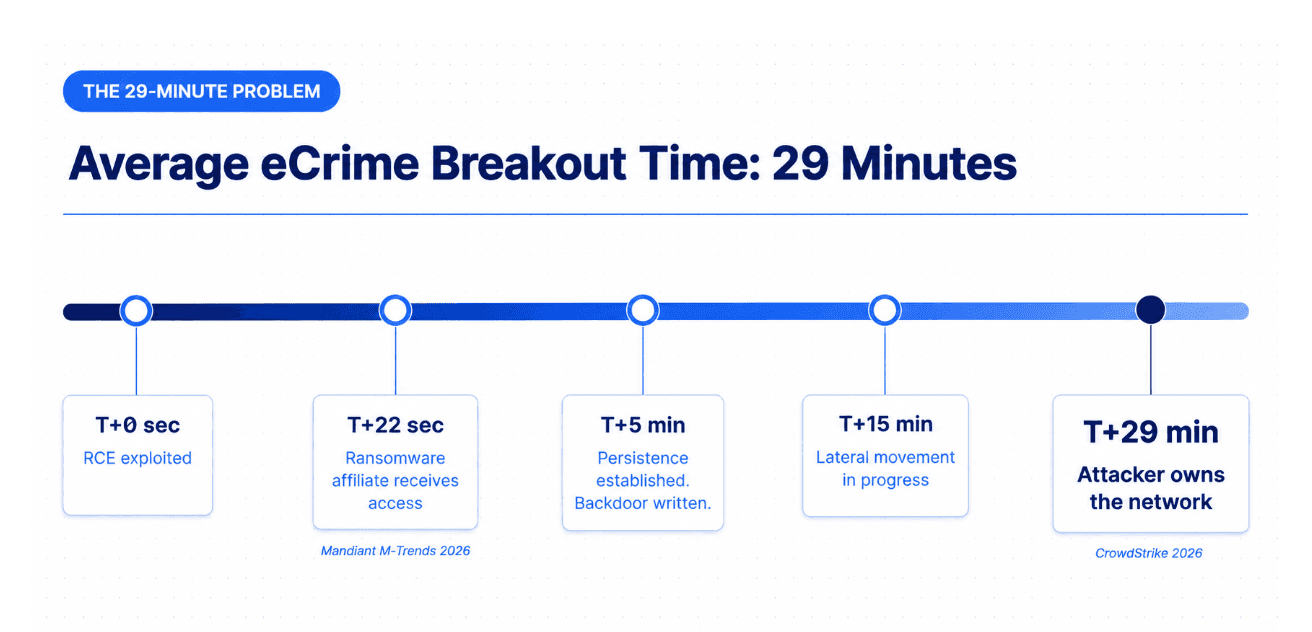
The CrowdStrike 2026 Global Threat Report found the average eCrime breakout time, from initial compromise to lateral movement, fell to 29 minutes. The fastest recorded breakout took 27 seconds. Mandiant M-Trends 2026 found the handoff between an initial access broker and a ransomware affiliate averages 22 seconds. Your SOC team might need 15 to 20 minutes to triage a single alert. The attacker has already moved.
The sequence inside that window follows a repeatable pattern. The attacker achieves code execution. They establish persistence via a backdoor or scheduled task. They enumerate the environment, mapping your internal network, identifying domain controllers, locating backup systems, finding credential stores. They escalate privileges and move laterally. By the time any alert fires, the initial compromised server is no longer the most important problem.
This is why RCE vulnerabilities consistently receive CVSS scores of 9.0 or higher. The BeyondTrust flaw disclosed in February 2026 (CVE-2026-1731) scored 9.9 and exposed approximately 11,000 instances to unauthenticated OS command execution. The moment an attacker has OS-level execution, the conversation moves from a security problem to a business continuity problem.
From RCE to Ransomware: The Specific Path
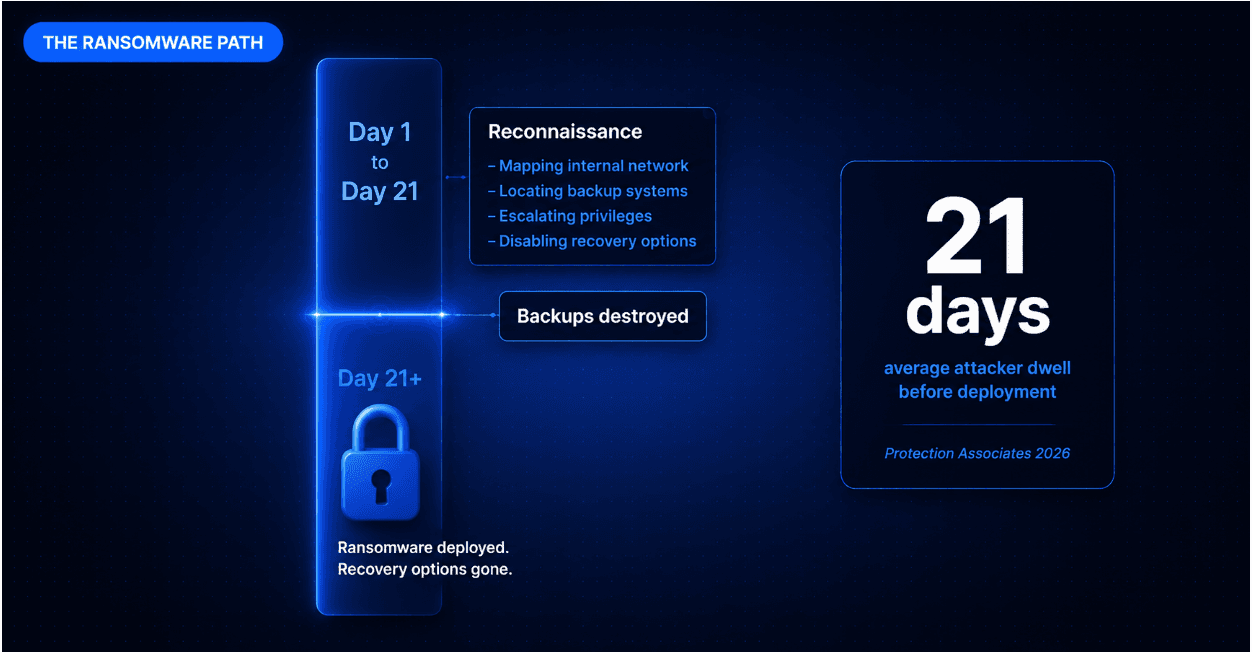
Ransomware is not dropped at the point of initial exploitation. The attacker spends time inside your network first. Protection Associates found attackers dwell for an average of 21 days before deploying ransomware, specifically using that window to locate and neutralise recovery mechanisms. Backup systems are identified and disabled. Offsite copies are encrypted or deleted. Shadow copies are removed. Only then is the ransomware payload deployed, precisely at the moment when your ability to recover independently is at its lowest.
The Equifax breach, caused by an unpatched Apache Struts RCE vulnerability, resulted in costs exceeding USD 1.4 billion across fines, settlements, and remediation. The cost came not from the vulnerability being discovered but from the 78 days between the patch being available and the system being updated. That gap is where the breach occurred. The vulnerability gave attackers a door. The unpatched window held it open long enough to matter.
Log4Shell, disclosed in December 2021, was still generating 35.6 million detection events in financial services environments in the first half of 2026, more than four years after patches were available. This is the compounding characteristic of RCE vulnerabilities: they do not become less relevant after disclosure. They become more dangerous, as automated exploitation tooling matures and attacker infrastructure scales.
Your Last Pentest Is Already Out of Date
Every week you ship without continuous testing is a week a vulnerability goes unseen. See what Capture The Bug finds in your first engagement.
Why Standard Testing Misses RCE in Practice
RCE vulnerabilities exist in places annual tests often do not reach. Newly deployed services. APIs added after the last test. Third-party dependencies updated between cycles. The environments where RCE lives are the environments that change most frequently.
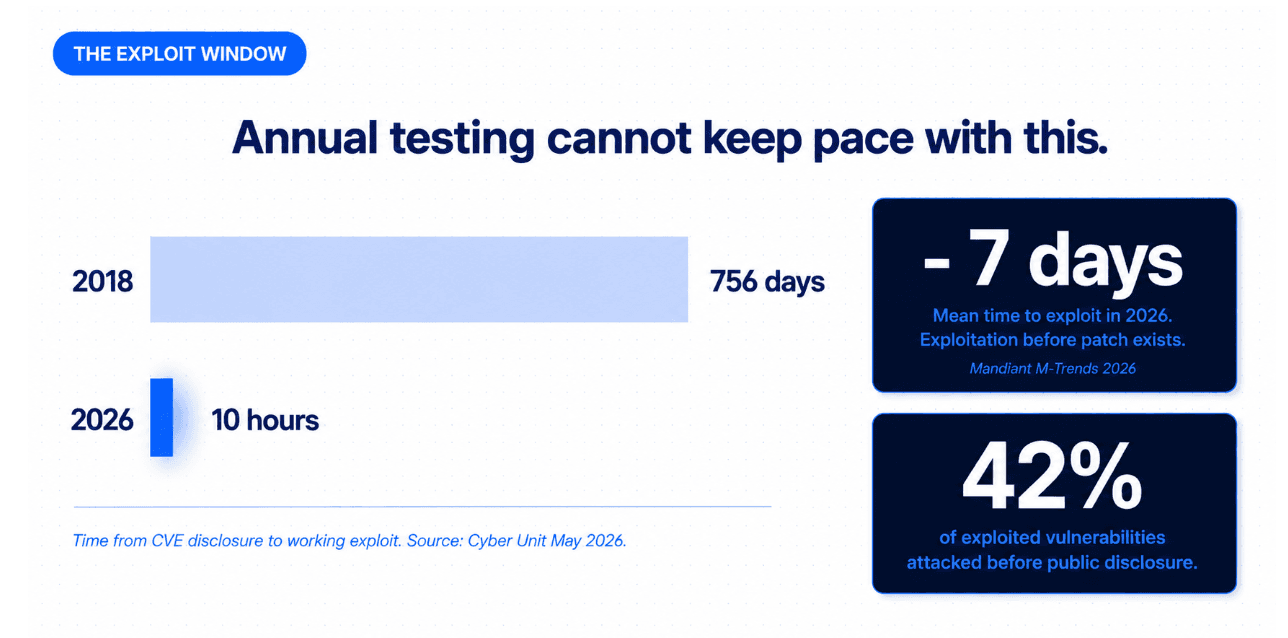
The CVE-to-exploit window collapsed from 756 days in 2018 to approximately 10 hours in 2026, per Cyber Unit's May 2026 analysis. Mandiant M-Trends 2026 confirmed exploitation now routinely occurs before a patch is available, with the mean time to exploit at negative seven days. Patching cannot be the only control for a class being weaponised before the patch exists.
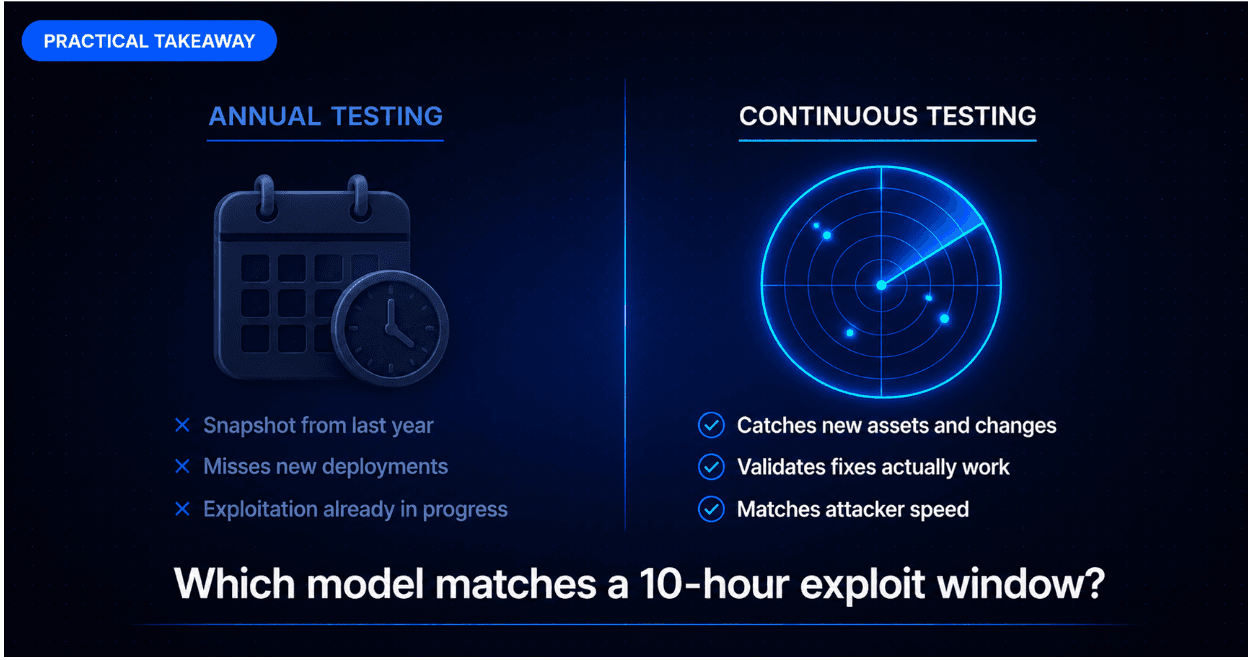
Testing that runs at the cadence of your environment, not an annual schedule, is the only model that keeps pace with that timeline. As detailed in the analysis of how attackers discover unpatched assets across cloud and SaaS environments, RCE-vulnerable systems are identified and indexed by automated tools within hours of deployment, long before most security teams schedule a test.
The question a well-structured penetration testing programme asks is not "do we have any RCE vulnerabilities?" It is "which of our currently deployed services, at this exact moment, could give an attacker unauthenticated code execution?" That question requires continuous testing to answer reliably, as explored in the guide to continuous penetration testing for SOC 2 and ISO 27001 compliance.
What This Means for Your Programme
RCE is the vulnerability class that turns a security incident into a business crisis. The escalation from initial exploit to lateral movement takes less than 30 minutes. Ransomware deployment follows a patient 21-day reconnaissance phase designed to eliminate your recovery options before you know you need them. The exploit window has compressed to hours.
Organisations that catch RCE before it becomes an incident test at the speed their environments change. Annual testing covers last year. Continuous testing covers right now. For teams assessing whether their current programme would surface an RCE before an attacker does, the guide to what happens after a penetration test covers the verification steps that confirm a fix actually closed the exposure.
Book a security consultation with Capture The Bug to find out whether your current testing would surface an RCE vulnerability in your environment before an attacker does.
Plan Your Annual Pentesting Strategy the Right Way
Learn how modern SaaS companies structure pentesting across the year to reduce risk, stay compliant, and avoid last-minute panic before audits.

FAQ
What is a remote code execution vulnerability?
A remote code execution (RCE) vulnerability allows an attacker to run arbitrary code on your systems remotely and typically without credentials. It occurs when an application fails to properly validate or sanitise user input, allowing an attacker to inject and execute malicious code. The attacker inherits whatever permissions the application holds at the time of exploitation, which can include database access, file system access, and administrative privileges.
How quickly can an attacker move after exploiting an RCE vulnerability?
Very quickly. The CrowdStrike 2026 Global Threat Report found the average eCrime breakout time, from initial compromise to lateral movement across other systems, fell to 29 minutes. The fastest recorded breakout took 27 seconds. Mandiant M-Trends 2026 found the handoff between an initial access broker and a ransomware affiliate averages 22 seconds. Detection that arrives after these windows have closed is structurally late.
How does an RCE vulnerability lead to a ransomware attack?
After establishing initial access through RCE, attackers typically dwell inside the network for an average of 21 days before deploying ransomware. During this period they map the environment, locate backup systems, escalate privileges, and systematically disable or destroy recovery options. Ransomware is deployed at the point when the organisation's ability to recover independently is at its lowest, maximising leverage for the attacker.
Why does penetration testing sometimes miss RCE vulnerabilities?
Annual penetration tests create a point-in-time snapshot of your environment. RCE vulnerabilities frequently exist in services deployed or updated after the last test, in third-party dependencies added between test cycles, or in APIs exposed through configuration changes. The CVE-to-exploit window has collapsed to approximately 10 hours in 2026. A system that was clean at the time of testing may be exposed within hours of a subsequent change.
What is the financial impact of an RCE-based breach?
Equifax's RCE-based breach through an unpatched Apache Struts vulnerability resulted in costs exceeding USD 1.4 billion. The broader financial impact of RCE incidents includes incident response costs, regulatory penalties, customer notification obligations, reputational damage, and in ANZ-specific contexts, obligations under APRA CPS 234, the RBNZ cyber resilience requirements, and the NZ Privacy Act 2020.