CERT-In SBOM Guidelines 2026: What Fintech Companies Must Know
In FY 2024, UPI fraud in India jumped by 85 percent, crossing ₹1,000 crore in reported losses. A large share of incidents traced back to weaknesses most fintech teams did not even know existed. Third-party libraries, inherited APIs, outdated cryptographic components, and long-forgotten dependencies quietly sitting in production.
That context matters, because it explains why the Indian Computer Emergency Response Team, CERT-In, tightened its Software Bill of Materials guidance and pushed it from recommendation to expectation.
For fintech CTOs and CISOs, the message is no longer subtle. You are responsible for your entire software supply chain, not just the code your engineers write. Every dependency, vendor component, API integration, and cryptographic primitive now sits under your risk ownership.
This article explains what the CERT-In SBOM Guidelines mean in 2026, how they affect fintech companies specifically, and how leaders can implement them without turning security into a paperwork exercise.
What an SBOM Really Is and Why Fintech Cannot Ignore It
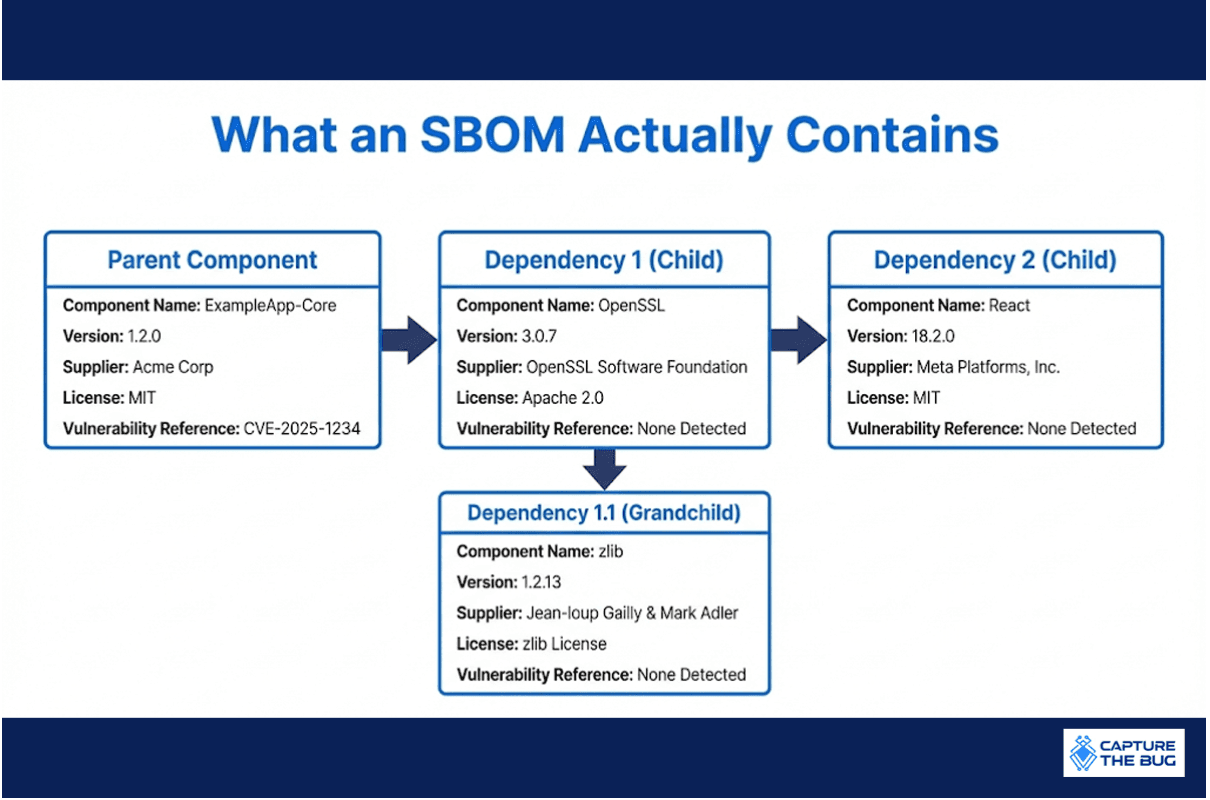
A Software Bill of Materials is a structured, machine-readable inventory of everything that makes up an application. Think of it as a living manifest of your software.
It lists each component, its version, where it came from, how it is licensed, whether it is still supported, and whether it carries known security weaknesses. It also records cryptographic hashes for integrity verification and maps how components depend on each other.
For fintech companies, SBOMs matter because payments, identity, and financial data depend on long chains of trust. A single outdated library inside a payment flow can invalidate controls everywhere else.
An accurate SBOM gives you three immediate advantages:
- Speed of response: When a new vulnerability is disclosed, you can instantly see whether you are affected and where.
- Supplier accountability: Instead of trusting vendor assurances, you can verify exactly what they ship to you.
- Audit confidence: Regulators, banks, and enterprise partners increasingly expect proof that you understand and manage your software supply chain.
In India's regulatory environment, this aligns closely with RBI expectations around third-party risk and continuous vulnerability management. SBOMs are becoming the primary evidence of diligence.
What Changed With CERT-In SBOM Guidelines Heading Into 2026
CERT-In's updated guidance formalised what many regulators were already signalling. SBOMs are no longer optional hygiene. They are a baseline expectation for essential and regulated services, including fintech and BFSI.
Three changes matter most:
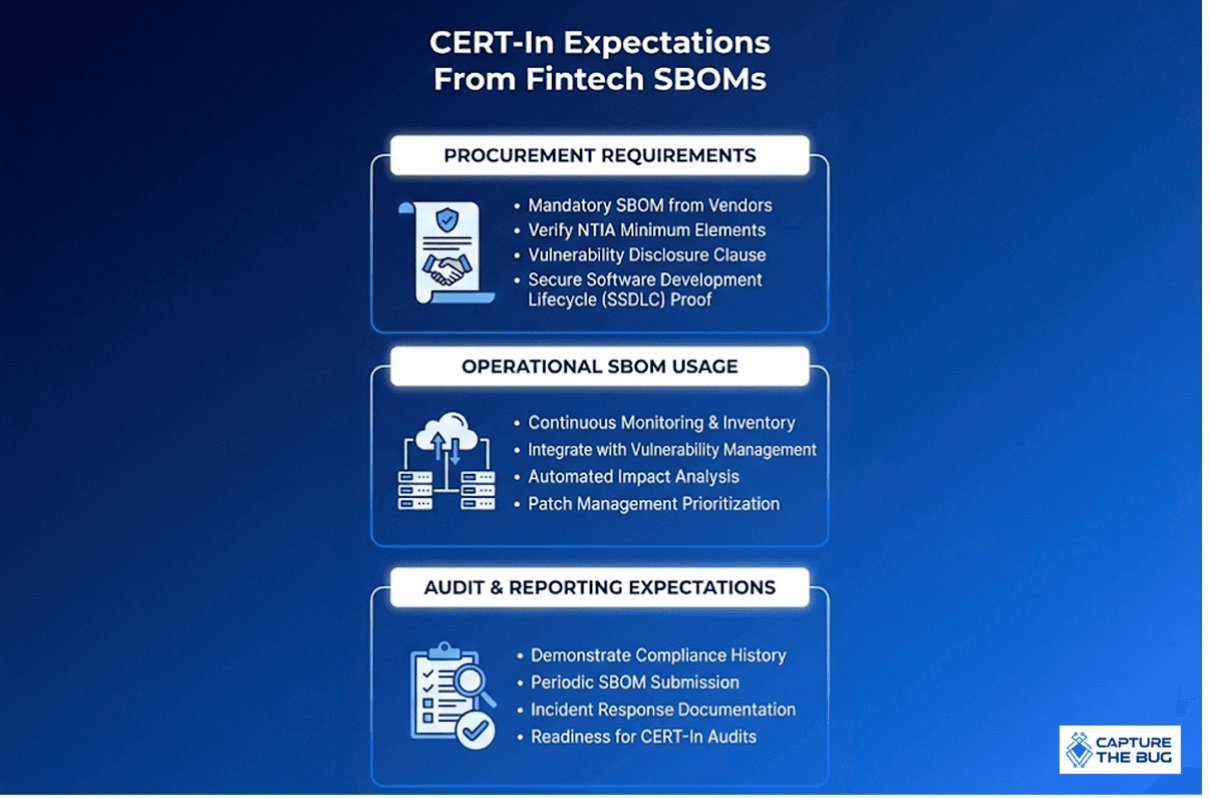
SBOMs Are Expected at Procurement Time
Every software supplier is expected to provide a complete SBOM with their deliverables. This shifts accountability to the start of the relationship, not after an incident.
For fintech procurement teams, this means contracts must specify SBOM format, update frequency, and delivery method. If a vendor cannot produce a usable SBOM, that is now a risk signal, not a minor inconvenience.
SBOMs Must Be Operational, Not Static
CERT-In explicitly positions SBOMs as part of vulnerability management workflows. They are not PDFs to be stored and forgotten.
Security teams are expected to use SBOMs as a live asset register that informs testing, remediation, and risk prioritisation.
Machine-Readable Formats Are Mandatory in Practice
Formats like SPDX and CycloneDX are now the standard. Human-readable summaries may still exist, but automation depends on structured data.
For fintechs running frequent releases, anything that cannot be consumed programmatically will break under operational load.
The Component Data Fintechs Are Expected to Track
CERT-In outlines more than 21 data points per component. While this may look overwhelming, each item exists for a reason.
Key fields include component name, version, supplier, origin, and license. These establish legal and ownership clarity.
Dependency mapping captures both direct and transitive components, which is critical in complex fintech stacks where risk often hides several layers deep.
Security-relevant fields include known vulnerabilities, patch status, cryptographic hashes, and integrity checks.
Lifecycle fields such as release date, end-of-life date, and criticality rating are particularly important for fintechs running long-lived systems.
Unique identifiers, often in Package URL format, ensure that components can be tracked accurately across renames, forks, and vendor changes.
Execution and archive properties reflect increased scrutiny on how components behave at runtime, not just what they are called.
The takeaway is simple. Auditors will not only ask whether a vulnerability exists, but whether you knew it existed, whether it was exploitable in your context, and whether you acted on it in time.
VEX and CSAF: Moving Beyond Raw Vulnerability Counts
One of the most misunderstood parts of the guidelines is Vulnerability Exploitability eXchange, or VEX.
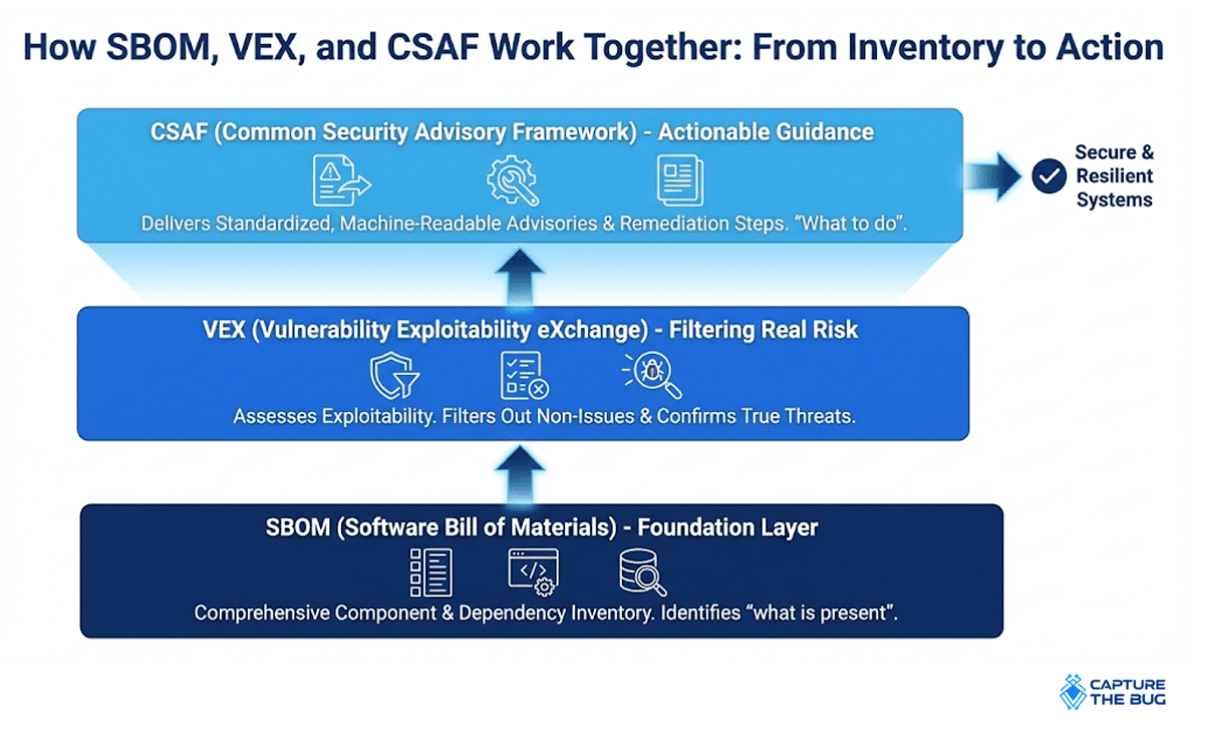
A VEX document tells you whether a known vulnerability actually affects your system. It categorises issues as not affected, affected, fixed, or under investigation.
For fintech teams drowning in vulnerability alerts, this is critical. It shifts focus from volume to relevance.
CERT-In also expects suppliers to issue Common Security Advisory Framework advisories with technical details, affected versions, and mitigation steps.
Together, SBOM, VEX, and CSAF form a closed loop. Inventory tells you what you have. VEX tells you what matters. CSAF tells you what to do next.
This is how mature fintech security teams reduce noise and improve response times without burning out engineering teams.
How Fintechs Should Implement CERT-In SBOM Requirements
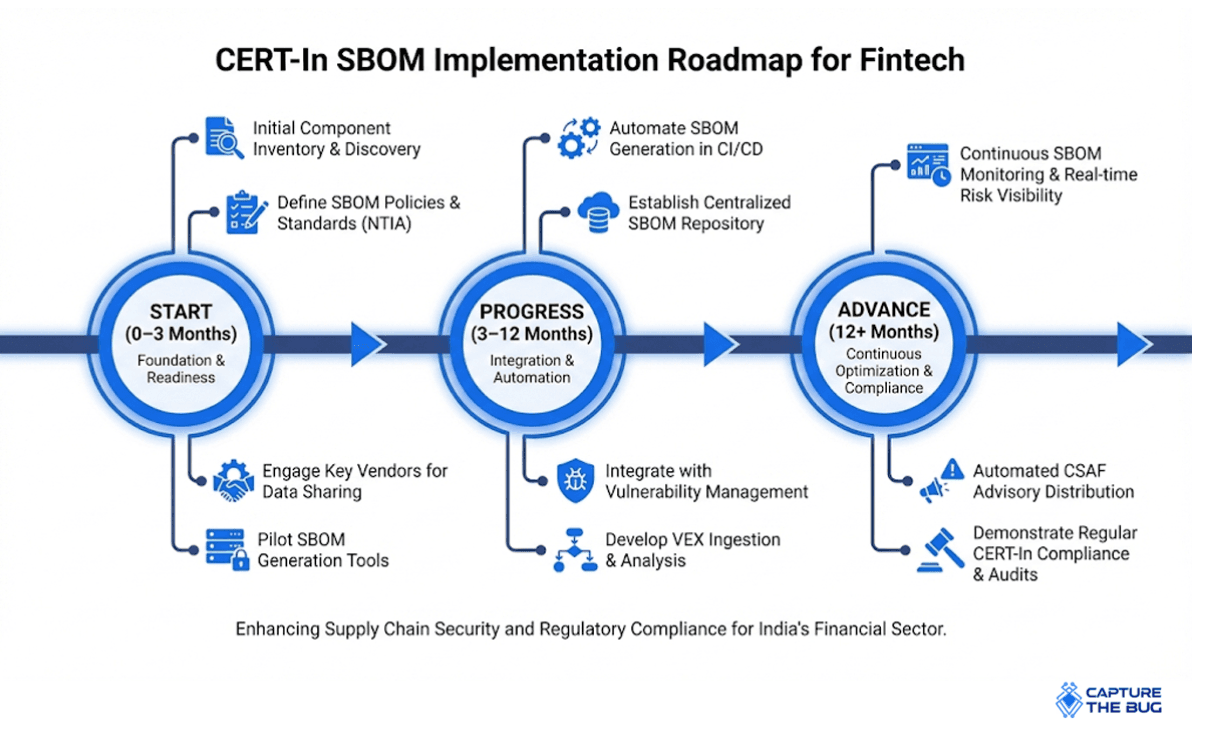
Successful implementation is not a single project. It is a staged capability build.
Phase One: Start With What Moves Money
Begin with systems that directly affect transactions and customer data. Payment gateways, UPI integrations, authentication services, and core APIs should be first.
Update procurement contracts to mandate SBOMs, VEX, and timely updates from vendors.
Assign clear ownership across security, legal, procurement, and engineering so SBOMs do not fall into organisational gaps.
Phase Two: Make SBOMs Part of Security Operations
Create internal SBOMs that enrich vendor data with deployment context and business criticality.
Integrate SBOM data into vulnerability workflows so findings map directly to components you know you run.
Standardise identifiers and naming to avoid confusion as systems evolve.
Phase Three: Treat SBOMs as Evidence
Use SBOMs during incident response to quickly assess blast radius.
Schedule regular validation to ensure SBOMs reflect reality, not intentions.
Use third-party testing and reviews to verify accuracy and completeness.
At this stage, SBOMs stop being compliance artefacts and start becoming decision tools.
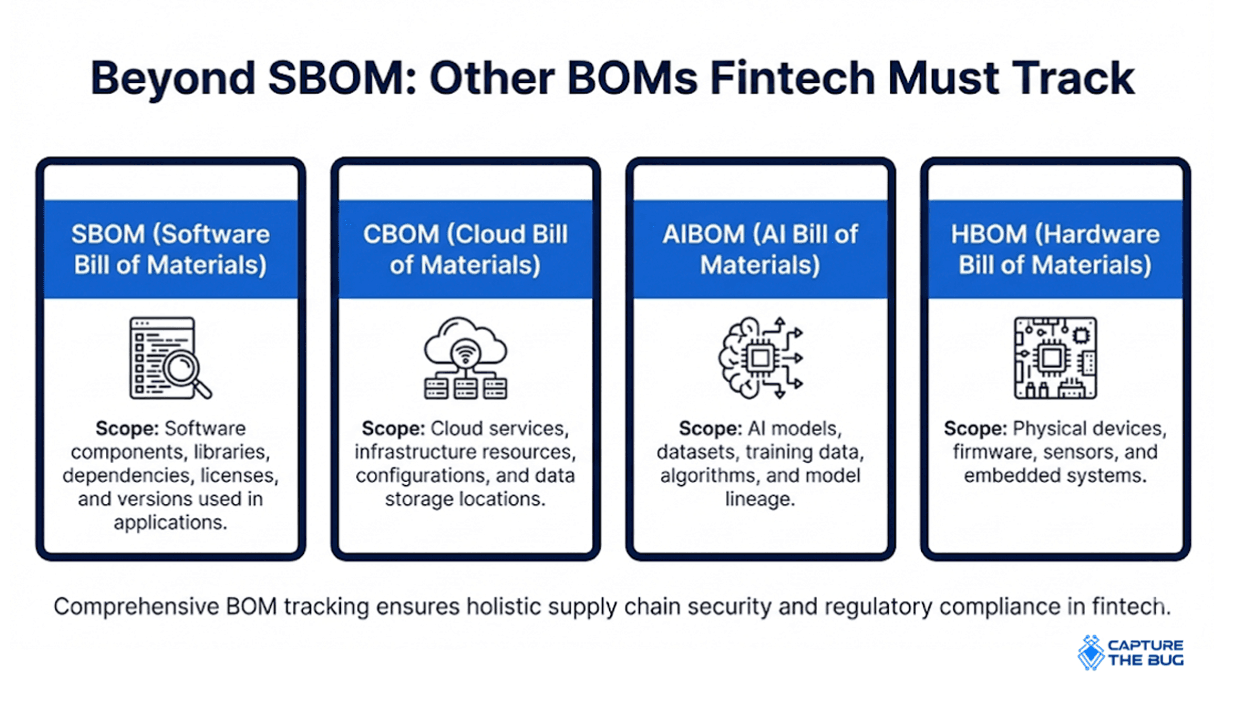
Beyond Software: Other BOMs Fintechs Should Care About
CERT-In's direction reflects a broader view of supply chain risk.
- Cryptographic Bills of Materials track algorithms, keys, certificates, and protocol usage. For fintechs, this supports secure payment flows and future readiness as cryptographic standards evolve.
- AI Bills of Materials document models, datasets, and frameworks used in fraud detection and risk scoring. This supports governance, bias control, and security assurance.
- Hardware Bills of Materials cover servers, network devices, and embedded systems such as ATMs. They help manage firmware risk and counterfeit exposure.
Together, these inventories create end-to-end visibility across digital and physical layers.
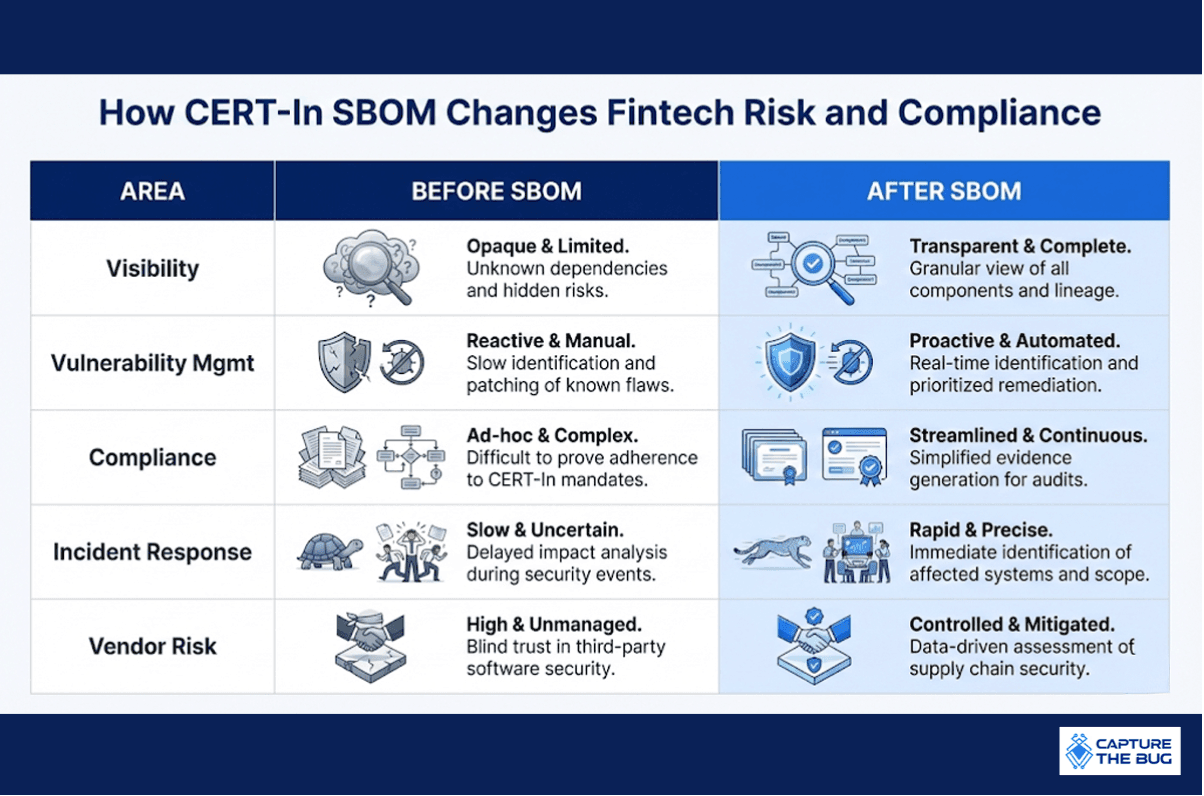
Compliance and Risk Management Impact for Fintech Leaders
From a governance perspective, SBOMs change how risk is discussed at board level.
Regulatory compliance now includes software supply chain evidence. Auditors will expect to see traceability, lifecycle awareness, and remediation proof.
Risk assessment moves away from generic severity scores toward exploitability and business impact.
Operationally, teams need to collaborate more closely. Security owns the inventory, procurement enforces supplier discipline, engineering acts on validated risks, and leadership signs off on residual exposure.
This integration shortens detection cycles and improves confidence with regulators, partners, and insurers.
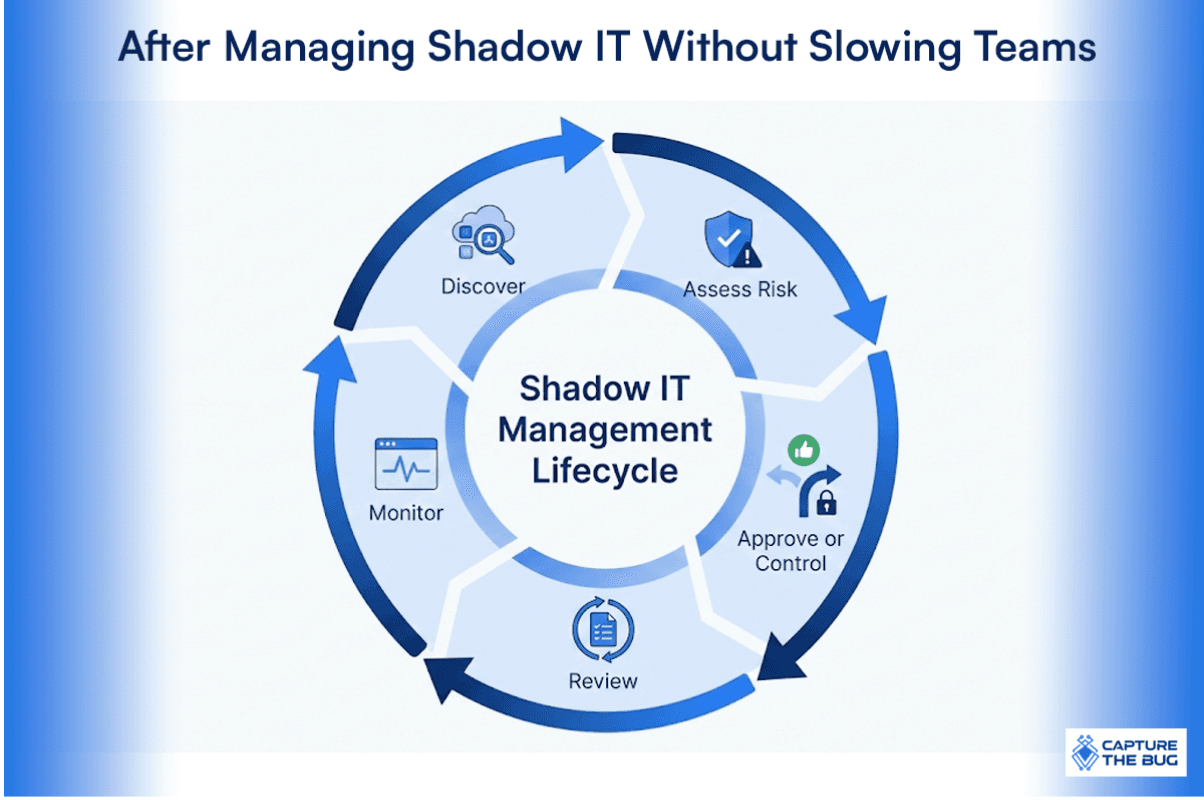
How to Keep SBOMs Accurate Over Time
An SBOM is only useful if it reflects reality.
Fintech teams should align SBOM generation with design, build, and runtime stages. Planned components differ from deployed ones, and both matter.
Automation helps, but governance matters more. Access controls, integrity checks, and regular audits prevent SBOMs from becoming stale or misleading.
Continuous testing and runtime validation provide the final check. They confirm that what you think is running actually is.

Where Capture The Bug Fits In
Capture The Bug works with fintech teams that understand SBOMs are necessary but not sufficient.
SBOMs describe what should be there. Testing validates what is actually exposed.
By mapping SBOM data to real-world testing results, Capture The Bug helps fintechs prove that documented components align with operational reality. This supports audit readiness, incident response, and executive reporting without turning security into a box-ticking exercise.
The result is not just compliance, but confidence.
Final Thoughts
CERT-In SBOM Guidelines heading into 2026 redefine accountability. Claims are no longer enough. Proof is required.
Fintech companies that build SBOM discipline early will handle audits faster, respond to incidents with clarity, and build trust with banks, regulators, and enterprise partners.
Those who delay will discover that rebuilding supply chain visibility under regulatory pressure is far harder than building it deliberately.
SBOMs are not about lists. They are about understanding what you run, why it matters, and how quickly you can act when something breaks.
FAQs
How do CERT-In SBOM guidelines affect fintech companies specifically?
They make fintechs responsible for documenting and managing every software component involved in payments and customer data. SBOMs become auditable evidence of supply chain diligence.
Are SBOMs required for third-party APIs used by fintechs?
Yes. Third-party APIs and SDKs are part of your software supply chain. Fintechs are expected to obtain and manage SBOMs for these integrations.
What role does VEX play in SBOM compliance?
VEX helps teams understand whether a known vulnerability actually affects their environment. It reduces noise and focuses remediation on confirmed risks.
How often should SBOMs be updated?
Whenever software changes. New releases, dependency updates, and configuration changes should trigger SBOM updates.
Is an SBOM enough to prove security?
No. SBOMs provide visibility, not validation. Testing and continuous review are needed to confirm that documented components are not introducing exploitable risk.