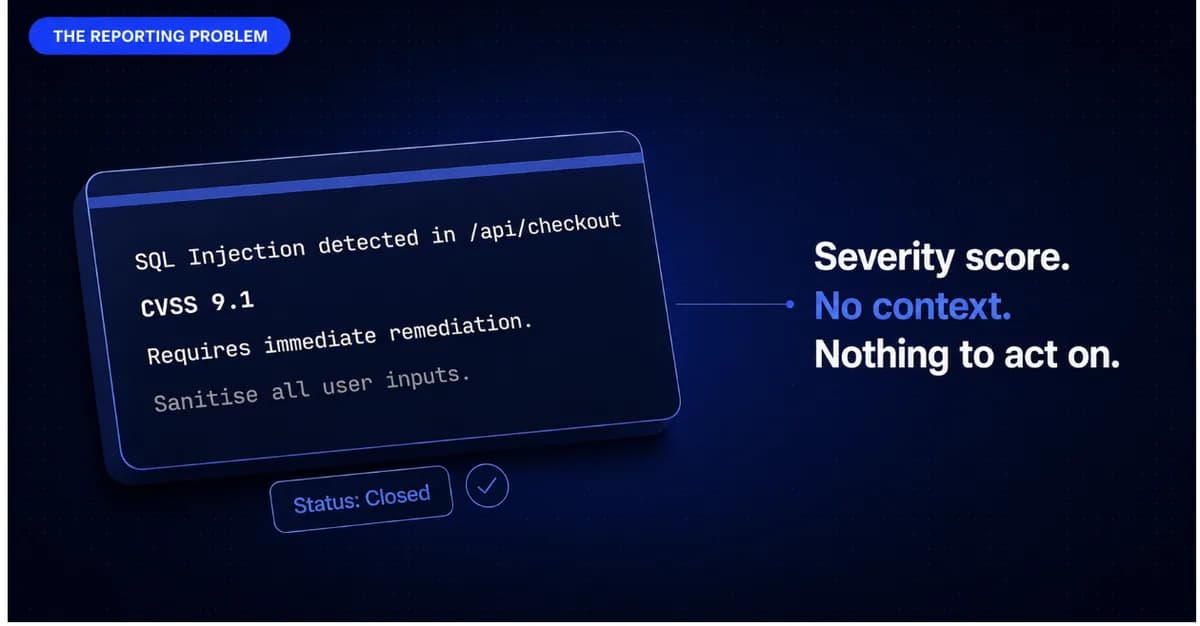
A penetration test found a SQL injection vulnerability in your checkout API. The report says: "SQL injection detected in /api/checkout. CVSS 9.1. Requires immediate remediation." The developer who receives that ticket opens it, reads it, and closes it. Not because they are ignoring security. Because there is nothing there to act on.
CVSS 9.1 tells them the severity. It does not tell them which parameter is injectable, what payload confirmed exploitation, what the attacker could reach from that entry point, or what a correct fix looks like in the specific framework the endpoint is written in. That gap between finding and action is where remediation time goes. It is not a people problem. It is a reporting problem.
Autonomous pentesting with reasoning traces changes what the developer receives.
What a Reasoning Trace Actually Is
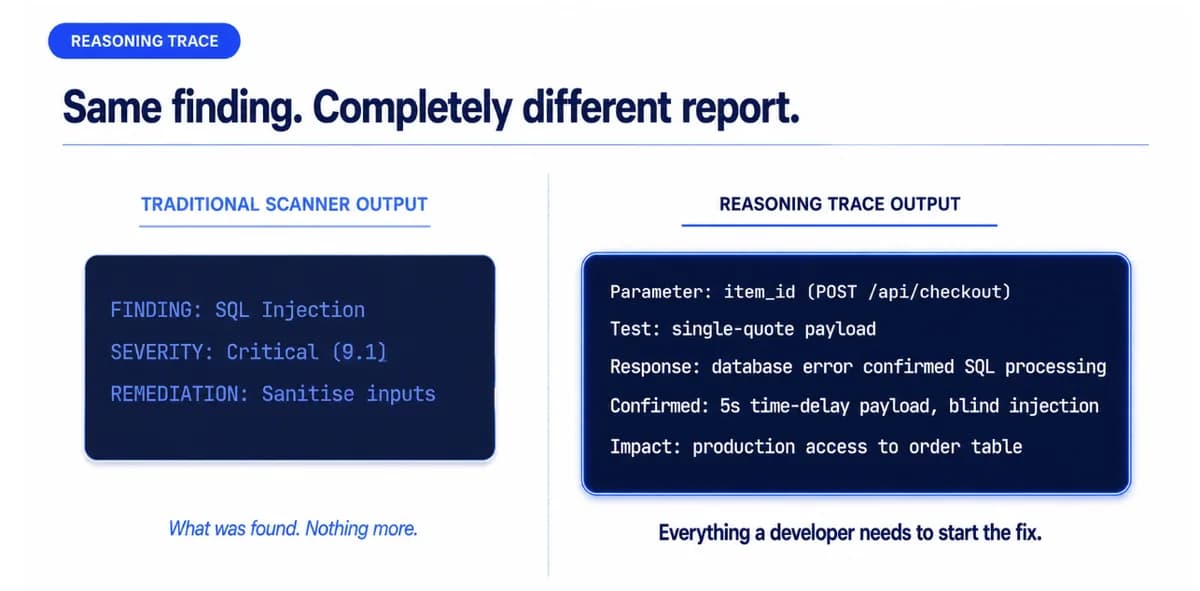
When an autonomous pentesting agent discovers a vulnerability, it logs the decision process that produced the finding: the hypotheses formed, the payloads tried, which ones failed and why, which succeeded, what the application returned, and what the agent concluded about exploitability.
That decision log is the reasoning trace. It is the equivalent of a senior tester narrating their thought process: "I tested a single-quote payload in item_id and observed a database error confirming server-side SQL processing. I then confirmed blind injection with a five-second sleep payload. The endpoint has production access to the order table, which contains payment method references."
A developer reading that trace does not need to reproduce the finding from scratch. They know which parameter, which payload class, and what is at risk. That collapses the investigation phase before any fix work.
Bishop Fox data shows AI-assisted reporting reduces time-to-report by 35%. That saving is at the creation side. The larger saving from reasoning traces is at the consumption side: the engineer who spends two hours investigating a finding before writing a single line of fix code is the friction point organisations consistently underestimate.
How the Trace Becomes a Developer Ticket
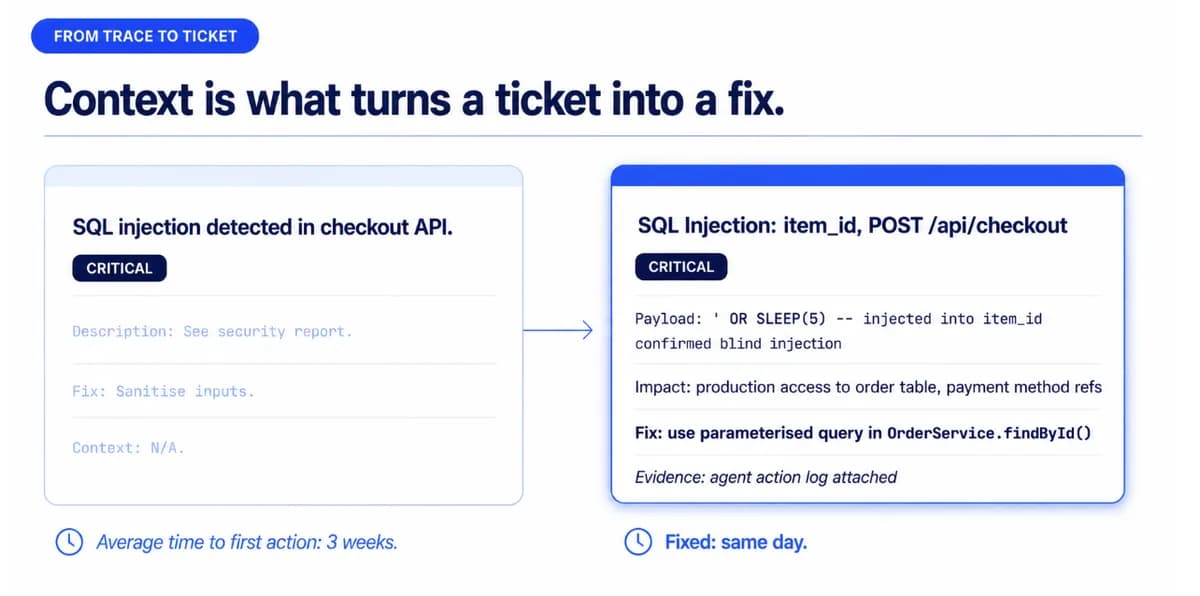
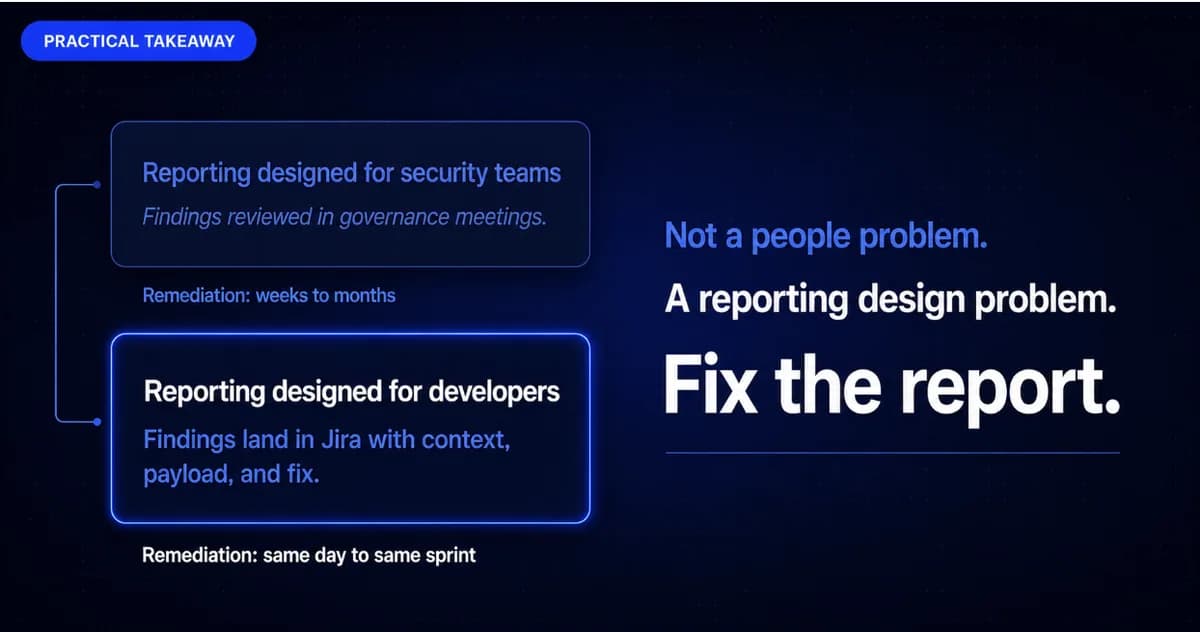
The problem with traditional pentest reports is structural. They are written for security audiences and handed to engineering teams. An executive summary, a CVSS table, and a remediation recommendation that says "sanitise all user inputs" covers the security requirement and misses the developer entirely.
Autonomous pentesting platforms that surface reasoning traces structure output differently. Each finding arrives with the attack sequence: the input point identified, the payloads attempted, the first successful response, the follow-on steps the agent took to establish impact, and the confirmed blast radius. The Jira ticket is not "SQL injection detected." It is a ticket with the affected parameter named, the payload class documented, the exploitation response attached, and remediation scoped to the specific ORM the endpoint uses. A developer picking up that ticket starts writing a fix, not an investigation.
For teams running continuous deployment where new code ships multiple times a week, this distinction changes the security economics. Continuous penetration testing for SOC 2 and ISO 27001 compliance is built around the assumption that findings reach developers at the speed code is changing. The reasoning trace is what makes that cadence possible.
Your Last Pentest Is Already Out of Date
Every week you ship without continuous testing is a week a vulnerability goes unseen. See what Capture The Bug finds in your first engagement.
From Kill Path to Fix Path
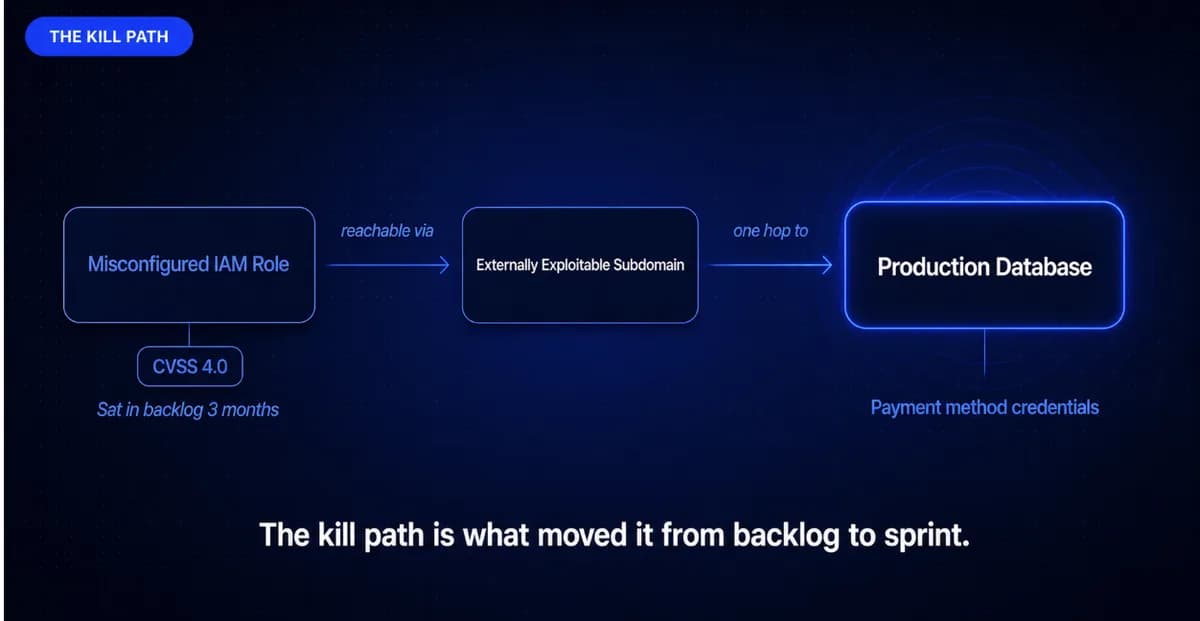
Advanced autonomous agents chain vulnerabilities rather than listing them individually. A misconfigured IAM role that is low risk in isolation becomes critical when the agent demonstrates it is reachable from an externally exploitable subdomain. That kill path, the complete route from initial access to privilege escalation, is something a scanner cannot produce.
The kill path is the most powerful driver of developer urgency. A CVSS 4.0 finding that sits in a backlog for three months moves to next sprint when the report shows it is one hop from a production database credential. As examined in the guide to how RCE vulnerabilities become business-critical incidents, the gap between technical severity and business consequence is where priority is consistently misjudged. A kill path documented with a reasoning trace closes that gap by showing the consequence, not just the finding.
What Gets Fixed Faster
Autonomous platforms that produce reasoning traces show shorter remediation cycles because the developer receives everything needed to act in the ticket itself. No separate security document. No call to understand the finding. No time reproducing the vulnerability before writing a fix.
Horizon3's NodeZero documents every attack chain step precisely because the evidence trail serves the engineer who needs to understand and reproduce a finding as much as it serves the auditor. XBOW's Pentest On-Demand delivers findings within five business days because the reporting is structured for immediate developer action, not a governance review.
The integration that puts the reasoning trace in the right place is covered in the guide to how Capture The Bug integrates with Slack, GitHub, Jira, and Microsoft Teams to streamline vulnerability management. The trace is the content. The integration is the delivery. Together they determine whether a finding takes a day or three months.
Developer friction in security remediation is a reporting design problem, not a developer engagement problem. The teams that fix fastest are the ones whose findings arrive with the reasoning already done.
Book a consultation with Capture The Bug to see how autonomous pentesting with reasoning-trace reporting would change what your engineering team receives and how fast they act on it.
Plan Your Annual Pentesting Strategy the Right Way
Learn how modern SaaS companies structure pentesting across the year to reduce risk, stay compliant, and avoid last-minute panic before audits.
FAQ
What is a reasoning trace in autonomous pentesting?
A reasoning trace is the logged decision process an autonomous pentesting agent generates as it discovers a vulnerability. It records the hypotheses the agent formed, the payloads it attempted, which ones succeeded, what the application returned, and what the agent concluded about exploitability. Unlike a traditional finding report that states an outcome, a reasoning trace shows the steps that produced the outcome. This gives developers the context to understand and fix a vulnerability without needing to reproduce the investigation from scratch.
Why do developers often ignore pentest findings and how does reasoning trace reporting address this?
Developers often cannot act on traditional pentest findings because they describe what is wrong without explaining how the vulnerability was confirmed, which specific parameter or function is affected, or what a targeted fix looks like. A CVSS score communicates severity to a security audience. It does not communicate context to an engineer. Reasoning trace reporting includes the attack sequence, the confirmed payload, the response that proved exploitation, and remediation guidance scoped to the specific technology stack, collapsing the investigation phase that precedes fix work.
What is a kill path and how does it change developer prioritisation?
A kill path is the complete documented route an autonomous pentesting agent constructed from initial access through to a high-value target: chaining an externally exploitable misconfiguration through an overprivileged service account to a production database, for example. Kill paths change developer prioritisation because they make consequence visible rather than inferred. A finding with a low CVSS score that would sit in a backlog for months moves to sprint priority when the reasoning trace shows it is one step from a credential with production database access.
How does autonomous pentesting with reasoning traces compare to traditional pentest reports for developer teams?
Traditional pentest reports are written for security audiences and translated for engineering teams, typically in a separate communication step. Autonomous pentesting with reasoning traces produces findings structured for developer consumption at the point of discovery: affected parameter named, payload class documented, application response attached, and remediation scoped to the specific framework or ORM in use. Bishop Fox data shows AI-assisted report generation reduces time-to-report by 35%. The larger saving is at the developer consumption side, where investigation time before fix work is eliminated.
How does reasoning trace reporting connect to continuous security programmes in NZ and Australia?
In New Zealand and Australia, compliance frameworks including APRA CPS 234 and RBNZ cyber resilience guidance require that security controls are tested at a frequency commensurate with threat exposure. Continuous testing at that cadence only reduces risk if findings reach developers and are remediated quickly. Reasoning trace reporting is the mechanism that makes continuous testing operationally sustainable: findings arrive with sufficient context for developer action without a manual security team translation step between discovery and remediation.