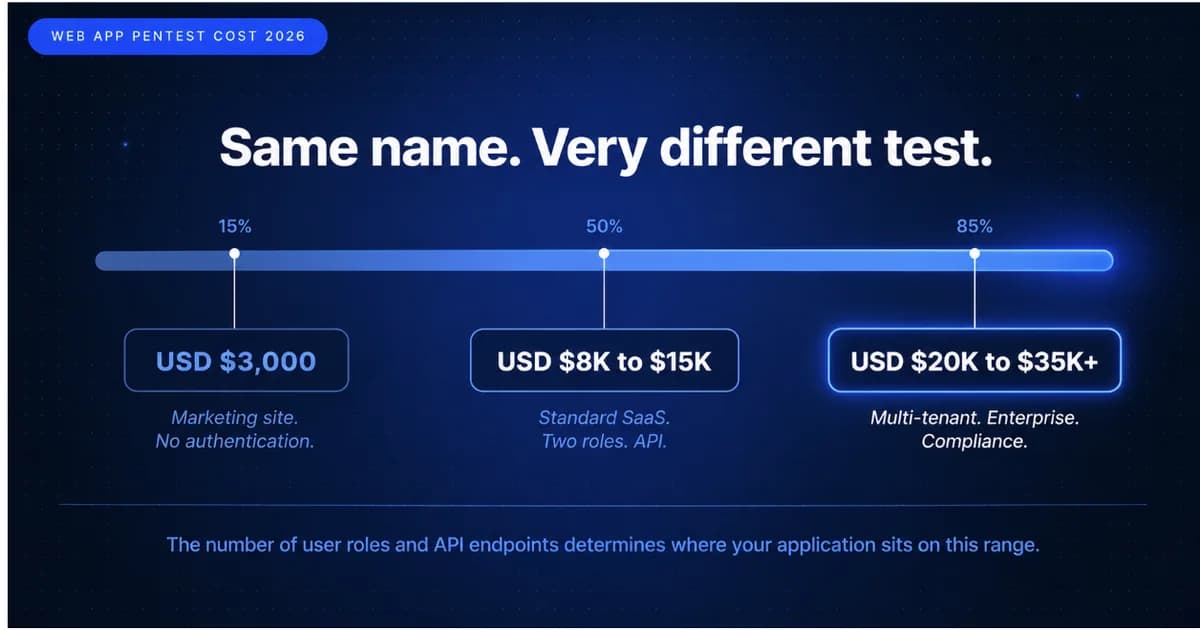
A web application penetration test in 2026 costs between USD $5,000 and USD $30,000 for most commercial engagements. The range is wide because "web application" covers everything from a marketing site with a contact form to a multi-tenant SaaS platform with payment processing, role-based access control, a REST API, a GraphQL interface, and SSO integration. The test that covers the first takes two to three days. The test that adequately covers the second takes ten to fifteen.
Understanding what specifically moves the price within that range lets you estimate your own cost before you request quotes, and gives you the ability to sanity-check quotes when they arrive.
Penetration testing cost is not only about the number of application pages. Modern web application testing requires reviewing authentication flows, API permissions, role-based access controls, SaaS integrations, business workflows, and operational trust relationships.
The five variables that set the price of a web application penetration test are: user roles, API coverage, testing methodology, compliance reporting requirements, and remediation retesting. Each adds tester days. Understanding how much each adds is the scope estimator.
Variable One: User Roles (The Most Underappreciated Cost Driver)
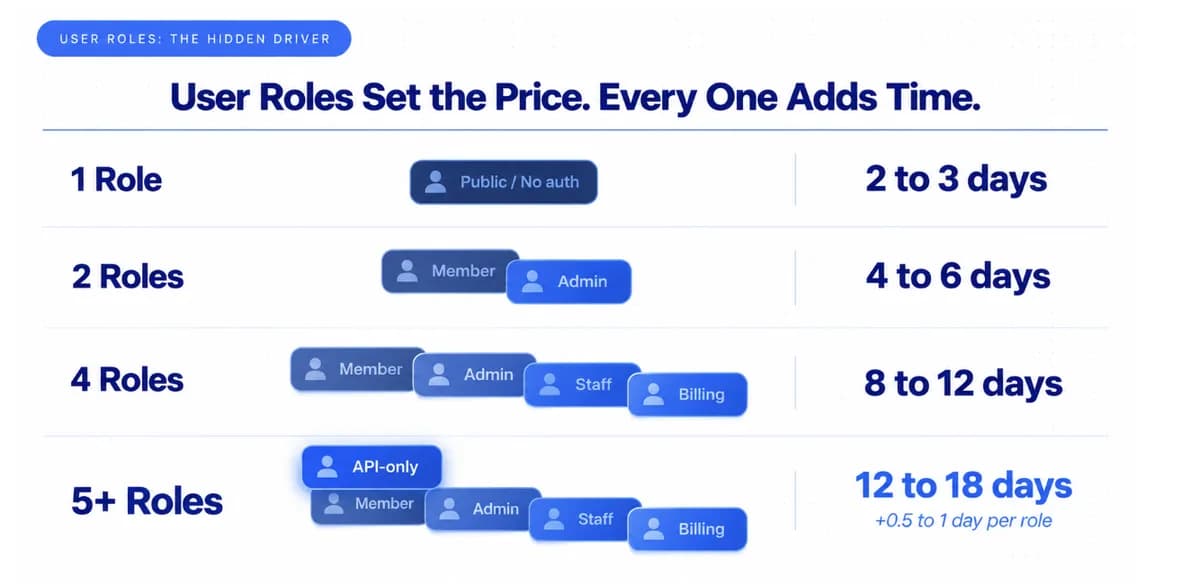
Every authenticated user role in a web application requires a separate test pass. The tester must log in as that role and validate that the role's access controls are enforced correctly — that it can access what it should and cannot access what it should not. A SaaS platform with a standard member role and an admin role is two test passes. A platform with member, admin, staff, billing, and API-only roles is five test passes. Each additional role adds approximately half to one full testing day for a competent manual tester.
A realistic budget for a meaningful grey box assessment of a medium-complexity SaaS application sits between $8,000 and $18,000 from a competent provider. Below that, scrutinise the methodology carefully.
• A single-role public-facing application: 2 to 4 testing days.
• A two-role authenticated application: 4 to 6 days.
• A four-to-five role SaaS platform: 8 to 14 days.
• A multi-tenant platform where each tenant's data isolation must be validated: 12 to 18 days, depending on the complexity of the isolation model.
Variable Two: API Coverage
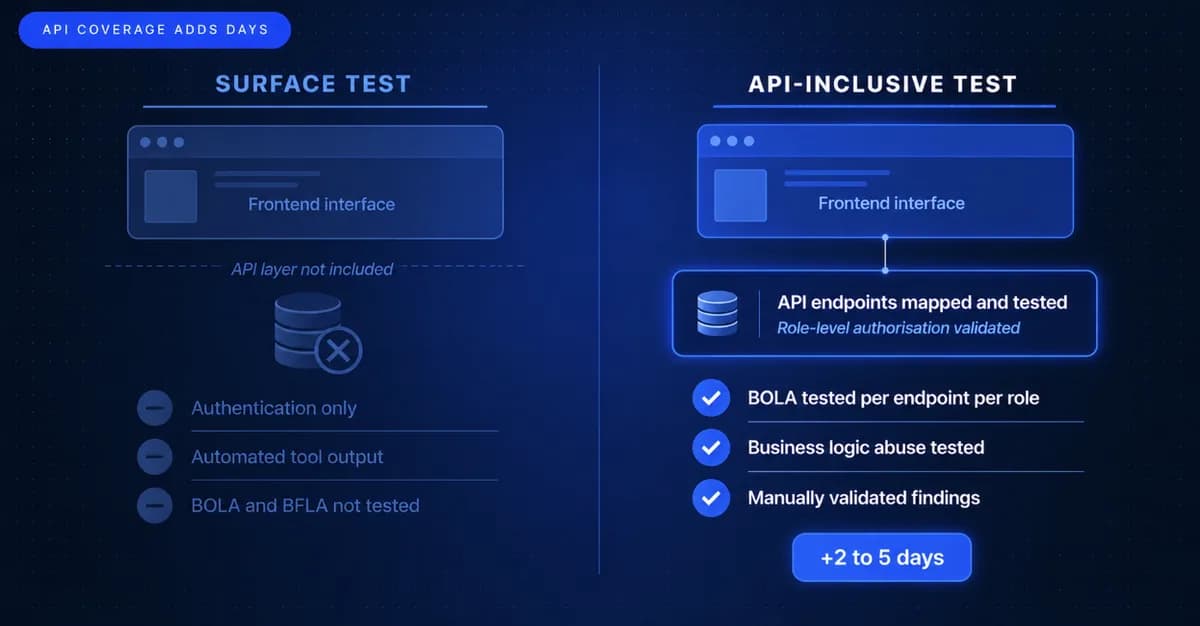
Most web applications call APIs. Whether the penetration test covers those API endpoints — and how deeply — is one of the most common scoping decisions that separates a surface-level test from a thorough one.
A test that covers only the front-end interface and does not examine the API layer will not find the authorisation failures that live there. Senior consultants and skilled testers, especially those holding advanced certifications like OSCP, OSCE, or CREST, command higher rates but uncover subtle, advanced vulnerabilities missed by entry-level practitioners. API authorisation testing, specifically broken object-level authorisation and broken function-level authorisation, requires manual test cases that automated scanners do not generate. For what API testing at this depth covers and why it matters for the full application security picture, the guide to API penetration testing and securing the backbone of modern applications covers the methodology that distinguishes surface-level API scanning from genuine API security testing.
A test that explicitly includes API endpoint mapping, authorisation validation per role, and business logic testing for each API function adds two to five days depending on the number of endpoints and the complexity of the authorisation model.
Variable Three: Testing Methodology
Black box testing gives testers no credentials or prior knowledge. Grey box and white box testing provide credentials and application knowledge that allow testers to reach deeper attack surfaces more efficiently.
Black box testing is not always cheaper in outcome. The tester spends more time on reconnaissance. Grey box testing with authenticated credentials for each user role reaches the access control, business logic, and API authorisation findings faster and produces more findings per day of testing than a black box approach against the same application. For most commercial web application tests where the goal is compliance evidence and finding real business-impact vulnerabilities, grey box is the better value.
Variable Four: Compliance Reporting
A web application penetration test that needs to produce SOC 2 audit-ready evidence, ISO 27001 control mapping, or PCI DSS requirement 6.3 documentation takes more time than a test producing a standalone technical report. The findings are the same. The reporting structure is more structured, more evidence-linked, and must map to specific control requirements that the compliance framework defines.
Compliance-structured reporting adds one to two days to a standard engagement. For organisations approaching a SOC 2 audit or ISO 27001 certification, the guide to continuous penetration testing for SOC 2 and ISO 27001 compliance covers how the web application test fits into the broader compliance evidence programme and what auditors specifically check.
Variable Five: Remediation Retesting
The cheapest test is the one that misses the breach. A low-cost engagement that misses most of the attack surface costs more in the long run than a well-scoped programme that finds what matters.
Retesting confirms that a remediation actually closed the vulnerability rather than suppressed its most visible symptom. For compliance-driven engagements, the retest evidence is what ISO 27001 and SOC 2 auditors specifically look for under corrective action clauses. Building retesting into the original scope is typically 10 to 20 percent of the initial engagement cost and is significantly cheaper than commissioning it as a separate engagement.
What a Web App Pentest Should Cost Based on Application Type
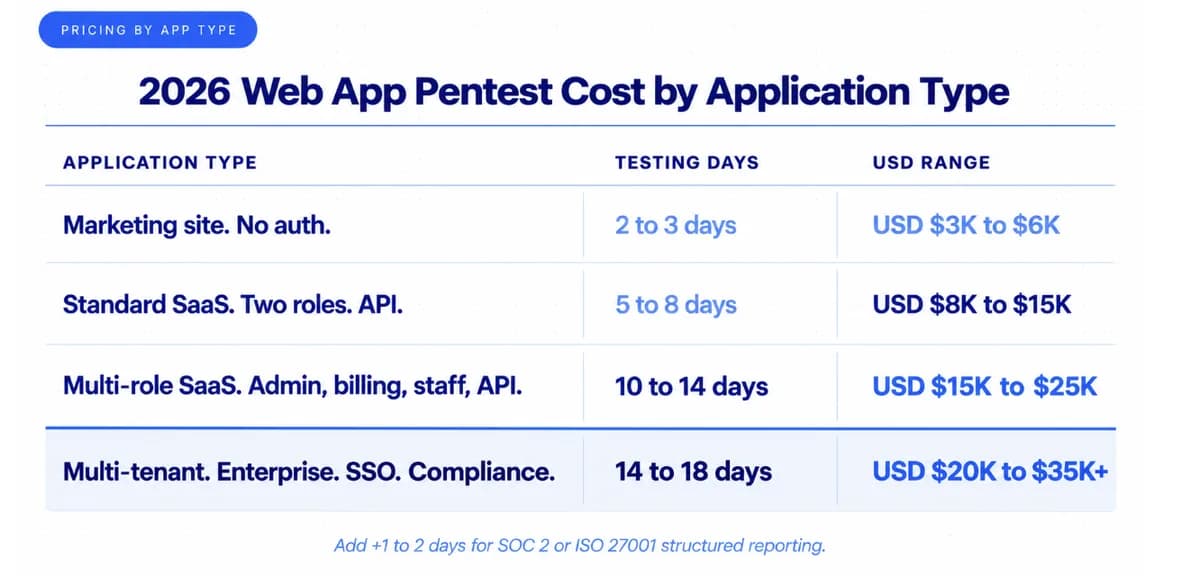
Single-page marketing site with contact form (no authentication)
USD $3,000 to $6,000. Two to three testing days. Minimal user roles. Limited API surface.
Standard SaaS application with two user roles and authenticated API
USD $8,000 to $15,000. Five to eight testing days. Grey box methodology.
Multi-role SaaS platform with admin, billing, API-only, and staff roles
USD $15,000 to $25,000. Ten to fourteen testing days. Grey box with full API coverage and business logic testing.
Multi-tenant enterprise application with tenant isolation, custom SSO, and compliance reporting requirements
USD $20,000 to $35,000. Fourteen to eighteen testing days.
The guide to what happens after a penetration test covers what a confirmed remediation cycle looks like, and why the retest evidence matters more than the initial report for compliance purposes.
Book a scoping consultation to get a specific price estimate for your web application based on role count, API surface, and compliance requirements.
Book a Scoping ConsultationPlan Your Annual Pentesting Strategy the Right Way
Learn how modern SaaS companies structure pentesting across the year to reduce risk, stay compliant, and avoid last-minute panic before audits.
Your Last Pentest Is Already Out of Date
Every week you ship without continuous testing is a week a vulnerability goes unseen. See what Capture The Bug finds in your first engagement.
Frequently Asked Questions
Q1: How much does a web application penetration test cost in 2026?
A: A web application penetration test in 2026 costs between USD $5,000 and USD $30,000 for most commercial engagements. A simple single-role application costs USD $3,000 to $6,000. A standard SaaS platform with two authenticated user roles and API coverage costs USD $8,000 to $15,000. A multi-role SaaS platform with admin, billing, staff, and API-only roles, full API coverage, and compliance reporting costs USD $15,000 to $25,000. Multi-tenant enterprise applications with compliance requirements and custom SSO typically cost USD $20,000 to $35,000.
Q2: What is the single biggest cost driver in a web application pentest?
A: User roles. Every authenticated user role requires a separate test pass to validate that role's access controls are correctly enforced. A single-role application is a two-to-four-day engagement. A five-role SaaS platform with member, admin, staff, billing, and API-only roles can require eight to fourteen days. Each additional authenticated role adds approximately half to one full testing day for a competent manual tester. Most buyers do not account for this when scoping a quote.
Q3: Is grey box or black box web application testing better value?
A: For most commercial web application tests, grey box testing with authenticated credentials for each user role produces more findings per day than black box. Black box testing requires the tester to spend time on reconnaissance that grey box bypasses with supplied credentials, which means less time reaches the access control, business logic, and API authorisation findings that produce the highest-impact results. Black box is more realistic as a simulation of an external attacker with no prior knowledge, but grey box is typically better value for compliance-driven engagements.
Q4: Does SOC 2 or ISO 27001 compliance affect web app penetration testing cost?
A: Yes, by one to two days typically. A compliance-structured web application penetration test must map findings to specific control requirements, produce evidence-linked reporting, and document remediation evidence in a format that auditors accept. The findings are the same as a standard engagement. The reporting structure is more detailed, takes more time, and must satisfy the specific evidence requirements of the compliance framework. Retesting must also be documented in a way that confirms specific vulnerabilities were closed, which ISO 27001 and SOC 2 auditors specifically look for under corrective action clauses.
Q5: How long does a web application penetration test take in 2026?
A: Testing duration depends on user role count, API surface, and testing methodology. A simple single-role application takes two to three days. A standard two-role SaaS application takes four to six days. A four-to-five role SaaS platform takes eight to fourteen days. Multi-tenant applications with complex isolation models take twelve to eighteen days. These figures reflect the testing phase only. Reporting, remediation, and retesting add additional time. Most providers deliver an initial report within five to ten business days of testing completion.