
A CTO at an Auckland-based fintech made a decision that looked smart on paper. His board wanted security to be a core internal capability, not a service they bought from outside. So the company hired a senior security specialist, gave the team a budget for tooling and infrastructure, and set out to build a penetration testing function that could run continuously and produce compliance-grade evidence for their upcoming SOC 2 review.
Fourteen months later, the function had produced three internal assessments, the original hire had moved to a competitor offering a higher salary, and the SOC 2 auditor had flagged their testing documentation as insufficient. The company went back to the market for an external provider at short notice, under pressure, with a compressed timeline.
The cost of the in-house experiment, when fully accounted for, was more than three times what a specialist PTaaS platform would have cost over the same period. The lesson was not that internal security capability is wrong. It is that penetration testing specifically is one of the hardest capabilities to build well internally, and one of the easiest to underestimate.
Why the Build Decision Feels Reasonable at First
The logic behind building in-house is not naive. It sounds like strategic thinking. Internal teams know the codebase. They can test continuously without scheduling external vendors. The knowledge stays inside the business rather than leaving with a provider at the end of an engagement.
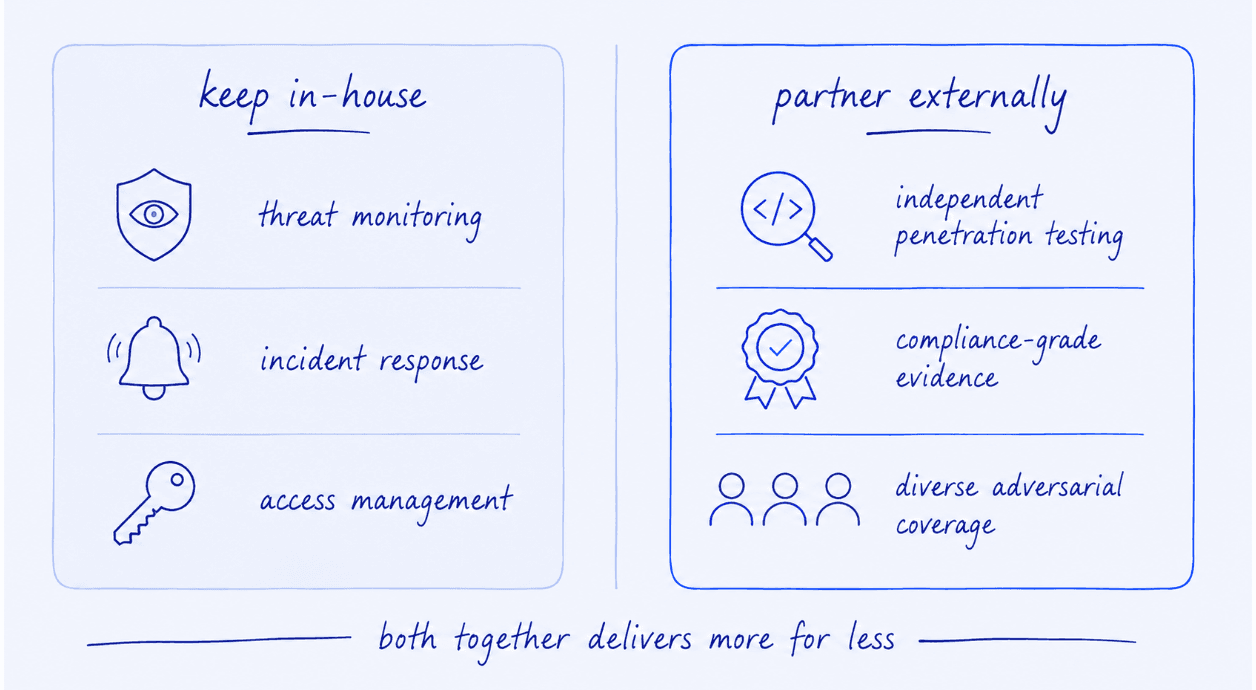
For certain security functions, this logic holds. Threat monitoring, incident response, and access management all benefit from internal ownership and deep product familiarity. But penetration testing sits in a different category.
Effective testing requires adversarial thinking that is deliberately different from how a product was built. The best security findings come from people who approach a system with no assumptions, no familiarity bias, and no loyalty to the architecture decisions that shaped it. Internal testers, no matter how talented, work against a natural tendency to test what they know rather than what they do not.
This is why CREST, the international benchmark for penetration testing quality, exists as an external credentialling body rather than an internal certification programme. It is also why regulators and enterprise procurement teams consistently ask for independent, third-party evidence rather than self-assessment.
The Costs That Do Not Appear in the Business Case
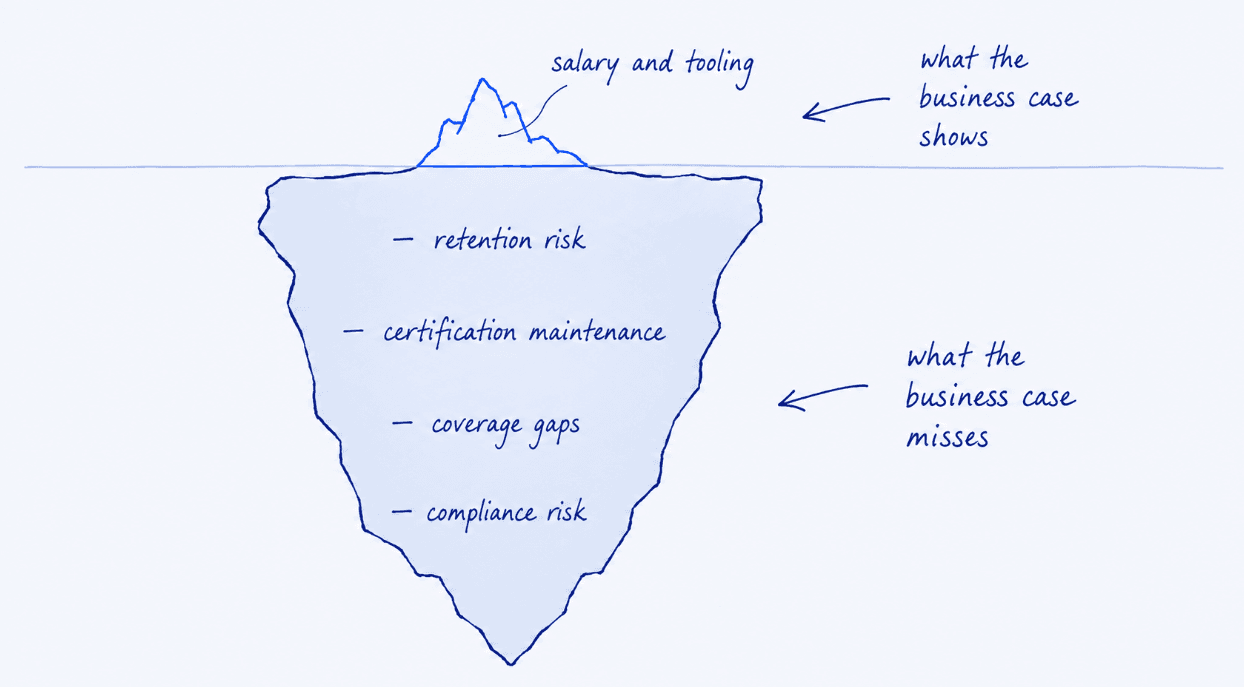
When leadership evaluates whether to build an internal penetration testing capability, the initial business case typically includes salary, tooling, and infrastructure. What it almost never includes are the costs that surface later.
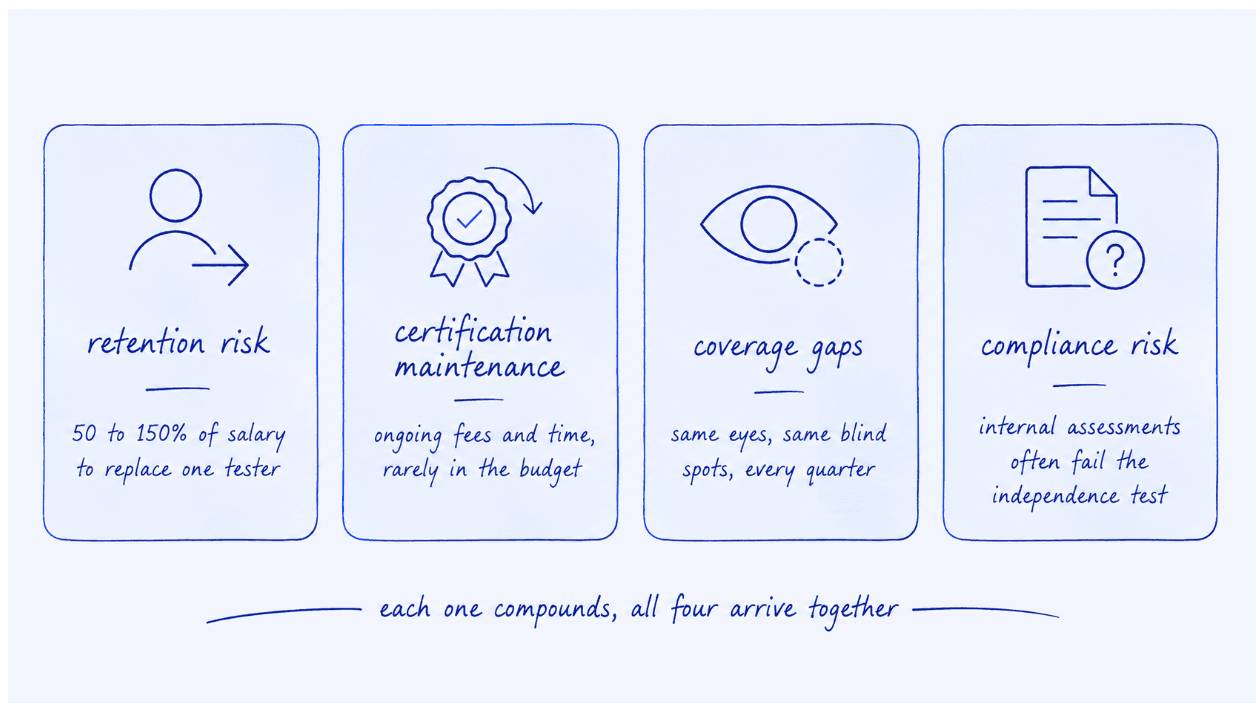
The first is retention. Security specialists with hands-on testing skills are among the most competed-for people in the ANZ talent market. A senior tester hired in Wellington or Sydney is receiving recruiter calls within months. The institutional knowledge built during onboarding, the familiarity with internal systems, and the time invested in building methodology all leave with that person. The cost of replacing them, including recruitment fees, onboarding time, and the productivity gap between departure and replacement, typically runs between 50 and 150 percent of annual salary.
The second is certification maintenance. Maintaining the credentials that make internal testing credible to external auditors, such as OSCP, CREST membership, or GPEN, requires ongoing investment in time and fees. For a team of two or three testers, this cost compounds year over year and rarely appears in the original budget.
The third is coverage gaps. An internal team of two or three testers, regardless of skill level, cannot match the breadth of perspective that a specialist platform brings. A SaaS product tested by the same two people every quarter develops blind spots. Fresh eyes, different methodologies, and exposure to a wider range of vulnerability patterns are built into the platform model in a way that a small internal team structurally cannot replicate.
The fourth is compliance risk. When an auditor, an enterprise customer, or a regulator asks for evidence of independent security testing, internal assessments often do not satisfy the requirement. The word "independent" carries specific meaning in compliance contexts. Building an internal function to produce compliance-grade evidence often requires external validation on top of the internal work, which means paying for both.
What the Platform Model Actually Delivers
Capture The Bug works with companies across New Zealand, Australia, Fiji, and the broader Pacific that have made both choices and then compared them over time. The pattern in the data is consistent.
A specialist PTaaS platform delivers CREST-certified testing coverage from day one, with no recruitment risk, no retention cost, and no certification overhead. When a tester leaves the platform's network, the replacement happens invisibly. The client continues to receive the same coverage without managing any of the transition.
The findings produced by a diverse pool of testers with different backgrounds, skill sets, and approaches consistently surface vulnerabilities that a small homogeneous internal team misses. This is not a reflection of individual skill. It is a structural advantage that comes from volume and variety of perspective.
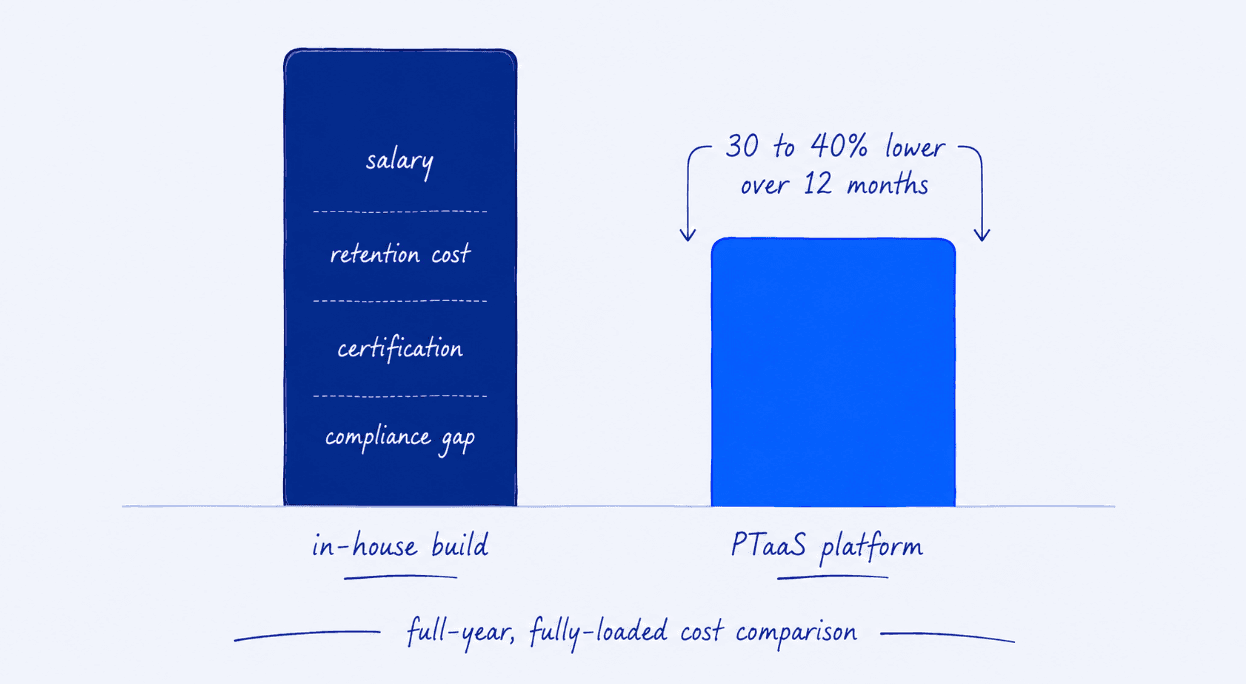
Capture The Bug's penetration testing services also produce compliance-ready evidence that satisfies SOC 2, ISO 27001, and PCI DSS requirements out of the box, without the additional overhead of commissioning external validation of internal work. The documentation that comes from each engagement is built to answer the questions an auditor actually asks. Over a full year, the total cost of continuous, CREST-certified, compliance-grade penetration testing through a specialist platform typically runs 30 to 40 percent below what a comparably credentialled internal function costs to staff and maintain.
Your Last Pentest Is Already Out of Date
Every week you ship without continuous testing is a week a vulnerability goes unseen. See what Capture The Bug finds in your first engagement.
The Question of Control
One argument that comes up consistently in these conversations is control. Leaders want visibility into what is being tested, when, by whom, and what the findings mean for the business. It is a legitimate concern and one that shapes how a good platform should be evaluated.
An annual engagement with a traditional provider where findings arrive in a PDF four weeks after the test ends does not give control. It gives a delayed summary of a past state. That is a fair criticism of how external testing has historically been delivered.
A platform model designed around real-time visibility changes this entirely. When findings appear in a shared dashboard as they are identified, when the team can see the status of every vulnerability and every remediation, and when communication between testers and the internal team happens in the same environment, the control argument shifts in favour of the platform. The CTO in the Auckland example was not wrong to want control. The mistake was assuming that internal hiring was the only way to get it. Capture The Bug's penetration testing services are built around exactly this model, giving teams across ANZ and the Pacific the visibility and evidence they need without carrying the overhead of building and maintaining the capability internally.
The Decision Framework for ANZ Leadership Teams
The honest answer to whether to build internally or partner with a specialist platform is not a universal one. It depends on what the testing function is actually for.
If the goal is deep product familiarity and continuous low-level security hygiene as part of the engineering culture, internal ownership of certain security functions makes sense. If the goal is credible, independent, compliance-grade penetration testing that satisfies auditors and enterprise customers, the internal build rarely delivers the outcome at the cost the business case assumed.
The companies in New Zealand, Australia, and Fiji that Capture The Bug works with most effectively are those that have made a clear distinction between the two. They invest internally in security culture, response capability, and risk ownership. They partner externally for the independent, adversarial testing that compliance and commercial confidence require. That combination delivers more security for less total cost than either approach alone. It also produces the evidence trail that enterprise deals, insurance renewals, and regulatory reviews now routinely demand. For any team currently evaluating the in-house versus platform decision, a direct conversation with Capture The Bug about what the specific testing requirement actually needs to deliver is the most useful first step. The scope, the cost, and the compliance fit become clear quickly, and there is no obligation beyond that conversation. Visit Capture The Bug's penetration testing services to start that discussion.
Plan Your Annual Pentesting Strategy the Right Way
Learn how modern SaaS companies structure pentesting across the year to reduce risk, stay compliant, and avoid last-minute panic before audits.
FAQ
1. Is it cheaper to build an in-house penetration testing team or use an external platform?
When the full cost is accounted for, including recruitment, retention, certification maintenance, tooling, and the cost of compliance gaps, building in-house is typically more expensive than partnering with a specialist PTaaS platform. Most ANZ companies that have made both choices report in-house total costs running significantly above initial budget expectations.
2. Why do auditors prefer independent penetration testing over internal assessments?
Compliance frameworks like SOC 2, ISO 27001, and PCI DSS require evidence of independent security testing specifically because internal assessments carry an inherent conflict of interest. An internal team testing its own product cannot provide the adversarial objectivity that an independent provider brings. Regulators and enterprise customers treat the two very differently.
3. What does CREST certification mean for penetration testing?
CREST is an international professional body that certifies the technical competence and professional standards of penetration testing providers. For businesses in New Zealand, Australia, and Fiji seeking compliance-grade security evidence, CREST certification is the credentialling standard that auditors and procurement teams recognise as authoritative.
4. How does a PTaaS platform address the control concerns that drive in-house build decisions?
A modern PTaaS platform built around real-time visibility gives leadership continuous access to findings, remediation status, and testing coverage. This delivers more operational control than a traditional external engagement while removing the staffing overhead of an internal function.
5. What security functions make sense to keep in-house versus outsourcing?
Threat monitoring, incident response, access management, and internal security awareness are well-suited to internal ownership because they benefit from deep product familiarity. Penetration testing benefits from being external and independent because adversarial credibility requires distance from the product being tested.
6. Does Capture The Bug operate in Fiji and the broader Pacific region?
Yes. Capture The Bug works with clients across New Zealand, Australia, Fiji, and the broader Pacific, providing CREST-certified penetration testing with compliance documentation suited to multi-framework requirements across the region.