

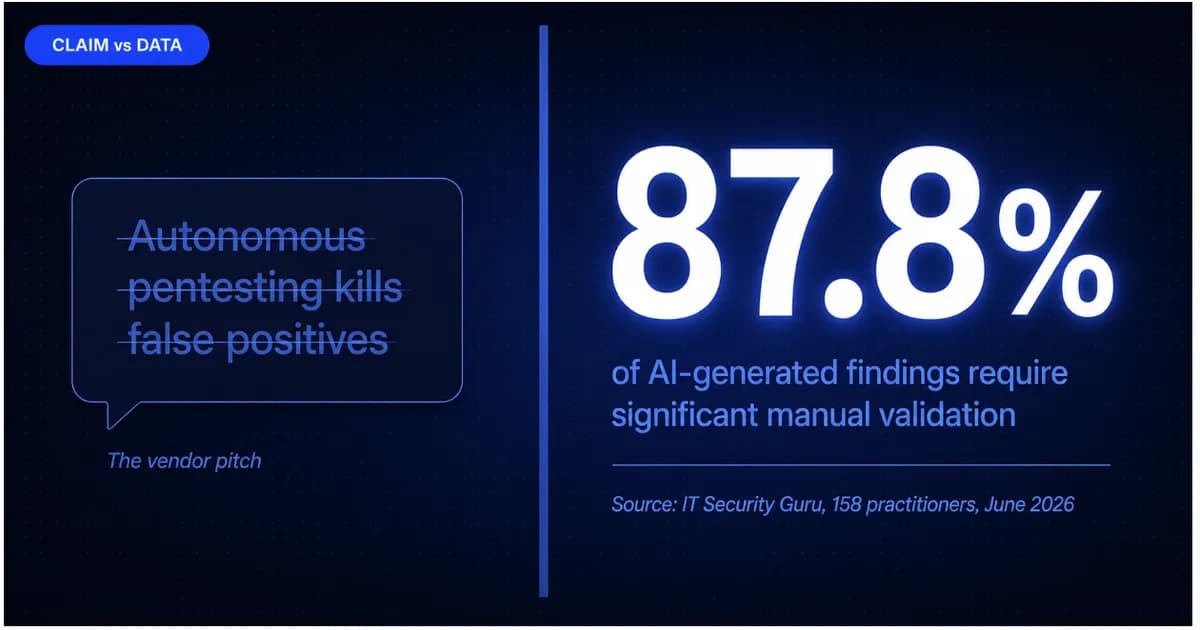
The pitch for autonomous pentesting tools has been consistent for the past two years. Automation finds vulnerabilities faster. It scales across more assets than a human team could ever cover. And it eliminates the false positives that make traditional vulnerability scanning so difficult to act on.
The 2026 data does not support that last part.
A survey of 158 security practitioners conducted in June 2026, published by IT Security Guru, found that 87.8% of respondents said AI-generated findings required significant manual validation. Among those, 26.5% said more than a quarter of AI-generated findings needed rework before they could be trusted. The most common single frustration with AI pentesting tools, cited in roughly 30% of free-text responses, was false positives, hallucinated exploits, or fabricated findings. That ranked above cost, integration issues, or any other complaint.
At the same time, the Cobalt 2026 State of Pentesting report found that confidence in fully autonomous AI pentesting for primary security needs fell from 29% to 9% in a single year. 78% of respondents experienced critical false negatives from automated scanning tools. Autonomous tools that generate more noise and miss more actual vulnerabilities are solving neither the false positive problem nor the coverage problem they were marketed to address.
Understanding why requires separating what autonomous tools are good at from what they are structurally unable to do.
What Autonomous Tools Actually Do Well
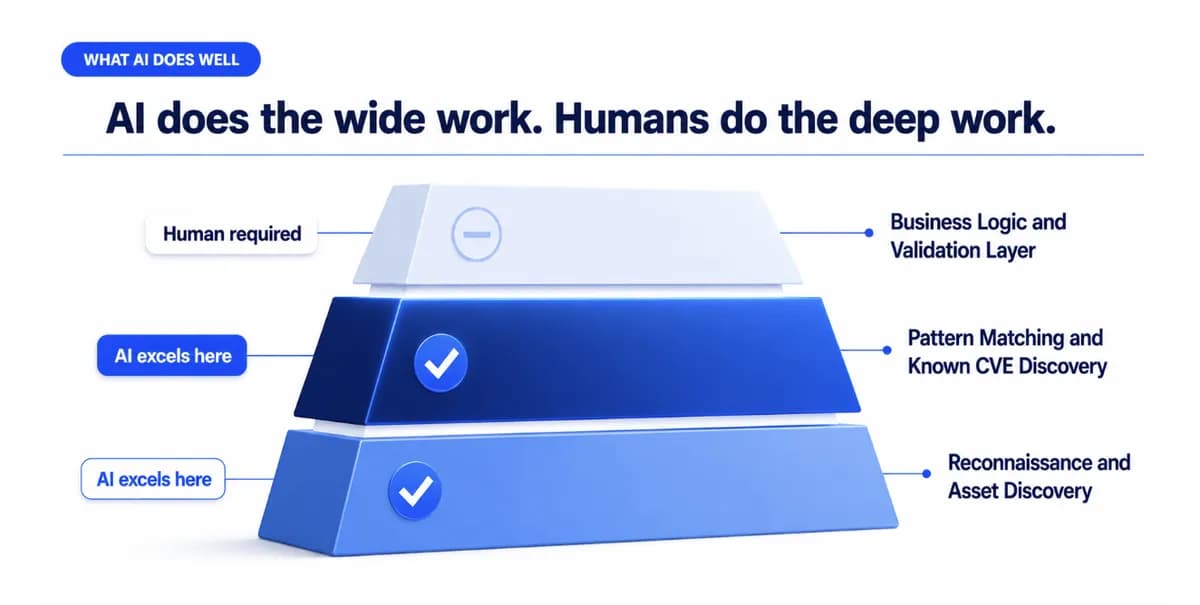
Autonomous scanning tools are genuinely fast at pattern matching. They scan large numbers of assets against known vulnerability signatures in minutes, finding open ports, outdated software versions, missing headers, and known CVEs at a scale a human team could not match in the same timeframe.
That is real value. HackerOne's 2025 research found 70% of security researchers use AI tools for reconnaissance speed and repetitive task reduction. At the coverage layer, autonomous tools reduce the workload that would otherwise fall to human testers on known-pattern discovery.
The false positive problem does not live at the pattern-matching layer. It lives at the next layer: the point at which a tool decides whether what it found is actually exploitable.
Where Autonomous Tools Generate Noise
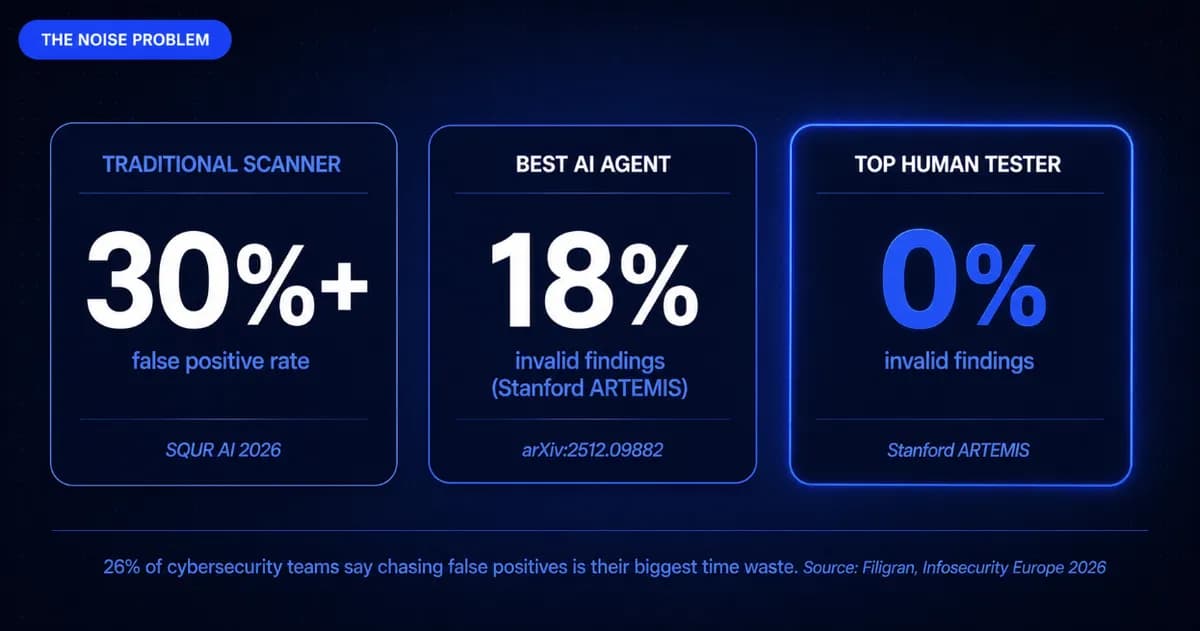
A traditional scanner flags every potentially vulnerable pattern without testing whether it is exploitable in the specific application context. An outdated library is flagged regardless of whether it is reachable from a request or whether compensating controls block exploitation.
The Stanford ARTEMIS study found the best autonomous AI pentest agent submitted an 18% invalid findings rate. Top human testers submitted zero invalid findings. XBOW had 10% of flagged vulnerabilities validated as genuine in one independent assessment.
An 18% invalid rate is workable as a first-pass discovery filter when a human validation step follows. It is not workable as a final deliverable to an engineering team already spending 26% of its time chasing false positives, per the Filigran survey of 168 cybersecurity leaders at Infosecurity Europe 2026. Replacing one noise source with another has not solved the problem.
AI tools also miss the finding categories that matter most. Business logic vulnerabilities, IDOR flaws, authentication bypass conditions, and chained exploits are the findings autonomous agents consistently fail to discover, and the ones with the highest business impact when missed. As detailed in the guide to how attackers discover unpatched assets across cloud and SaaS environments, the most consequential attack vectors are precisely those that pattern-matching cannot surface.
Your Last Pentest Is Already Out of Date
Every week you ship without continuous testing is a week a vulnerability goes unseen. See what Capture The Bug finds in your first engagement.
What Actually Reduces False Positives
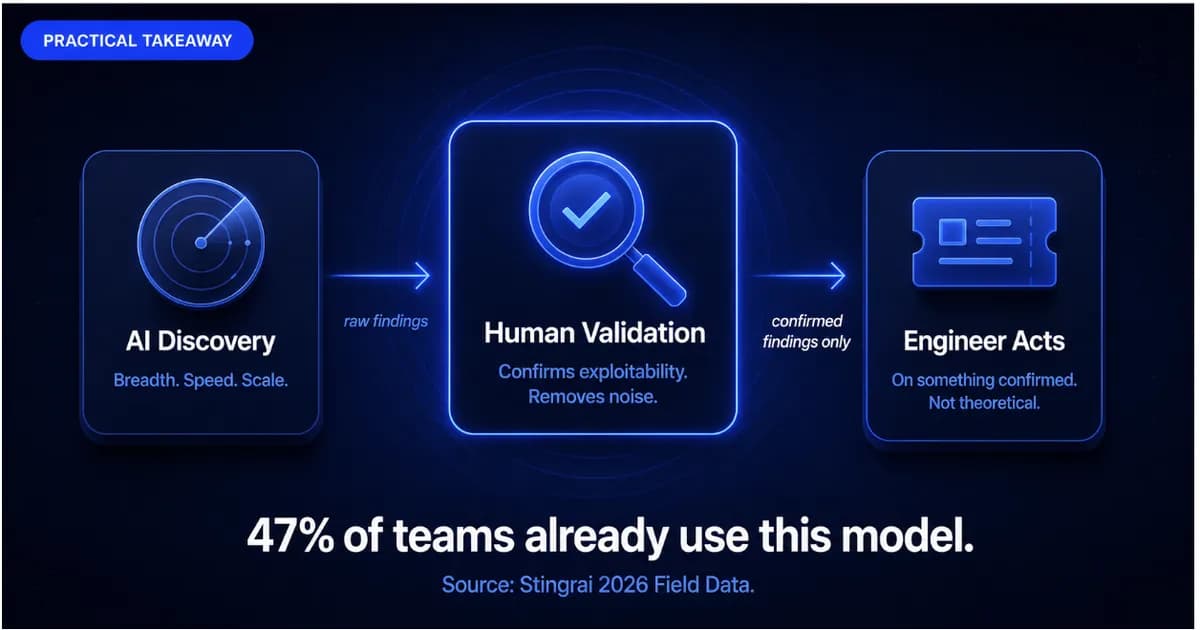
The security testing model that reduces false positives meaningfully in 2026 is validated testing: autonomous discovery at breadth and speed, followed by human expert validation before any finding reaches the engineering team.
This is what the 2026 market has converged on. 47% of the market has adopted hybrid AI-plus-human testing per Stingrai's 2026 field data. Organisations that reduced false positives most significantly did so by adding AI-driven discovery as a first pass that a human validates before the finding reaches the backlog.
The validation step is what changes the false positive rate. When a human tester confirms exploitability with a proof of concept before the ticket is created, the engineering team receives a confirmed finding, not a theoretical risk. That is the distinction between a programme that generates actionable remediation work and one that generates a queue of tickets nobody trusts.
For organisations running continuous testing programmes, the same principle applies at cadence. Continuous penetration testing for SOC 2 and ISO 27001 compliance is structured around continuous validated findings, not raw scanner output. That difference is what closes the gap between finding volume and remediation throughput.
The false positive problem is not a tool selection problem. It is a workflow problem. The tool discovers. The expert validates. The engineer acts on something confirmed. No autonomous tool skips the middle step without shifting the validation burden onto the team that was supposed to benefit from the automation. The guide to what happens after a penetration test covers the confirmation steps that make a finding confirmed rather than assumed.
Book a security consultation with Capture The Bug to see what a validated testing programme produces versus a scanner-only or autonomous-only approach.
Plan Your Annual Pentesting Strategy the Right Way
Learn how modern SaaS companies structure pentesting across the year to reduce risk, stay compliant, and avoid last-minute panic before audits.

FAQ
Does autonomous pentesting reduce false positives?
Not on its own. The 2026 data from IT Security Guru found that 87.8% of AI-generated findings required significant manual validation, and the most common frustration with AI pentesting tools was false positives, hallucinated exploits, or fabricated findings. Autonomous tools generate false positives at rates between 10% and 45% depending on the tool, per Stingrai's 2026 false positive reference table. False positive rates are only meaningfully reduced when AI-driven discovery is followed by human expert validation before findings reach the engineering team.
What is the false positive rate of AI pentesting tools in 2026?
The Stanford ARTEMIS study found the best autonomous AI pentest agent submitted 18% invalid findings. XBOW achieved 10% invalid findings in one independent assessment. Vendor claims of sub-2% false positive rates should be verified against the corpus and methodology before being accepted, per Stingrai's 2026 benchmark analysis. Top human testers in the same Stanford study submitted zero invalid findings.
Why did confidence in autonomous pentesting fall so sharply in 2026?
According to the Cobalt 2026 State of Pentesting report, confidence in fully autonomous AI pentesting fell from 29% to 9% in a single year. 78% of respondents experienced critical false negatives from automated scanning tools, meaning important vulnerabilities were missed entirely. Autonomous tools proved effective at pattern-matching for known vulnerabilities but failed to discover business logic flaws, IDOR vulnerabilities, and chained exploits that require contextual reasoning.
What is the hybrid pentesting model and why is 47% of the market adopting it?
The hybrid model combines AI-driven automated discovery for breadth and speed with human expert validation before findings are reported. 47% of the market has adopted this model per Stingrai's 2026 field data. The AI layer handles reconnaissance, known-pattern vulnerability discovery, and repetitive testing at scale. The human layer validates exploitability, dismisses false positives, and discovers business logic vulnerabilities that automation cannot reason about. The combination reduces false positive rates to the human baseline while maintaining the scale benefits of automation.
How does human-in-the-loop validation reduce false positives in practice?
When a human expert reviews an AI-flagged finding and confirms exploitability with a proof of concept before creating a remediation ticket, the engineering team receives a confirmed finding rather than a theoretical risk. This shifts the validation work from the engineering team to the security specialist, where it belongs. The result is a remediation backlog that engineers trust and act on, rather than a queue of tickets they triage and dismiss.