API Security vs Application Security in 2025: The Real Differences Leaders Must Understand
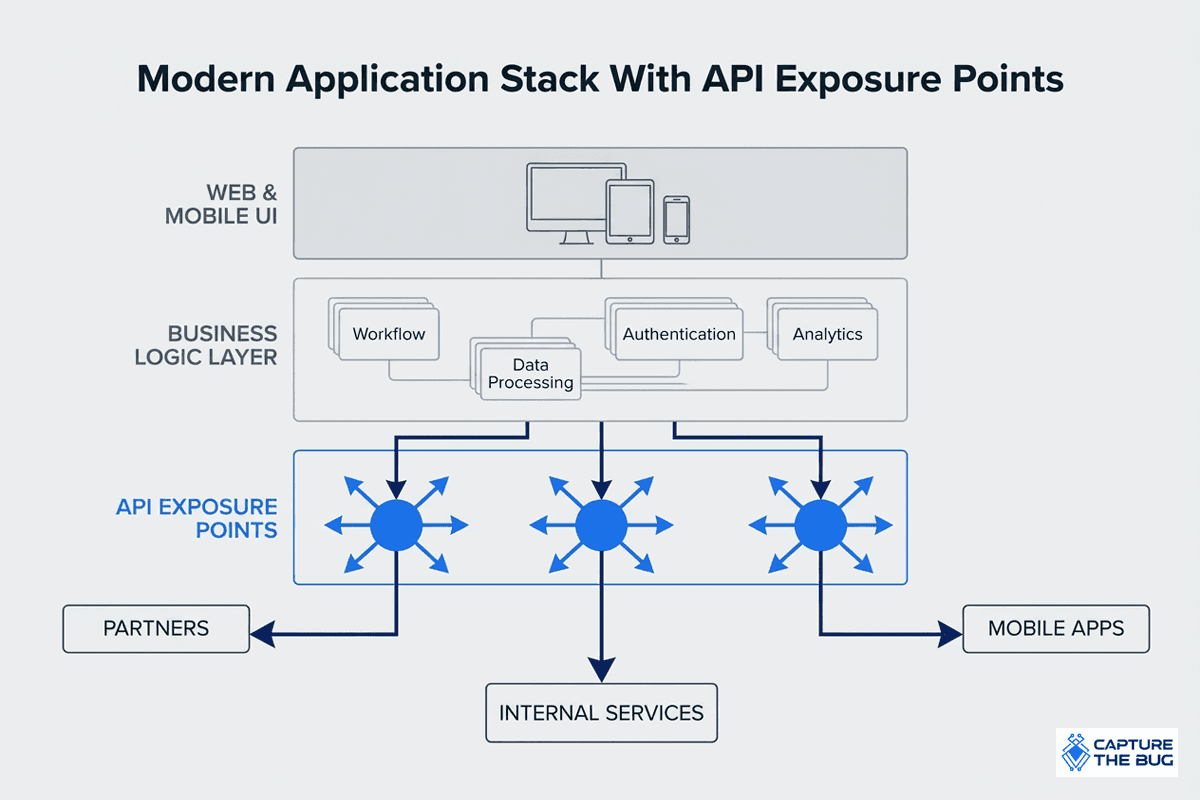
Modern digital products aren't built the way they used to be. What once looked like a simple web application has evolved into a network of interfaces, micro frontends, partner connections, and internal services that speak to each other constantly. Somewhere in that complexity, a gap opens. And attackers know exactly where to look.
This is where the distinction between API security and application security becomes mission-critical. They sound similar, but in practice, they solve different problems and guard different doors.
Capture The Bug works with organisations across ANZ, the USA, and global markets, and one pattern appears again and again: teams believe their application is secure because the UI behaves as expected. But the real exposure sits behind the UI, in the APIs that quietly move data, process logic, and run the core of the business.
This blog breaks down the differences clearly, shares lessons learned from real engagements, and provides guidance leaders can use today.
A Story That Explains the Problem Clearly
A fast-growing fintech shipped a customer rewards feature after weeks of sprint testing. The web application passed every check. Nothing seemed off.
Two weeks later, a partner discovered unusual reward redemptions happening without any UI interaction.
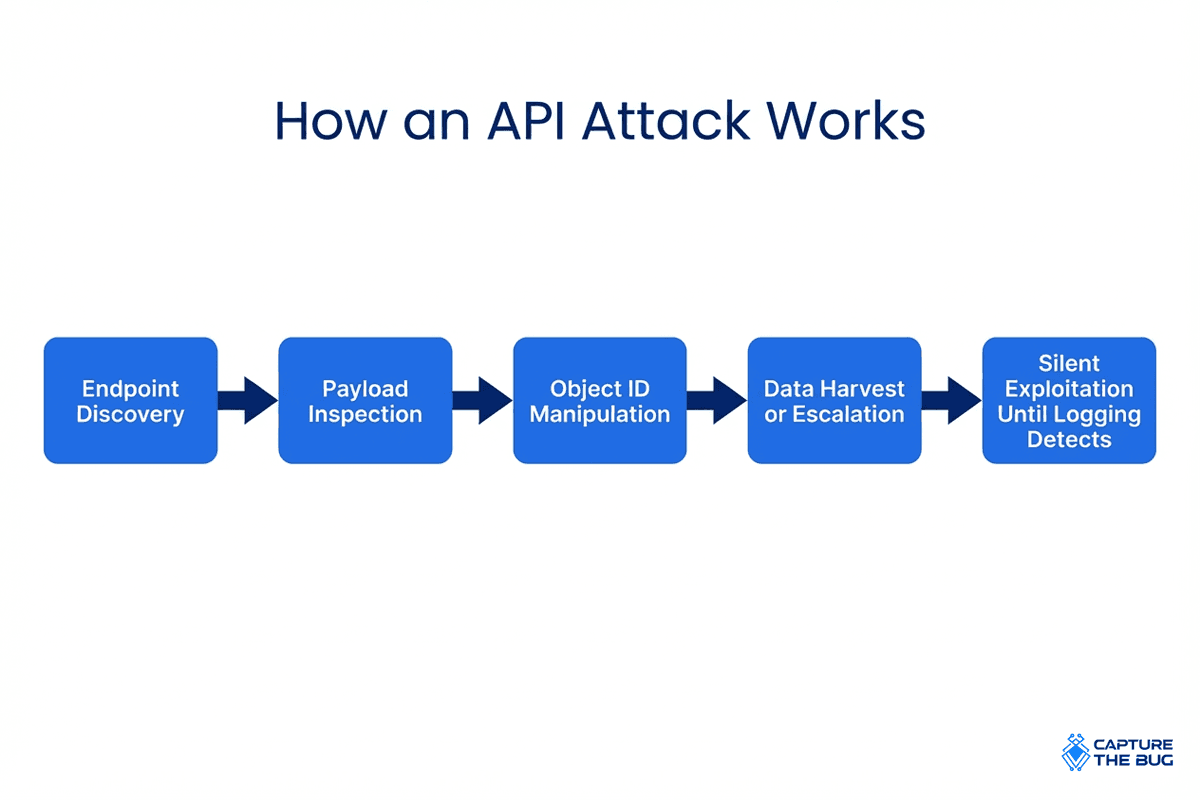
The issue had nothing to do with the application layer. The problem was a private API endpoint returning far more data than intended, with a predictable object ID pattern. Attackers bypassed the UI entirely. The application was secure, but the API behind it was exposed.
This is the gap many organisations don't see until the damage is already done.
What Application Security Really Covers
Application security focuses on everything a person touches and everything that supports that experience. This includes the web interface, mobile interface, backend logic, user sessions, form inputs, stored data, and any component that processes user-driven actions.
Its main purpose is to stop attacks like injection, session manipulation, cross-site scripting, access misconfigurations, and mismanaged credentials.
Application security deals with questions such as:
- Can a session be hijacked or misused?
- Can an attacker inject unexpected code?
- Does the app reveal information it shouldn't?
- Are third-party libraries introducing risk?
- Are user flows hardened against tampering?
It's broad. It's layered. And it's critical. But it's not enough on its own anymore.
What API Security Protects
APIs are not interfaces people see. They are the functions that power everything behind the scenes: mobile interactions, dashboards, partner workflows, checkout flows, and internal tools.
API security focuses on:
- How endpoints validate identity
- Which fields get returned
- How object IDs are handled
- How data flows between services
- Whether business logic can be abused
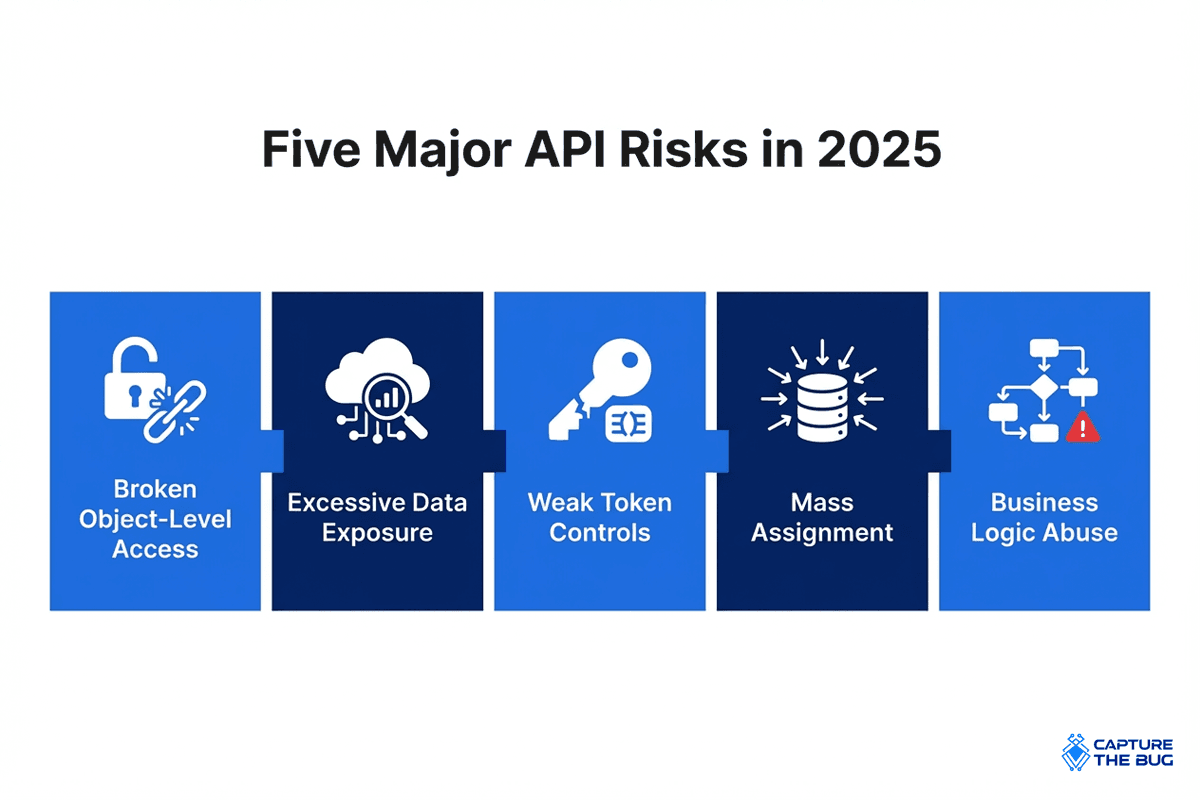
Typical API problems include:
- Broken object-level access that exposes another user's data
- Excessive data exposure where the endpoint returns full records
- Weak token enforcement that lets attackers impersonate legitimate roles
- Mass assignment where fields not meant for user control are updated
- Business logic abuse where the attacker misuses legitimate functions at scale
APIs don't wait for a button click. They perform exactly the same action regardless of who is calling them. That is why attackers prefer APIs.
Key Differences at a Glance
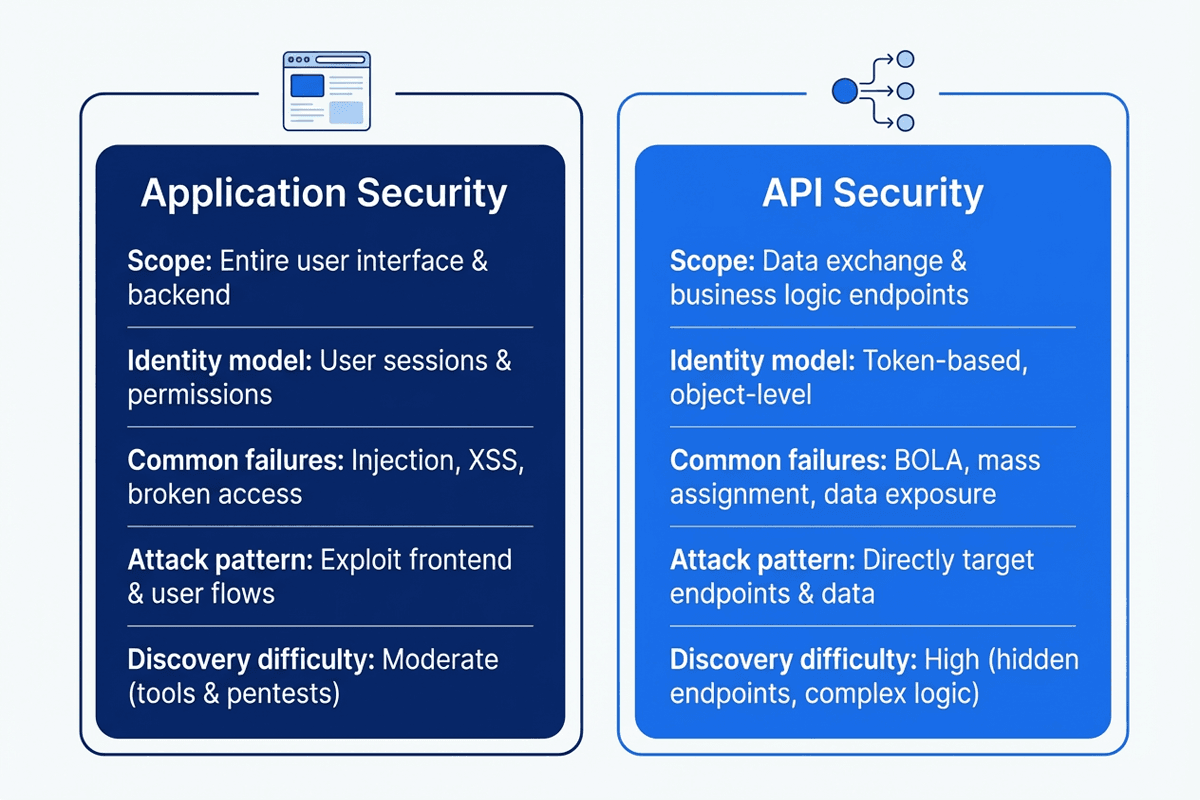
Leaders often ask for a simple way to view the distinction. Here it is:
| Aspect | Application Security | API Security |
|---|---|---|
| Core Purpose | Protects user-facing systems and workflows | Protects machine-to-machine interfaces and exposed business logic |
| Auth Model | Sessions, roles | Tokens, scopes, signed requests |
| Common Failures | XSS, CSRF, SQL injection | BOLA, mass assignment, data exposure |
| Attack Pattern | Interactive attacks | Automated, high-volume exploitation |
| Discovery Challenge | Known pages and routes | Undocumented, outdated, internal, or partner APIs |
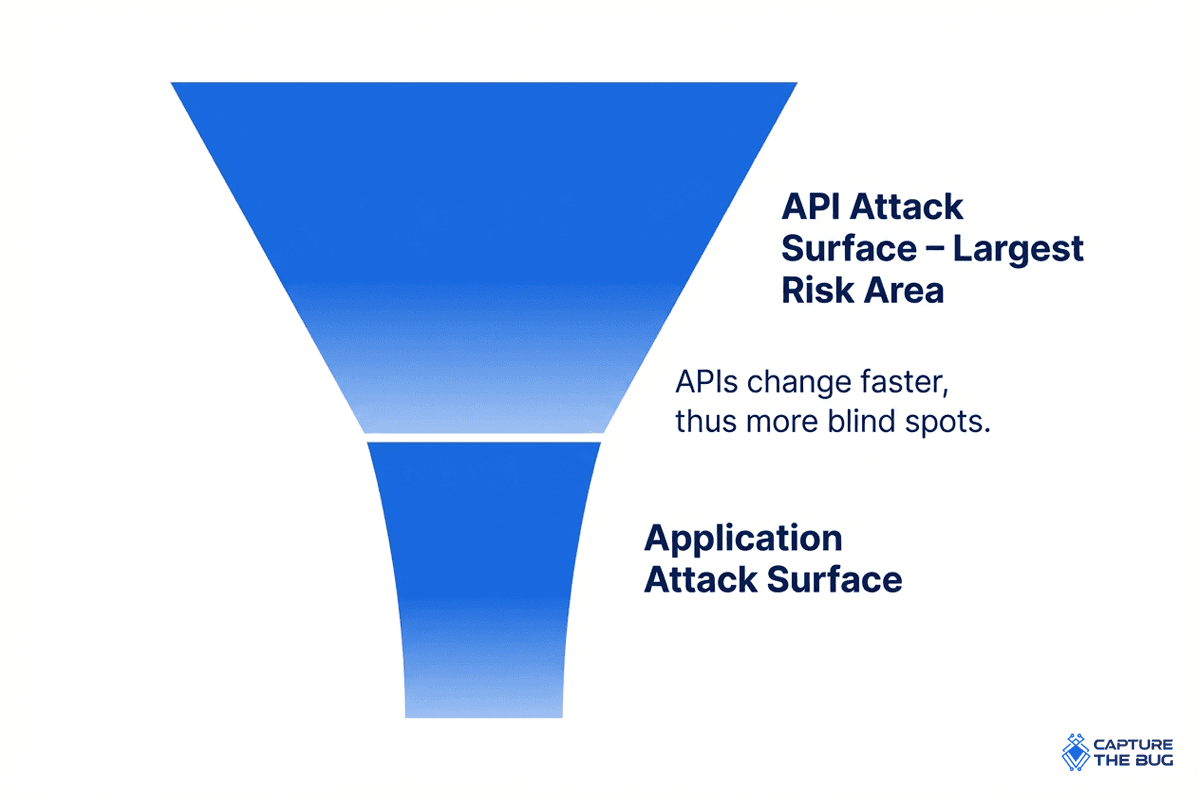
The takeaway: APIs are the most rapidly changing and least understood part of an organisation's attack surface.
Why Both Matter Together
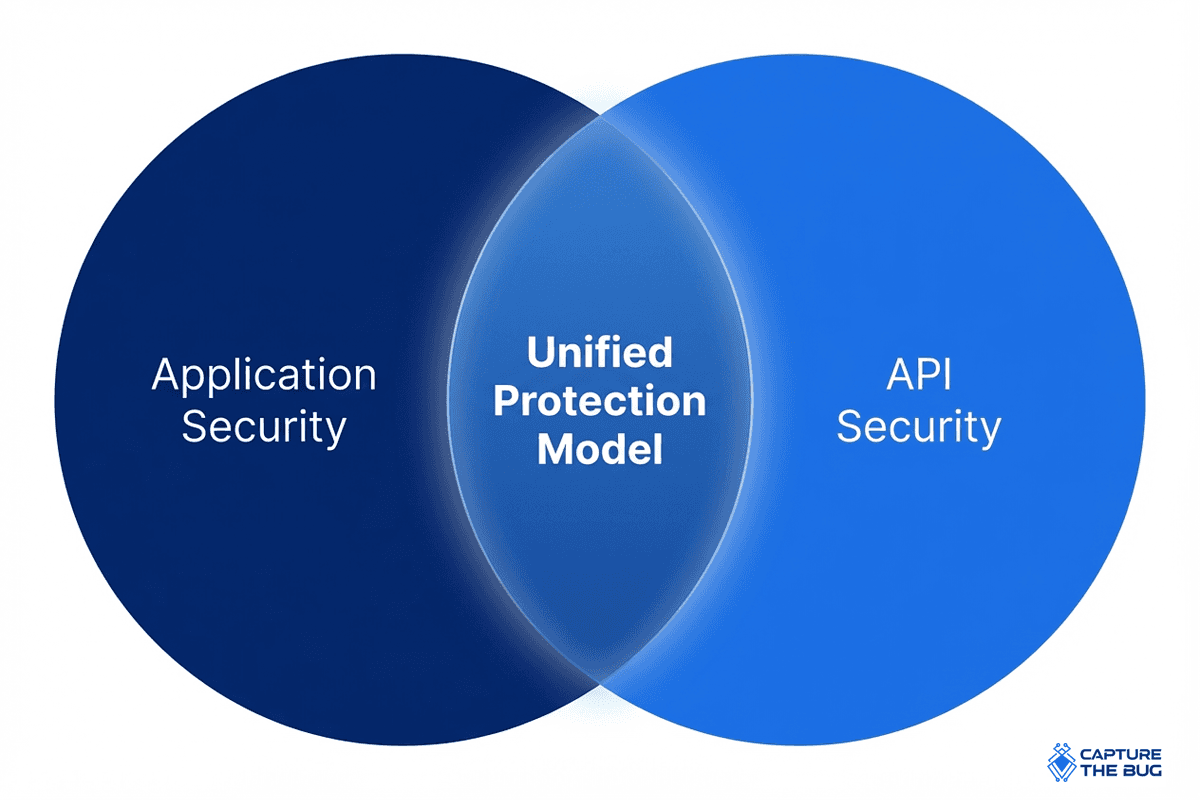
The modern stack is interconnected. APIs feed the application. The application triggers the APIs. If you secure one and ignore the other, attackers simply choose the weaker path.
Application security protects the experience.
API security protects the foundation that experience relies on.
When Capture The Bug performs PTaaS assessments across industries, one insight remains consistent: APIs fail silently and expose more data than teams realise. That's why leaders must view these surfaces as complementary, not competing priorities.
How Organisations Should Approach Application Security in 2025
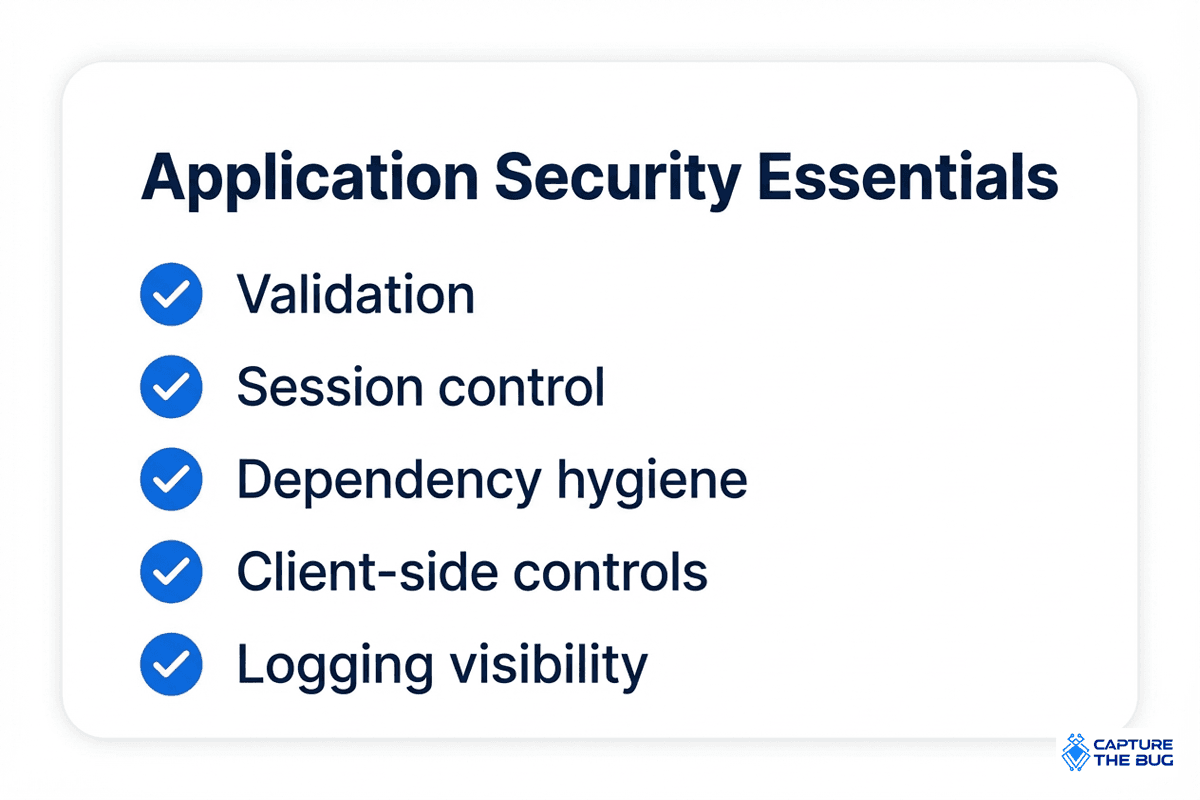
Application security has matured, but the execution still matters. These are foundational controls every business should implement:
- Robust Input and Output Validation: Validate every input and encode every output. This protects against most injection-based risks.
- Session and Credential Hardening: Shorter-lived sessions, clear invalidation paths, and strict cookie settings make a meaningful difference.
- Lifecycle Management for Dependencies: Outdated libraries and misconfigured modules remain one of the largest sources of compromise.
- Secure Client-Side Controls: Use well-defined content security policies, careful script loading, and reduce exposure in the browser.
- Actionable Logging: Link user sessions to backend actions so auditing becomes decisive, not guesswork.
How Organisations Should Approach API Security in 2025
API security requires different thinking. Here's what Capture The Bug sees as essential today:
- Full API Inventory and Classification: If a team cannot list every API, version, and exposure level, gaps already exist.
- Strong Identity and Token Standards: Short-lived tokens, signed requests, and scope boundaries are non-negotiable.
- Field-Level Minimisation: Return only what the operation requires. No more large objects with hidden fields attackers can exploit.
- Rate Controls and Behaviour Monitoring: APIs need protections against volume abuse, scraping, and credential replay.
- Business Logic Testing: Technical scanning is not enough. Organisations must test how attackers might misuse legitimate workflows.
- Secure Decommissioning: Inactive or outdated APIs must be fully retired. “Temporary” APIs tend to become permanent risks.
Testing: Where Most Teams Struggle
Even mature organisations find testing difficult for three reasons:
- Incomplete visibility: Undocumented APIs, internal endpoints, and forgotten versions are common.
- Limited coverage: Traditional testing tools focus on technical flaws but often miss business logic abuse.
- Fragmented workflows: Testing happens in silos. Findings don't always flow into development, product, or operations teams.
Capture The Bug's PTaaS model exists because security must be continuous, collaborative, and validated by experts who understand real attack behaviour.
Governance: Who Owns What
Modern security programs benefit from shared responsibility:
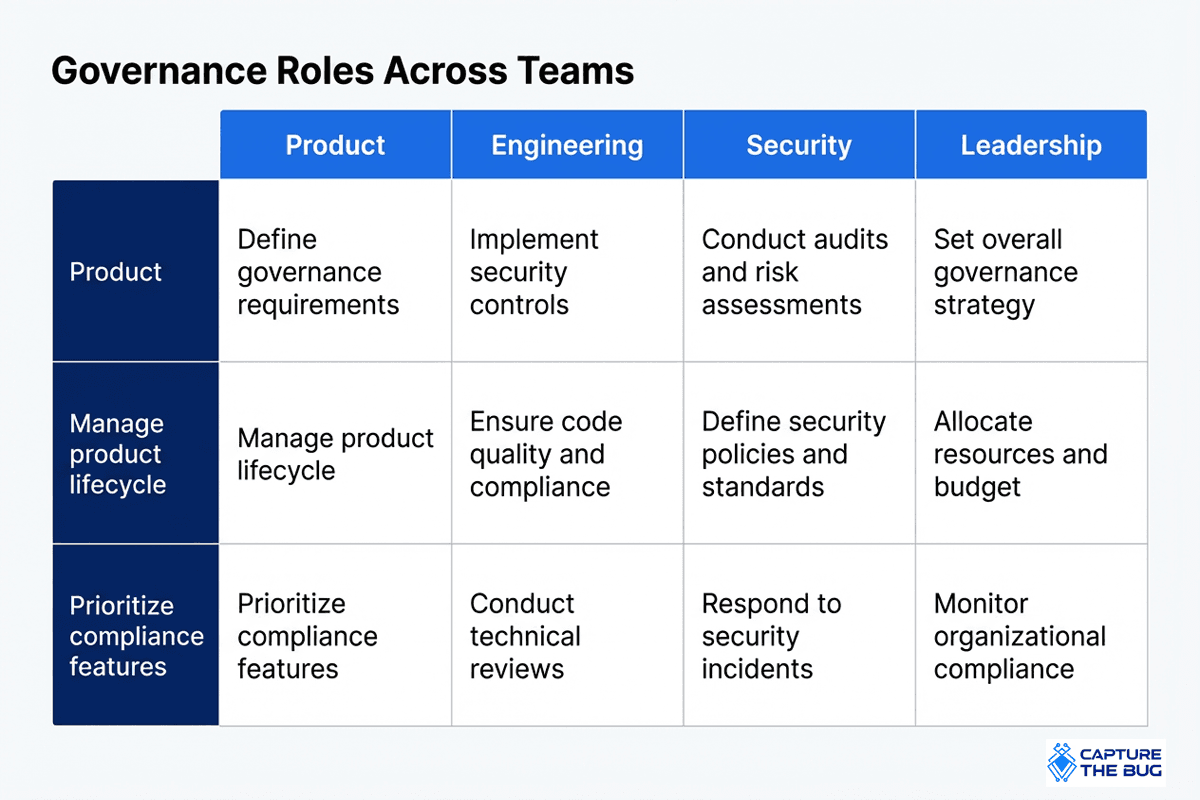
- Product teams own secure API and app design.
- Engineering teams enforce token policies, identity standards, and secure patterns.
- Security teams validate, coach, and challenge assumptions.
- Leadership demands measurable evidence of protection across both application and API layers.
This alignment prevents the gaps that attackers use to slip through.
Final Guidance for 2025
Leaders don't need more noise. They need clarity and evidence.
Here's the guidance Capture The Bug gives every client:
- Treat APIs as first-class assets with their own governance
- Harden both surfaces in parallel
- Test business logic, not just technical inputs
- Maintain a living inventory of all endpoints
- Require continuous validation, not point-in-time testing
- Prioritise controls that reduce the largest real-world risks
Applications and APIs are intertwined. Securing one without the other creates a false sense of confidence. In 2025, the organisations that thrive are the ones that can demonstrate — not just assume — that every layer of their digital experience is protected end to end.
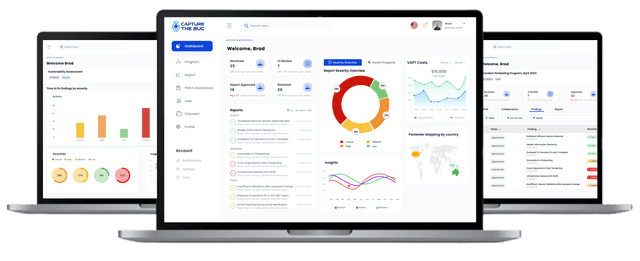
Experience Capture The Bug Platform
Streamline your security testing with our PTaaS platform. Collaborate with expert testers, track vulnerabilities, and secure your applications effortlessly.
Frequently Asked Questions
1. Why is API security so important today?
APIs run most digital services. If an endpoint leaks data or exposes a workflow, attackers bypass the UI entirely and move straight into the core business logic. This makes API risk both silent and high impact.
2. Can strong application security protect APIs automatically?
No. APIs behave differently, use different identity models, and require separate controls. Securing the UI does not secure the backend that powers it.
3. What is the most common API weakness?
Broken object-level access. This flaw lets attackers manipulate identifiers to access another user’s data, often without triggering alerts.
4. How often should APIs and applications be tested?
Continuously. Point-in-time audits no longer reflect the speed at which modern APIs evolve. Continuous pentesting validates fixes, finds regressions, and supports leadership reporting.
One platform to manage, track, and secure all your penetration tests.
Simplify your vulnerability management with Capture The Bug’s PTaaS platform where businesses and security experts collaborate seamlessly.