Zero Trust Security in 2026: Is Your Company Already Outdated?
The uncomfortable truth about trust in cybersecurity: In 2026, the biggest risk is not what companies don’t know. It is what they still trust.
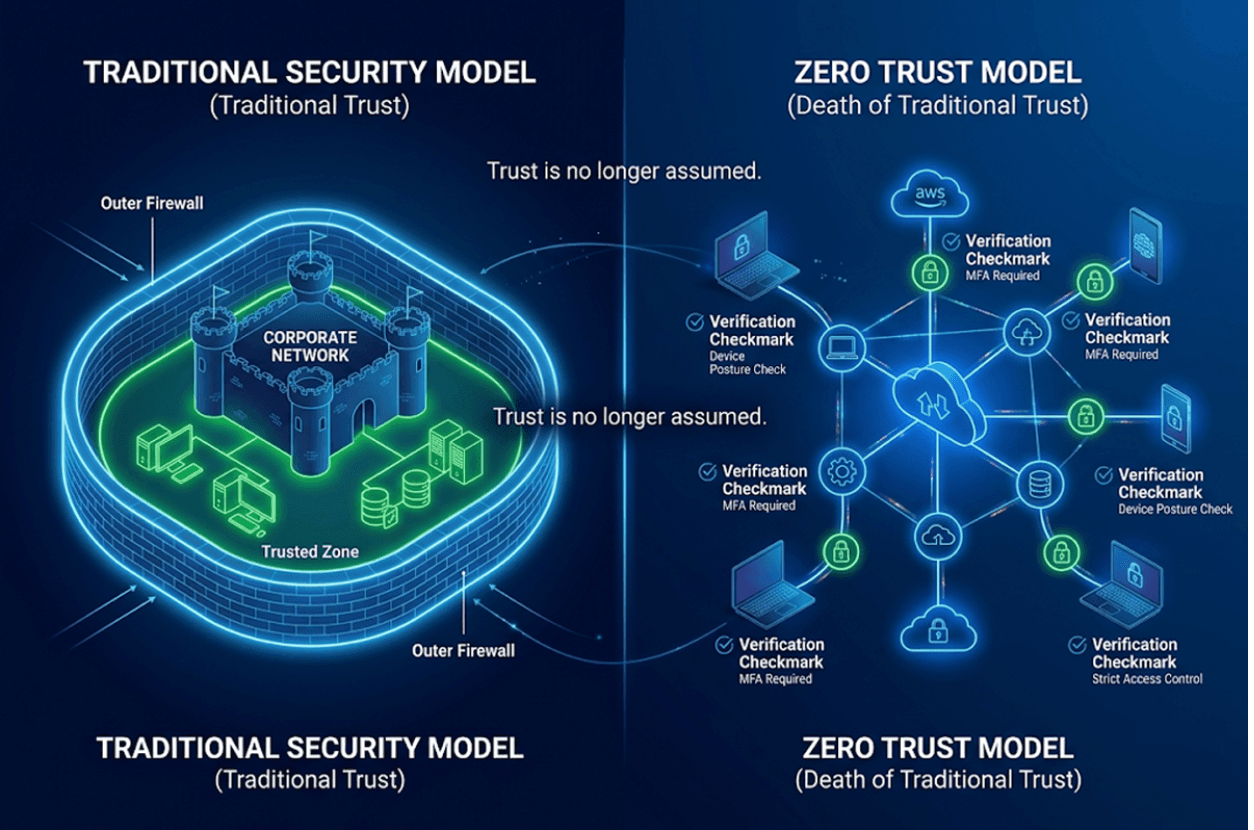
For years, organizations built security around a simple idea. Once inside the network, users and systems were trusted. Firewalls acted as gates. Passwords acted as proof. Internal access meant safety.
That model is now broken. Modern environments are distributed. Teams work remotely. Applications live across cloud providers. APIs connect everything. And attackers no longer break in loudly. They move quietly through trusted paths.
This is why Zero Trust is no longer a concept. It is a requirement. The real question is not whether your company has heard of Zero Trust. It is whether your current security model is already outdated.
What Zero Trust really means in 2026
Zero Trust is often misunderstood as a product or a checklist. It is neither. It is a shift in mindset.
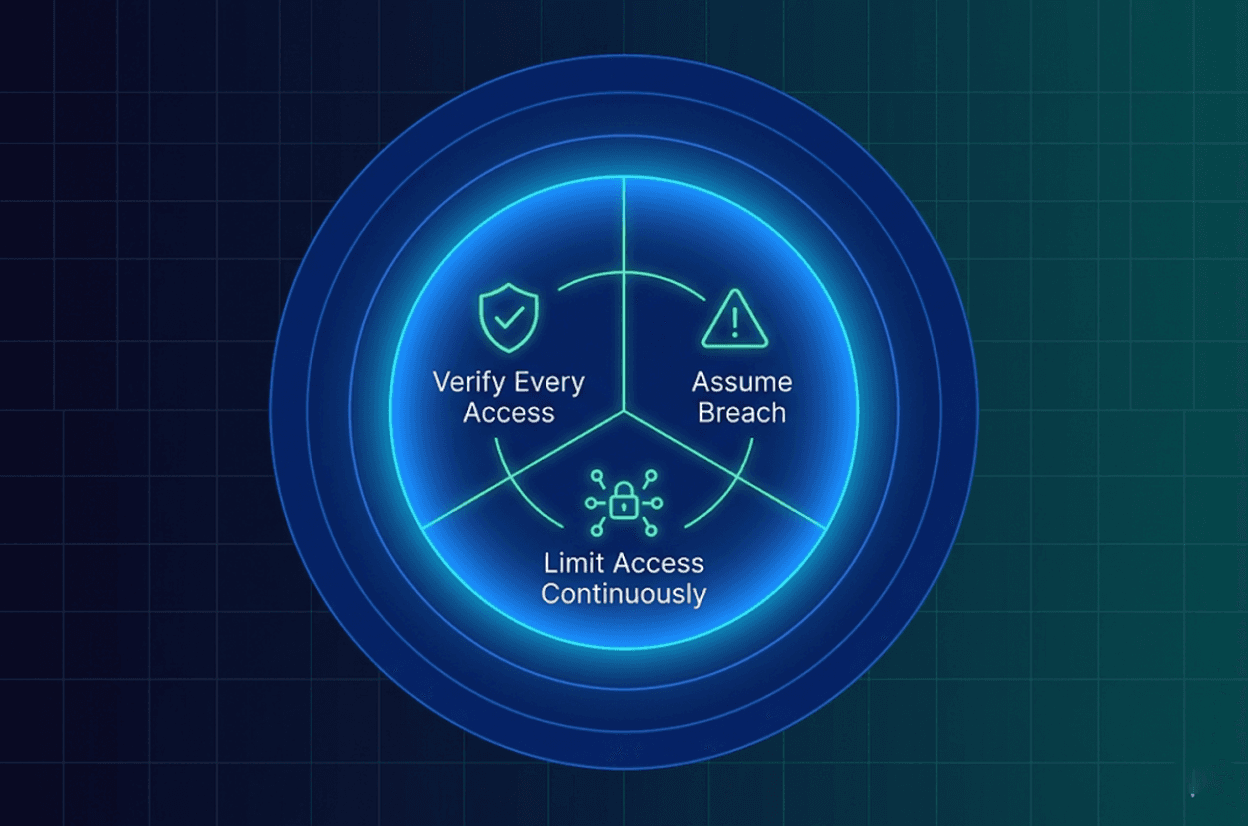
Instead of assuming trust based on location or identity, Zero Trust assumes nothing. Every request must be verified. Every system must prove itself. Every access point is treated as a potential risk.
In simple terms:
- No user is trusted by default
- No device is trusted automatically
- No system is beyond validation
This approach reflects how modern attacks actually happen. Most breaches today do not start with brute force. They start with valid credentials, misconfigured access, or overlooked integrations. Zero Trust removes the assumption that "inside equals safe."
Why traditional security models are failing

Many companies still rely on security structures designed for a different era. Think about a typical setup: VPN access grants broad internal visibility, single sign-on gives wide permissions, and annual penetration testing provides a snapshot of risk.
On paper, this looks secure. In reality, it creates blind spots. The problem is timing and trust. Traditional testing happens periodically. Systems change daily. That gap between testing and reality is where vulnerabilities live.
As explained in modern security approaches, static testing models cannot keep up with dynamic environments. Zero Trust addresses this by removing reliance on assumptions and replacing it with continuous verification.
The hidden gaps most companies ignore
Even companies that claim to follow Zero Trust often miss critical areas:
- 1. Over-trusted integrations: Third-party tools and APIs are often granted deep access. Once connected, they are rarely re-evaluated. This creates silent entry points.
- 2. Identity without context: Logging in successfully does not mean the request is safe. Device health, behavior patterns, and access timing all matter.
- 3. Static validation: Security checks that happen once a quarter or once a year cannot reflect real-time risk.
- 4. Internal exposure: Most breaches expand internally after initial access. If internal systems are trusted by default, attackers move freely.
Zero Trust is not about adding more tools. It is about removing blind trust.
A real-world shift happening right now
Across ANZ and the US, security leaders are changing how they think about protection. Instead of asking "Are we secure right now?", they are asking "Can we prove security continuously?"
This shift is driving adoption of models that align with Zero Trust principles. One of the strongest enablers of this shift is continuous penetration testing. Because if every access must be verified, then every system must also be tested continuously.
Where most Zero Trust strategies fail
Here is where many companies get it wrong. They invest in identity tools. They enforce stricter login rules. They deploy access controls. But they do not validate whether those controls actually work.
Zero Trust without testing is just policy. And policy without validation creates false confidence. This is where modern penetration testing plays a critical role.
Continuous validation is the missing layer
Zero Trust is not complete without continuous validation. If your systems are constantly changing, your testing must match that pace. Traditional approaches fall short because reports arrive weeks after testing, vulnerabilities may already be outdated, and retesting takes additional time and cost.
Modern PTaaS models solve this gap by providing ongoing visibility and real-time validation. This aligns directly with Zero Trust principles. Instead of trusting controls, you verify them continuously.
Capture The Bug approaches this by combining expert-led testing with real-time visibility, ensuring that security is not a one-time activity but an ongoing process.
Understand the Difference That Impacts Your Risk
Compare traditional penetration testing vs continuous testing and see which model actually protects your business in real time.
How Capture The Bug supports Zero Trust in practice

For companies moving toward Zero Trust, the biggest challenge is execution. It is not about understanding the model. It is about maintaining it daily. Capture The Bug helps organizations operationalize Zero Trust by focusing on continuous validation.
Through its penetration testing approach available at capturethebug.xyz/services/penetration-testing, companies can:
- Test new features as they are released
- Validate access controls and authentication flows
- Identify vulnerabilities before they become entry points
- Track remediation progress in real time
This ensures that Zero Trust is not just a strategy on paper, but something actively maintained. Many organizations also revisit their security posture during scaling phases to ensure that growth does not introduce silent risks.
The business impact of outdated trust models
Outdated security is not just a technical issue. It is a business risk:
- Revenue risk: Security incidents delay deals, especially with enterprise clients.
- Compliance pressure: Frameworks increasingly expect ongoing validation, not point-in-time checks.
- Reputation damage: Customers expect transparency and continuous assurance.
- Operational slowdown: Reactive security creates bottlenecks instead of enabling growth.
Zero Trust, when implemented correctly, becomes a growth enabler rather than a restriction.

How to know if your company is already outdated
Ask these questions honestly:
- Do you rely on periodic testing instead of continuous validation?
- Do internal systems assume trust once access is granted?
- Do you lack real-time visibility into vulnerabilities?
- Do you depend on reports instead of live security insights?
If the answer is yes to even one of these, your current model may already be outdated. Zero Trust is not about perfection. It is about progress.
The future of Zero Trust
By 2026, Zero Trust is no longer optional for serious organizations. But it is also evolving. The future is not just about access control. It is about continuous assurance.
Security will move from periodic checks to live validation, from assumed trust to proven trust, and from static reports to real-time visibility.
Final thoughts
Zero Trust is not a trend. It is a response to how technology and threats have changed. The companies that succeed will not be the ones with the most tools. They will be the ones that verify continuously.
Because in 2026, trust is no longer given. It is proven, every single day. And if your systems are not being tested continuously, your Zero Trust strategy is incomplete.
FAQ
1. What is Zero Trust security in simple terms?
Zero Trust is a security model where no user or system is trusted by default. Every access request must be verified continuously.
2. Why is Zero Trust important in 2026?
Because modern environments are distributed and constantly changing, making traditional trust-based models ineffective.
3. How does penetration testing support Zero Trust?
It validates whether security controls actually work by continuously identifying and verifying vulnerabilities.
4. Is Zero Trust only for large enterprises?
No. Startups and SaaS companies benefit even more because they move faster and have rapidly changing environments.
5. What is the biggest mistake companies make with Zero Trust?
Focusing on access control without continuous validation, leading to false confidence.